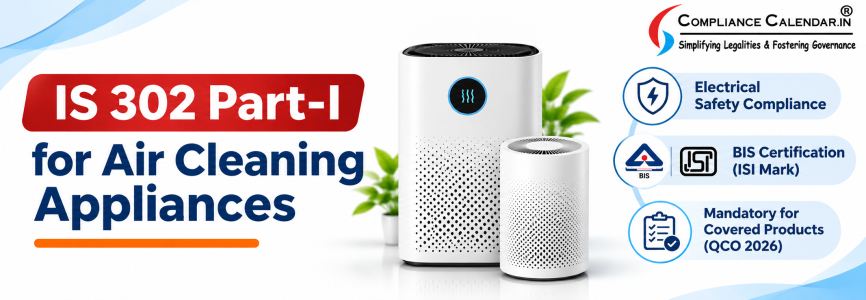



Air cleaning appliances are becoming increasingly important in Indian homes, offices, hospitals, schools and commercial establishments. With growing concerns about indoor air pollution, businesses are manufacturing a wide range of electric air cleaners and purifiers designed to remove dust, smoke and other airborne particles. However, while customers generally compare filtration efficiency, power consumption and product features, electrical safety is equally important. An air cleaning appliance contains several electrical and mechanical components, including motors, fans, wiring, power supplies and electronic control systems. These components must operate safely under normal conditions and meet relevant safety requirements when exposed to prescribed abnormal operating conditions. Poor insulation, overheating, defective wiring or unsuitable components can create serious risks for consumers.
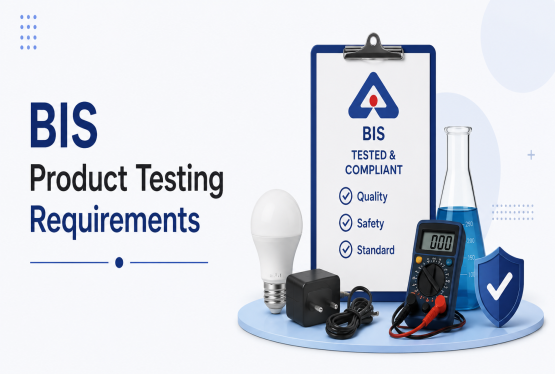
To regulate electrical appliance safety, the Bureau of Indian Standards (BIS) has established IS 302 (Part 1):2024, which specifies general safety requirements for household and similar electrical appliances. The standard adopts IEC 60335-1:2020 and addresses electrical, thermal, mechanical and construction-related safety requirements. The Government of India has also made BIS certification mandatory for covered air-cleaning appliances under the Safety of Household, Commercial and Similar Electrical Appliances (Quality Control) Order, 2026, subject to the notification's scope, exemptions and implementation dates.
What Is IS 302 Part-I for Air Cleaning Appliances?
IS 302 (Part 1):2024 is the Indian Standard titled Household and Similar Electrical Appliances – Safety, Part 1: General Requirements. It establishes general safety requirements for electrical appliances intended for domestic and similar applications. For air cleaning appliances, the standard addresses potential hazards associated with electrically powered equipment. It includes requirements relating to protection against electric shock, heating, electrical insulation, internal wiring, mechanical construction and other relevant safety aspects.
Air cleaning appliances are generally designed to draw surrounding air into the equipment, pass it through a filtration or purification system and release the treated air back into the indoor environment. The electrical components responsible for this operation must meet applicable safety requirements. The objective of IS 302 Part-I is not to measure how much pollution an air purifier removes. Instead, it establishes whether the appliance satisfies relevant electrical safety requirements.
For example, an air purifier may have an effective HEPA filtration system but still pose safety risks if its power supply overheats or internal wiring is inadequately insulated. Testing under IS 302 helps manufacturers evaluate such risks.
For more information about air purifier-specific requirements, read our article on Electrical Safety for Air Purifiers in India.
Applicable BIS Standard for Air Cleaning Appliances
The applicable general electrical safety standard is IS 302 (Part 1):2024, which is based on IEC 60335-1:2020.
|
Particular |
Details |
|
Product category |
Air Cleaning Appliances |
|
Indian Standard |
IS 302 (Part 1):2024 |
|
International reference |
IEC 60335-1:2020 |
|
Standard title |
Household and Similar Electrical Appliances – Safety, Part 1: General Requirements |
|
Certification authority |
|
|
Certification scheme |
Scheme I – ISI Mark Certification |
|
Applicable legislation |
|
|
Applicable QCO |
|
|
Government notification |
|
|
General implementation date |
1 October 2026 |
The standard covers general appliance safety requirements. Where BIS has issued additional product-specific standards or manuals, those requirements should also be examined. The BIS Product Manual, issued in December 2024, specifically states that a separate product manual for an individual appliance should be followed wherever one is available.
Official BIS Product Manual: IS 302 (Part 1):2024 – Product Manual.
Which Air Cleaning Appliances Are Covered Under IS 302 Part-I?
The 2026 Quality Control Order applies to specified household, commercial and similar electrical appliances within the prescribed voltage limits. The notification expressly includes Air-Cleaning Appliances under entry 64 and DC-Supplied/Battery-Operated Air Purifiers under entry 90.
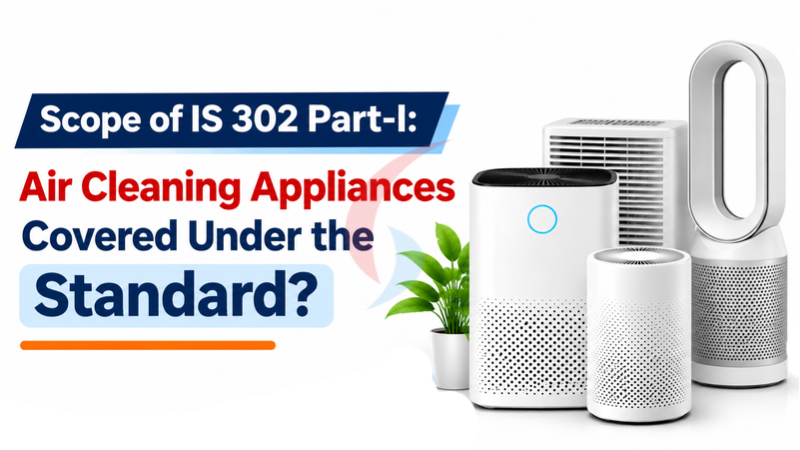
Examples of equipment that may fall within the relevant product category include:
|
Appliance type |
Description |
|
Household air purifiers |
Electrical appliances designed for indoor air cleaning |
|
Commercial air cleaners |
Air-cleaning equipment used in offices and commercial establishments |
|
Portable electric air purifiers |
Movable appliances designed for indoor use |
|
Smart air purifiers |
Appliances with electronic sensors and automated controls |
|
Battery-operated air purifiers |
Air-cleaning appliances powered by rechargeable or other batteries |
|
DC-powered air cleaners |
Appliances operating through direct-current power supplies |
These are general product descriptions rather than a definitive legal classification for every model.
For example, an industrial air-treatment system or a passive filtration unit may require a different regulatory assessment. Product classification should consider the equipment's intended use, voltage, construction and applicable notifications. The order also excludes appliances already covered by another applicable QCO or mandatory BIS certification requirement under another Act.
Is BIS Certification Mandatory for Air Cleaning Appliances in India?
Yes. BIS certification is mandatory for air-cleaning appliances covered by the Safety of Household, Commercial and Similar Electrical Appliances (Quality Control) Order, 2026, subject to the prescribed exclusions and transitional provisions.
DPIIT issued the notification through S.O. 1739(E), dated 6 April 2026, under Section 16 of the Bureau of Indian Standards Act, 2016. The order requires covered electrical appliances to conform to IS 302 (Part 1):2024 and bear the prescribed BIS Standard Mark under a licence granted through Scheme I of Schedule II to the BIS (Conformity Assessment) Regulations, 2018.
The notification specifies the following voltage limits:
- Single-phase appliances: rated voltage not exceeding 250 V.
- Other appliances: rated voltage not exceeding 480 V.
- DC-supplied and battery-operated appliances are included within the applicable scope.
The government notification also includes exemptions and transitional arrangements that must be reviewed before determining an individual manufacturer's obligations.
Official notification: Safety of Household, Commercial and Similar Electrical Appliances QCO, 2026.
Latest Government Update: Implementation Dates Under QCO 2026
The 2026 QCO introduced different compliance deadlines for general, small and micro manufacturers.
|
Manufacturer category |
Implementation date |
|
General manufacturers |
1 October 2026 |
|
Small enterprises |
1 January 2027 |
|
Micro enterprises |
1 April 2027 |
As of November 2026, the general implementation date has passed. The later dates provide additional implementation time for qualifying small and micro enterprises. Manufacturers should examine their enterprise classification before relying on a later implementation date. These are not permanent exemptions from certification. The notification also contains provisions concerning domestically manufactured goods intended for export, qualifying research and development imports and certain pre-implementation stock.
For detailed information about certification requirements for smaller businesses, read BIS Certification for Small Manufacturers and MSMEs.
Important Electrical Safety Requirements Under IS 302 Part-I
IS 302 Part-I addresses a broad range of safety requirements. The exact assessments depend on the appliance's construction, electrical rating, insulation class and applicable product-specific provisions.
Protection Against Electric Shock
Protection against electric shock is a fundamental requirement for air-cleaning appliances. The appliance contains electrical components that may be hazardous if users can accidentally access live parts. Manufacturers must provide appropriate insulation, enclosures and protective arrangements.
For example, customers may remove an air purifier's filter cover for cleaning or replacement. The appliance must satisfy applicable requirements concerning access to hazardous electrical components.
Heating and Temperature Rise
Air-cleaning appliances often operate continuously for extended periods. Their motors, power supplies and electronic components generate heat during operation. The heating test evaluates whether relevant components and surfaces remain within the prescribed temperature limits. Poor ventilation inside the appliance, unsuitable motor selection or inadequate thermal protection may affect the outcome of testing.
Leakage Current and Electric Strength
Electrical insulation prevents dangerous current flow between live components and accessible parts. Leakage current testing evaluates current flowing through unintended paths under specified conditions. Electric strength testing assesses whether insulation can withstand prescribed electrical stress. These assessments help identify weaknesses in insulation and electrical construction.
Abnormal Operation
Air-cleaning appliances must also be evaluated under applicable abnormal operating conditions. Testing may involve conditions affecting electrical components, motor operation or other relevant systems, as prescribed by the standard. The purpose is to determine whether the appliance continues to provide the required level of protection against hazards under the specified test conditions.
Mechanical Strength and Stability
Air purifiers may be placed on floors, tables or other surfaces and may be moved between rooms. The standard contains requirements relating to mechanical strength, stability and construction where applicable. A product should be designed to reduce relevant hazards associated with instability, damage or accessible moving components.
Internal Wiring and Electrical Connections
Internal wiring connects the motor, electronic controls, power supply and other components. Manufacturers must ensure that wiring and connections satisfy applicable safety requirements. Poor routing, inadequate protection or unsuitable connections can affect electrical safety.
Resistance to Heat and Fire
The standard includes requirements addressing resistance to heat and fire for relevant components and materials. These requirements are important because electrical components can generate heat during normal operation or prescribed abnormal conditions. Manufacturers should use suitable components and materials and verify their performance through the applicable assessments.
BIS Testing Requirements Under IS 302 Part-I
The BIS Product Manual identifies various testing requirements, along with guidance on testing equipment and inspection arrangements.
|
Test |
Relevant clause |
Purpose |
|
Marking and instructions |
Clause 7 |
Verifies prescribed product information |
|
Protection against electric shock |
Clause 8 |
Evaluates access to live parts |
|
Power input and current |
Clause 10 |
Checks electrical characteristics |
|
Heating |
Clause 11 |
Evaluates temperature rise |
|
Leakage current and electric strength |
Clauses 13 and 16 |
Assesses insulation and electrical protection |
|
Moisture resistance |
Clause 15 |
Evaluates protection under specified moisture conditions |
|
Abnormal operation |
Clause 19 |
Checks applicable abnormal operating conditions |
|
Stability and mechanical hazards |
Clause 20 |
Evaluates relevant mechanical risks |
|
Mechanical strength |
Clause 21 |
Checks mechanical construction |
|
Internal wiring |
Clause 23 |
Evaluates wiring arrangements |
|
Components |
Clause 24 |
Checks relevant electrical components |
|
Provision for earthing |
Clause 27 |
Evaluates protective earthing where applicable |
|
Resistance to heat and fire |
Clause 30 |
Evaluates relevant material and component safety |
The table summarises selected requirements; it is not a complete testing checklist for every model. The BIS Product Manual also includes routine tests such as earth continuity, electric strength and functional testing. Product-specific requirements must be considered wherever applicable.
Official reference: BIS IS 302 Part-I Product Manual – Annexes A to D.
Difference Between IS 302 Part-I and IS 17531:2021
Manufacturers sometimes confuse general electrical safety requirements with product-specific air purification performance requirements.
However, these standards serve different purposes.
|
Basis |
IS 302 (Part 1):2024 |
IS 17531:2021 |
|
Main purpose |
Electrical appliance safety |
Portable electric indoor air purifier specification |
|
Primary focus |
Electrical, thermal, mechanical and construction safety |
Product performance and technical specifications |
|
Product application |
Household and similar electrical appliances |
Portable electric indoor air purifiers |
|
Main regulatory relevance |
Referenced in the final Electrical Appliances Safety QCO, 2026 |
Separate product-specific QCO was proposed |
|
Certification route |
Scheme I for covered products under the 2026 QCO |
Depends on the final applicable notification and scheme |
A manufacturer should not assume that compliance with one standard automatically establishes compliance with every other applicable requirement.
For example, a product may pass filtration performance testing but fail electrical insulation testing. Both areas must be evaluated independently where applicable.
For more information, read IS 17531:2021 for Portable Electric Indoor Air Purifiers.
Documents Required for BIS Certification of Air Cleaning Appliances
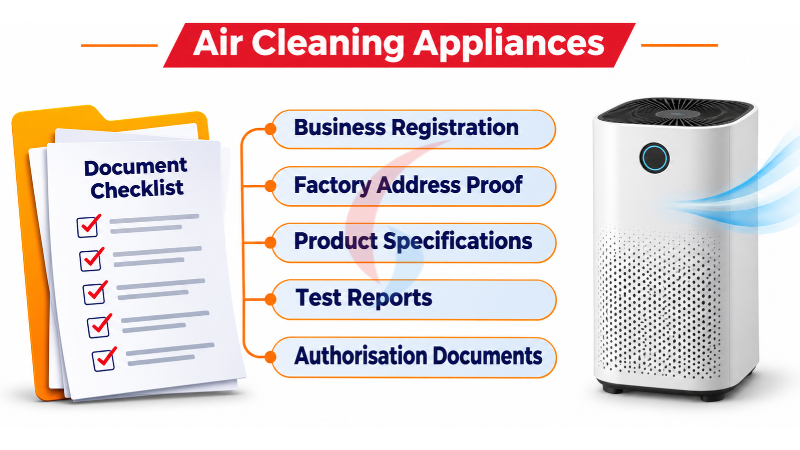
Manufacturers seeking BIS certification must prepare relevant business, technical and manufacturing documentation.
|
Document |
Purpose |
|
Company registration certificate |
Establishes the legal identity of the applicant |
|
Factory address proof |
Verifies the manufacturing location |
|
Manufacturing process flow chart |
Explains production activities |
|
Product technical specifications |
Identifies appliance characteristics |
|
Electrical circuit diagram |
Describes electrical construction |
|
Bill of materials |
Identifies important components |
|
Product model details |
Establishes proposed licence scope |
|
Product photographs |
Supports product identification |
|
Manufacturing machinery list |
Establishes production capability |
|
Testing equipment details |
Supports quality control assessment |
|
Calibration certificates |
Establishes measuring equipment status |
|
Laboratory test reports |
Supports conformity assessment |
|
Quality control records |
Demonstrates production monitoring |
|
Authorised signatory documents |
Establishes application authority |
|
AIR documentation, where applicable |
Supports foreign manufacturer applications |
The actual checklist depends on the manufacturer's location, product design and the applicable BIS certification process.
For more information about certification documentation, read ISI Certification in India: Process, Documents and Fees
Step-by-Step BIS Certification Process Under IS 302 Part-I
Step 1: Identify the Correct Product Classification
The manufacturer must first confirm whether its air-cleaning appliance falls within the scope of IS 302 Part-I and the 2026 QCO. The review should include the electrical rating, power supply, intended use and relevant product-specific standards. Correct classification is important because the certification route depends on the applicable requirements.
Step 2: Prepare the Manufacturing Facility
The manufacturer should review its production equipment, testing arrangements and quality control procedures. The BIS Product Manual provides guidance concerning manufacturing and testing arrangements. Manufacturers should ensure that appropriate personnel and necessary records are available.
Step 3: Register on BIS Manak Online
The manufacturer can submit an application through the official BIS Manak Online Portal. The application requires relevant factory information, product details and supporting documents.
Step 4: Arrange Electrical Safety Testing
The appliance must undergo applicable testing according to IS 302 Part-I and other relevant requirements. The manufacturer should ensure that the samples represent the models proposed for certification. Testing may involve insulation, heating, electrical strength, abnormal operation, construction and other safety parameters.
Step 5: Complete Factory Inspection
BIS may inspect the manufacturing facility to evaluate its production arrangements, technical capabilities and quality control systems. Inspecting officials may verify equipment, testing records, product specifications and other documents.
Manufacturers can learn more through our article on BIS Certification: What Happens During a Factory Visit?.
Step 6: Submit Clarifications and Corrective Documents
BIS may raise observations if the application, testing arrangements or manufacturing records are incomplete. The applicant must provide relevant clarifications and complete corrective action wherever required.
Step 7: Obtain the BIS ISI Licence
After satisfactory evaluation, BIS may grant a Scheme I licence for approved products. The licence permits the manufacturer to use the prescribed BIS Standard Mark on products within the approved certification scope.
Step 8: Maintain Post-Certification Compliance
After obtaining certification, manufacturers must continue following the applicable testing, inspection and product marking requirements. Changes in components, power supplies, electrical construction or product models may affect certification scope.
For more information, read BIS ISI Licence Scope Expansion.
Product Grouping and Model-Wise Certification Under IS 302
Product grouping is important because manufacturers often produce several air-cleaning appliances under one brand.
For example, one company may manufacture a small desktop purifier, a larger floor-standing purifier and a rechargeable portable model. Although these appliances perform similar functions, their electrical ratings, construction, components and power supply systems may differ.
The December 2024 BIS Product Manual requires manufacturers to declare the models and relevant technical parameters. Its general grouping guidance also states that each model of each appliance type is to be tested for initial licence grant or scope changes. The certification scope may identify the product type, model number, appliance class, electrical ratings and supply type.
BIS Certification for Imported Air Cleaning Appliances
Foreign manufacturers supplying air-cleaning appliances to India must examine the compulsory certification requirements. Where the 2026 QCO applies, imported products must satisfy the prescribed requirements unless a valid exemption or transitional provision is available. Eligible overseas manufacturers may apply through the Foreign Manufacturers Certification Scheme (FMCS). The process can involve an overseas manufacturing facility assessment, product testing, technical documentation and appointment of an Authorised Indian Representative. Importers should verify whether the manufacturer's BIS licence covers the actual model being imported. A licence covering one appliance should not automatically be treated as certification for every product sold by the same manufacturer.
Official portal: BIS Foreign Manufacturers Certification Scheme.
BIS Certification Cost for Air Cleaning Appliances
The cost of BIS certification depends on the number of models, testing requirements, manufacturing location and applicable BIS fees.
|
Cost component |
Description |
|
Application fee |
As prescribed under Scheme I |
|
Laboratory testing charges |
Depends on the required safety assessments |
|
Factory inspection expenses |
Based on applicable assessment arrangements |
|
Licence fee |
According to the current BIS schedule |
|
Marking fee |
As prescribed for the relevant product |
|
Additional model testing |
Depends on product grouping and testing requirements |
|
Foreign manufacturer expenses |
May include overseas assessment and AIR-related costs |
|
Consultancy fees |
Depends on the professional services required |
Testing charges can vary significantly because different laboratories may have different approved scopes and facilities. Manufacturers should obtain laboratory quotations based on the actual appliance design and the current applicable standard.
Official laboratory portal: BIS Laboratory Information Management System.
Common Mistakes Manufacturers Should Avoid
One common mistake is assuming that successful filtration testing is sufficient for electrical safety compliance. Air purification performance and electrical safety are different technical considerations.
Another mistake is selecting the incorrect certification scheme. The 2026 QCO prescribes Scheme I for covered electrical appliances, and manufacturers should not automatically treat the product as falling under the BIS Compulsory Registration Scheme.
Some businesses also overlook product grouping requirements. Introducing a new model without checking the approved licence scope may create compliance problems. Manufacturers should also maintain appropriate testing records, calibration certificates and production quality controls after certification.
Legal Penalties for Non-Compliance With IS 302 Requirements
The Bureau of Indian Standards Act, 2016 provides the legal foundation for compulsory product certification.
Section 16 empowers the Central Government to require compulsory conformity assessment for specified products. Section 17 addresses restrictions relating to notified goods that do not comply with applicable requirements.
Section 29 prescribes penalties for specified violations of the Act.
Manufacturers and importers dealing in products covered by the QCO must ensure compliance with the relevant certification requirements. Unauthorised use of the BIS Standard Mark or making misleading claims about certification may result in regulatory action and penalties under the applicable provisions.
Why Choose Compliance Calendar LLP for IS 302 Part-I BIS Certification?
Obtaining BIS Certification for Air Cleaning Appliances requires a proper understanding of IS 302 Part-I, electrical safety testing, technical documentation and applicable Quality Control Orders. Compliance Calendar LLP provides professional assistance to manufacturers, importers and foreign businesses seeking BIS ISI Certification in India. Our team helps with product classification, preparation of certification documents, BIS application filing, laboratory testing coordination, factory inspection preparation and handling certification-related queries. We also assist manufacturers in understanding product grouping requirements, licence scope expansion and ongoing compliance obligations. Our objective is to simplify the certification process and help businesses avoid unnecessary documentation errors and procedural delays.
For professional assistance with BIS Certification for Air Purifiers and electrical safety compliance, contact Compliance Calendar LLP at +91 9988424211 or info@ccoffice.in
Frequently Asked Questions
Q1. What is IS 302 Part-I for Air Cleaning Appliances?
Ans. IS 302 (Part 1):2024 is the Indian Standard prescribing general electrical safety requirements for household and similar electrical appliances. It addresses protection against electric shock, heating, insulation, mechanical construction and other safety considerations relevant to covered air-cleaning appliances.
Q2. Is BIS Certification mandatory for air-cleaning appliances in India?
Ans. Yes. Air-cleaning appliances covered by the Electrical Appliances Safety QCO, 2026 must comply with the prescribed BIS requirements, subject to applicable exclusions and transitional provisions. The general implementation date is 1 October 2026.
Q3. Which BIS certification scheme applies to air-cleaning appliances?
Ans. Covered appliances require certification under Scheme I of Schedule II to the BIS (Conformity Assessment) Regulations, 2018. This scheme permits the use of the BIS Standard Mark under an appropriate licence.
Q4. What is the difference between IS 302 and IS 17531?
Ans. IS 302 Part-I addresses general electrical safety requirements, while IS 17531:2021 provides a product specification for portable electric indoor air purifiers. Electrical safety and air purification performance must be assessed separately wherever applicable.
Q5. What tests are required under IS 302 Part-I?
Ans. The relevant tests may include protection against electric shock, heating, leakage current, electric strength, abnormal operation, mechanical strength, earthing and resistance to heat and fire. Exact applicability depends on the appliance's construction and relevant standards.
Q6. Does IS 302 Part-I apply to battery-operated air purifiers?
Ans. Yes. The 2026 QCO expressly lists DC-supplied and battery-operated air purifiers. Manufacturers should review the product's power supply, electrical ratings and relevant requirements before applying for certification.
Q7. What are the BIS certification deadlines for small and micro enterprises?
Ans. The implementation date for qualifying small enterprises is 1 January 2027, while qualifying micro enterprises have until 1 April 2027. General manufacturers were required to comply from 1 October 2026.
Q8. Can foreign manufacturers obtain BIS certification for air-cleaning appliances?
Ans. Yes. Eligible overseas manufacturers can apply through the applicable BIS certification arrangements, including FMCS. Requirements may include technical documentation, factory inspection, testing and appointment of an Authorised Indian Representative.
Q9. How much does BIS certification for air-cleaning appliances cost?
Ans. The total cost depends on laboratory testing, application fees, licence charges, inspection requirements and the number of models. Manufacturers should verify the latest BIS fee schedule and applicable laboratory charges.
Q10. Where can manufacturers apply for IS 302 Part-I BIS certification?
Ans. Manufacturers can submit the relevant application through the official BIS Manak Online Portal. The process generally includes document submission, product testing, factory assessment and BIS evaluation before the licence is granted.
Article last updated on : 21 Nov 2026.