


Imagine walking through a beautifully decorated wedding venue in Delhi. Hundreds of tiny LED lights are hanging from trees, wrapped around pillars and illuminating the entrance. The entire place looks attractive, and most visitors never think about the technical details behind these lights. For them, LED lighting chains are simply decorative products. But for the companies manufacturing or importing them, there is an important question: Are these LED lighting chains BIS certified? This question becomes particularly important when a business plans to introduce decorative lighting products into the Indian market. LED lighting chains may look like simple electrical accessories, but problems involving defective wiring, inadequate insulation or overheating can create serious safety risks.
Because these products are commonly used in homes, hotels, commercial buildings and outdoor decoration, compliance with electrical safety requirements is essential. In India, BIS CRS Certification for LED Lighting Chains is mandatory for products covered under the notified category. The Bureau of Indian Standards (BIS) regulates these products through the Compulsory Registration Scheme (CRS). Manufacturers must demonstrate conformity with the applicable Indian Standard before commercially supplying covered LED lighting chains.
What Are LED Lighting Chains?
LED lighting chains are decorative lighting products consisting of multiple LED light sources connected together through electrical wiring or other suitable arrangements. These products are widely used for festivals, weddings, events, interior decoration and commercial displays. They may be designed for temporary or continuous decorative use, depending on the manufacturer's specifications and the applicable safety classification. Unlike ordinary LED bulbs, which are installed individually, LED lighting chains usually contain several light sources arranged along a connected system. Their design allows users to create different lighting patterns, colours and decorative effects.
For example, a restaurant owner may purchase LED lighting chains to decorate an outdoor dining area. During the daytime, the products appear to be ordinary decorative accessories. However, at night, when the lights operate for several hours, the quality of their wiring, insulation and electrical connections becomes particularly important. Manufacturers dealing in multiple lighting products can explore our detailed guide on BIS Certification for LED Lights to understand how the certification process applies to different LED products.
Why Is BIS CRS Certification Mandatory for LED Lighting Chains?
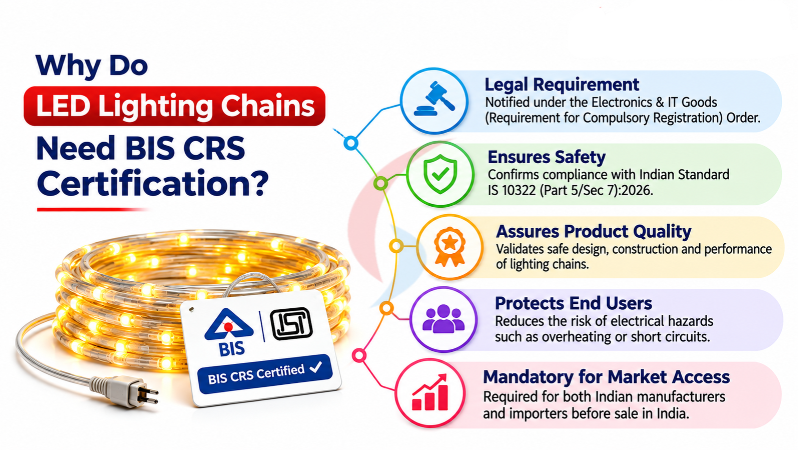
BIS CRS Certification is mandatory because LED lighting chains are included in the product categories notified under the Electronics and Information Technology Goods (Requirement for Compulsory Registration) Order. The mandatory registration requirement for LED lighting chains came into effect on 23 May 2018.
The objective of the Compulsory Registration Scheme is to ensure that notified electronic and electrical products comply with relevant Indian Standards. Under the scheme, manufacturers arrange product testing through BIS-recognised laboratories and submit registration applications supported by prescribed declarations and documentation. The requirement is administered through the BIS registration system under the regulatory responsibility of the Ministry of Electronics and Information Technology (MeitY).
Manufacturers planning to sell decorative LED lighting products in India must understand the applicable BIS CRS Registration requirements.
A Small Importer's Expensive Mistake
Consider a fictional example of a startup called Bright Fest Decor, based in Jaipur. The founders decided to import decorative LED lighting chains for the upcoming wedding season. After finding an overseas supplier offering competitive prices, they placed a bulk order and began accepting advance bookings from event decorators.
The shipment was ready, but during their compliance review, they discovered that the products did not have the required BIS CRS registration covering the manufacturing facility and brand. The supplier had provided overseas safety documents, but these were not a substitute for the applicable Indian certification. The company now faced the possibility of shipment delays, additional expenses and missed commercial opportunities. Had the founders verified BIS requirements before finalising the supplier, they could have arranged the necessary compliance measures much earlier.
This fictional example highlights an important lesson: BIS registration should be checked before manufacturing, importing or launching covered LED lighting chains, not after the products are ready for sale.
Applicable BIS Standard for LED Lighting Chains in India
LED lighting chains are covered under IS 10322 (Part 5/Sec 7), which specifies particular requirements for lighting chains. The standard was previously published as IS 10322 (Part 5/Sec 7):2017 and has been revised to IS 10322 (Part 5/Sec 7):2026. The revised edition corresponds to IEC 60598-2-20:2022. It addresses relevant safety and construction requirements and must be considered along with applicable general luminaire provisions.
|
Particulars |
Details |
|
Product name |
LED Lighting Chains |
|
Certification scheme |
BIS Compulsory Registration Scheme (CRS) |
|
Earlier Indian Standard |
IS 10322 (Part 5/Sec 7):2017 |
|
Revised Indian Standard |
IS 10322 (Part 5/Sec 7):2026 |
|
International reference |
IEC 60598-2-20:2022 |
|
Regulating authority |
Bureau of Indian Standards |
|
Responsible ministry |
MeitY |
|
Original mandatory implementation |
23 May 2018 |
The 2026 edition is a second revision of the Indian Standard. Manufacturers holding existing registrations must review the relevant changeover instructions to determine the testing and administrative steps necessary for continued compliance.
For example, BIS CRS Registration for Fixed General Purpose LED Luminaires follows requirements that differ from those applicable to decorative LED lighting chains.
Are LED Lighting Chains and LED Rope Lights the Same Product?
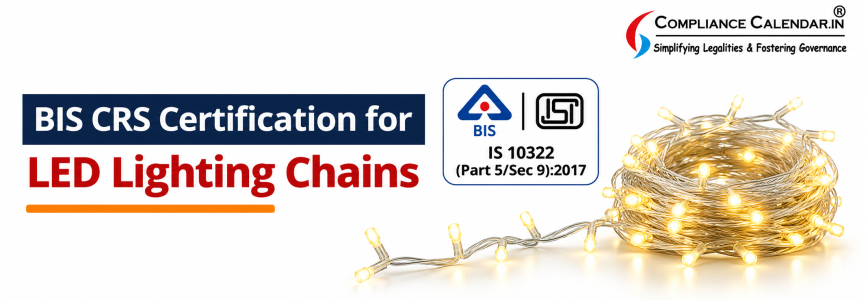
Although LED lighting chains and LED rope lights are both used for decoration, their construction and applicable BIS classification may differ. This distinction is important because BIS lists LED Lighting Chains and Lighting Chain (Rope Lights) as separate compulsory registration categories. LED lighting chains are listed under IS 10322 (Part 5/Sec 7), while the separately notified Lighting Chain (Rope Lights) category is listed under IS 10322 (Part 5/Sec 9):2017. The rope-light category became mandatory on 1 April 2021.
|
LED Lighting Chains |
Lighting Chain (Rope Lights) |
|
Covered under Part 5, Section 7 |
Separately notified under Part 5, Section 9 |
|
May consist of interconnected decorative LED light sources |
Often uses a continuous rope-like construction |
|
Must satisfy the applicable lighting-chain requirements |
Must satisfy the applicable rope-light requirements |
|
CRS implementation from 23 May 2018 |
CRS implementation from 1 April 2021 |
The commercial description printed on the packaging is not sufficient for choosing the standard. BIS has also clarified that LED strip and tape lighting products require appropriate classification according to their technical specifications. Manufacturers should confirm the applicable standard before submitting samples for testing.
Eligibility Criteria for BIS CRS Registration of LED Lighting Chains
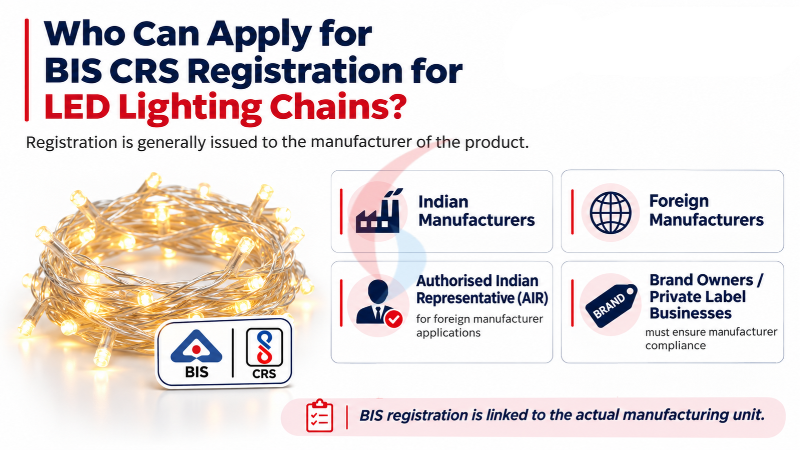
BIS CRS Registration is issued to the manufacturer of the notified product rather than simply to a trader or distributor. This means the actual manufacturing unit is a central part of the registration process. Indian manufacturers producing LED lighting chains must obtain registration covering the relevant product category and brand. Where a company operates more than one manufacturing facility, separate registration requirements may arise for each production location. The manufacturer must ensure that its technical information, factory address and brand details are accurately reflected in the application.
Foreign manufacturers are also eligible to obtain BIS registration for products intended for the Indian market. Where applicable, they must appoint an Authorised Indian Representative (AIR) who can fulfil the prescribed responsibilities and communicate with BIS on behalf of the overseas manufacturing entity. Importers and private-label businesses should pay particular attention to the actual manufacturer and brand coverage. If a trader in Mumbai imports lighting chains from China and sells them under its own brand, it must ensure that the relevant manufacturing facility and brand are appropriately covered by valid BIS registration.
Documents Required for BIS CRS Certification for LED Lighting Chains
Getting BIS registration is not only about passing a laboratory test. The manufacturer must also establish its legal identity, manufacturing arrangements, product specifications and brand ownership. Incorrect or incomplete documentation can delay an application even when the samples meet the applicable technical requirements.
For example, suppose a manufacturer submits a test report showing one factory address, while its business registration and BIS application mention another. BIS may ask for clarification before processing the application. This is why the information in all supporting documents should be reviewed carefully.
|
Required Document |
Purpose |
|
Certificate of Incorporation or business registration |
Establishes the manufacturer's legal identity |
|
Factory address proof |
Verifies the production location |
|
Manufacturing process details |
Explains how the LED lighting chains are produced |
|
Product specifications |
Provides technical information about voltage, power and design |
|
Circuit diagram and component details |
Supports laboratory evaluation |
|
Product photographs |
Identifies the lighting chain model |
|
Brand registration or authorisation |
Establishes entitlement to use the declared brand |
|
BIS-recognised laboratory test report |
Demonstrates compliance with the applicable standard |
|
Authorised signatory documents |
Identifies the person representing the applicant |
|
AIR nomination documents |
Required for applicable foreign manufacturer applications |
|
Prescribed undertakings |
Confirms compliance with BIS requirements |
The exact document requirements may vary according to the applicant, manufacturing arrangements and applicable BIS application instructions.
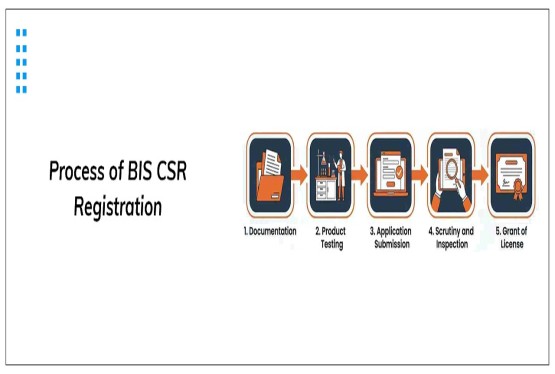
How to Obtain BIS CRS Certification for LED Lighting Chains in India
A manufacturer planning to launch LED lighting chains should begin the certification process during product development rather than waiting until production is complete. Early compliance planning can help identify potential problems in construction, components and product classification.
-
Confirm the product category and Indian Standard
Examine the product's construction and technical specifications to identify the correct BIS category. For LED lighting chains, the applicable standard is IS 10322 (Part 5/Sec 7), subject to the current implementation and transition requirements. -
Choose a BIS-recognised testing laboratory
Select a laboratory whose BIS recognition covers the applicable standard and required tests. Confirm sample quantities, documentation and testing charges before dispatching products. -
Submit samples and complete testing
The laboratory evaluates the submitted lighting chains against the prescribed requirements. If the product fails a test, the manufacturer must address the non-conformity and arrange any necessary retesting. -
Prepare and submit the application
After obtaining a satisfactory test report, prepare the manufacturer's information, factory details, brand documents, technical specifications and prescribed declarations. Submit the application through the official BIS CRS portal. -
Pay the applicable registration fees
Pay the prescribed BIS charges using the available payment facility. Testing charges are separate from the government's registration fees. -
Respond to BIS scrutiny
BIS reviews the application and may request corrections or additional supporting information. Inconsistent documents, incorrect product details or an inadequate test report can delay approval. -
Receive registration and apply the Standard Mark
Once the application is approved, BIS grants registration for the relevant manufacturing unit, product category and brand. The manufacturer can then use the prescribed Standard Mark and registration number in accordance with BIS requirements.
Businesses can also refer to our guide on the BIS CRS Registration Step-by-Step Process to understand product testing, document preparation and online registration.
What Safety Tests Are Required for LED Lighting Chains?
LED lighting chains are frequently installed in locations where several units operate close to people, decorations, curtains or other materials. They may also be connected to electrical supplies for extended periods during events and celebrations. The safety of their insulation, components and construction is therefore particularly important.
IS 10322 (Part 5/Sec 7) establishes particular requirements for lighting chains. The applicable test programme must consider those requirements together with relevant general luminaire provisions.
|
Testing Area |
Purpose |
|
Electric strength |
Checks the ability of insulation to withstand specified electrical stress |
|
Insulation resistance |
Evaluates the effectiveness of electrical insulation |
|
Protection against electric shock |
Assesses protection from accessible hazardous live parts |
|
Mechanical strength |
Examines the product's ability to withstand specified mechanical stresses |
|
Temperature and endurance |
Evaluates safety during prescribed operating conditions |
|
Resistance to heat and fire |
Examines applicable material safety characteristics |
|
Cable and wiring requirements |
Checks relevant conductors, connections and wiring arrangements |
|
Dust and moisture protection |
Evaluates protection where required by classification |
|
Construction requirements |
Verifies compliance with the prescribed design provisions |
|
Marking and instructions |
Checks required electrical and safety information |
These are broad testing areas rather than a complete clause-by-clause test schedule. The actual requirements depend on the lighting chain's design, classification and applicable standard edition. BIS-recognised laboratories must determine the appropriate testing programme.
BIS CRS Certification Fees for LED Lighting Chains
The cost of BIS certification depends on the applicable government charges, laboratory testing costs, product complexity and number of models proposed for registration. Businesses should distinguish the official BIS fees from testing and professional service charges.
|
Fee Component |
Cost Basis |
|
BIS application fee |
Current government fee schedule |
|
Registration or processing fee |
Applicable BIS CRS provisions |
|
Laboratory testing fee |
Laboratory quotation and required testing scope |
|
Additional model testing |
Number and technical differences of models |
|
AIR documentation |
Applicable foreign manufacturer requirements |
|
Professional consultancy |
Separate service charges, where engaged |
|
Ongoing registration charges |
Current BIS validity and annual fee provisions |
As of 2026, BIS has published revised provisions for licence validity, renewal and annual fee payment, dated 27 May 2026. Therefore, manufacturers should avoid relying solely on older fee schedules that assumed a fixed two-year registration arrangement. The official BIS Laboratory Information Management System also publishes laboratory-specific testing information. Actual laboratory quotations can vary substantially, so manufacturers should obtain a current quotation before finalising their compliance budget.
Latest BIS CRS Certification Updates for LED Lighting Chains in 2026
The year 2026 brought an important regulatory development for manufacturers of LED lighting chains. BIS introduced IS 10322 (Part 5/Sec 7):2026, replacing the earlier 2017 edition. The revised standard corresponds to IEC 60598-2-20:2022. On 20 March 2026, BIS issued guidelines for implementing the revised standards for several LED luminaire categories, including LED lighting chains. The guidelines initially specified a concurrent-running period ending on 2 August 2026.
Subsequently, BIS published an extension notice on 5 August 2026. The revised deadline for the specified LED luminaire standards was extended to 2 February 2027. This gives affected manufacturers additional time to complete the transition, subject to the conditions contained in the relevant BIS instructions.
Manufacturers can read our article on BIS LED Luminaire Standards Update for background on the revised requirements.
What Does This Change Mean for Existing Manufacturers?
Consider another fictional example. A manufacturer in Ahmedabad obtained BIS registration for LED lighting chains in 2023 and has continued supplying decorative lighting products to retailers across India. The company already has registered models and established suppliers. However, because the Indian Standard has been revised, the company must now examine whether its products require additional testing, updated documentation or other actions under the changeover guidelines.
Instead of assuming that its earlier registration automatically satisfies all future requirements, the manufacturer should evaluate the revised standard, coordinate with a recognised laboratory where necessary and complete the relevant transition formalities.
Existing manufacturers and new applicants should check the BIS CRS latest circulars for subsequent notices before filing or modifying their registrations.
Can Multiple LED Lighting Chain Models Be Registered Together?
Manufacturers often produce several lighting chain models with different lengths, electrical ratings, colour options or configurations. Some models may be eligible for inclusion under one registration, depending on the applicable BIS grouping guidelines and technical requirements.
For example, a business might sell LED lighting chains in different decorative colour combinations while using similar electrical construction. Whether these models can be covered through the same testing arrangement depends on the relevant BIS series approval guidelines. Where differences affect electrical safety or other prescribed characteristics, additional testing may be required. Manufacturers should also follow the applicable inclusion procedure before adding new models to an existing registration.
The important point is that one BIS registration does not automatically cover every lighting product manufactured by the same company.
BIS Marking and Labelling Requirements
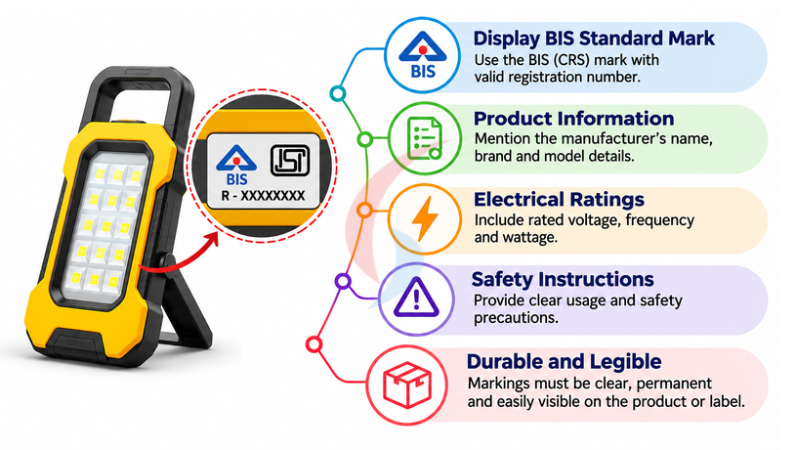
Once a manufacturer obtains BIS registration, the products must carry the prescribed Standard Mark and registration details in accordance with the applicable BIS marking provisions. Additional information may be required under the lighting chain standard, including rated voltage, electrical ratings, manufacturer identification and relevant safety instructions. The applicable marking requirements depend on the product and its technical classification.
Markings should be clear, legible and placed in the manner required by BIS. Manufacturers must not use a registration number that belongs to another manufacturing unit or does not properly cover the relevant product and brand. Product packaging and promotional materials should also avoid misleading certification claims. In particular, a manufacturer should not describe an unregistered model as BIS certified merely because another model in its range has received registration.
What Happens If LED Lighting Chains Are Sold Without BIS Registration?
Manufacturing, importing or commercially supplying covered LED lighting chains without complying with the applicable compulsory registration requirements may result in regulatory action. The BIS Act, 2016, the applicable conformity assessment regulations and the compulsory registration order provide the legal basis for enforcement. Depending on the circumstances, non-compliance can lead to seizure of goods, restrictions on sale, prosecution and applicable statutory penalties.
Importers may also face difficulties at customs if their products do not meet the relevant compulsory registration requirements. For businesses selling products during seasonal peaks such as Diwali, Christmas or the wedding season, compliance-related shipment delays can have a particularly significant commercial impact. A product that arrives after the relevant sales season may lose much of its expected market value.
Why Choose Compliance Calendar LLP for BIS CRS Certification?
Obtaining BIS CRS Certification for LED Lighting Chains requires careful attention to product classification, applicable Indian Standards, test reports, manufacturing documentation and registration procedures. For new manufacturers and businesses importing decorative lighting products, these technical and legal requirements can become difficult to manage without proper preparation.
Compliance Calendar LLP provides professional assistance with BIS CRS Registration, BIS Certification and regulatory compliance for electronic and lighting products. Its services include guidance on applicable standards, documentation preparation, laboratory testing coordination, registration applications and related compliance requirements.
Businesses planning to manufacture or import LED lighting chains can contact Compliance Calendar LLP at +91 9988424211 or info@ccoffice.in for professional assistance.
Frequently Asked Questions (FAQs)
Q1. Is BIS CRS Certification mandatory for LED lighting chains in India?
Ans. Yes. LED lighting chains covered by the notified product category require BIS registration under the Compulsory Registration Scheme. The requirement has applied since 23 May 2018, and covered products must comply with the applicable Indian Standard before being commercially supplied in India.
Q2. Which BIS Standard applies to LED lighting chains?
Ans. LED lighting chains are covered under IS 10322 (Part 5/Sec 7). The earlier 2017 standard has been revised to IS 10322 (Part 5/Sec 7):2026, aligned with IEC 60598-2-20:2022. The relevant BIS transition provisions must be followed.
Q3. What is the difference between LED lighting chains and rope lights?
Ans. LED lighting chains and rope lights are listed separately under the BIS compulsory registration categories. LED lighting chains fall under Part 5, Section 7, while Lighting Chain (Rope Lights) is separately notified under Part 5, Section 9. Product construction and technical specifications determine the correct classification.
Q4. Can foreign manufacturers obtain BIS CRS Certification?
Ans. Yes. Foreign manufacturers can apply for BIS CRS registration for products intended for the Indian market. Where applicable, they must appoint an Authorised Indian Representative and submit the prescribed documents along with the required product testing evidence.
Q5. How much does BIS CRS Certification for LED lighting chains cost?
Ans. The cost depends on current government fees, laboratory testing charges, the number of models and the documentation requirements. Manufacturers should request a current testing quotation and verify the applicable BIS fee schedule before estimating the total expense.
Q6. How long does BIS registration for LED lighting chains take?
Ans. The overall duration depends on product testing, documentation completeness and BIS application scrutiny. A product that requires design modifications or retesting may take longer. Manufacturers should begin the compliance process before their proposed manufacturing or import schedule.
Q7. Can one BIS registration cover multiple LED lighting chain models?
Ans. Eligible models may be covered under a single registration, subject to the applicable BIS grouping and inclusion requirements. However, technical differences may require additional evaluation or testing. Manufacturers must confirm model coverage before applying the registration number.
Q8. What is the latest BIS update for LED lighting chains in 2026?
Ans. The important update is the revision to IS 10322 (Part 5/Sec 7):2026. BIS also issued changeover guidelines and subsequently extended the concurrent-running deadline for the specified LED luminaire standards to 2 February 2027.
Q9. Are imported LED lighting chains required to have BIS registration?
Ans. Yes, where the products fall within the notified category. Importers should verify that the actual manufacturer's registration is valid and appropriately covers the relevant factory, brand and product models before arranging commercial imports.
Q10. What documents are needed for BIS CRS Certification?
Ans. Common documents include manufacturer registration details, factory address proof, technical specifications, product photographs, brand documents, prescribed undertakings and a BIS-recognised laboratory test report. Foreign manufacturers may also need AIR nomination and related authorisation documents.
Article last updated on : 20 Nov 2026.