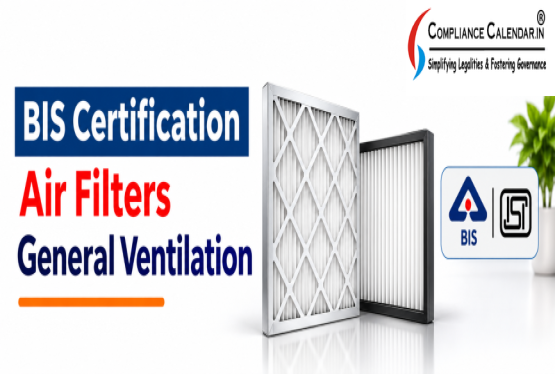



Air filtration has become an important part of building design in India. From commercial offices and shopping malls to hospitals, hotels and industrial facilities, ventilation systems continuously circulate air to maintain comfortable indoor conditions. However, the quality of circulated air depends significantly on the filters installed in these systems. A poorly performing air filter may allow dust and fine particulate matter to pass through, while an excessively restrictive filter may increase energy consumption and reduce ventilation efficiency.
This is where IS 17570 for General Air Filter Ventilation becomes important. The Bureau of Indian Standards (BIS) introduced IS 17570 (Part 1):2021 to establish technical specifications, performance requirements and a classification system for air filters used in general ventilation. The standard is based on the internationally recognised ISO 16890 series and evaluates filtration performance according to particulate matter efficiency, commonly called ePM.
For manufacturers, importers and HVAC equipment suppliers, understanding IS 17570 is not simply a matter of product quality. The Government of India made certification compulsory for covered general ventilation air filters under the Air Cooler and Air Filters (Quality Control) Order, 2025, subject to specified exemptions. In February 2026, the government also revised exemption provisions for eligible smaller manufacturing enterprises.
For more information about BIS compliance requirements for domestic manufacturers, explore our article on BIS Certification for Indian Manufacturers.
What Is IS 17570 for General Air Filter Ventilation?
IS 17570 is an Indian Standard covering the evaluation and classification of air filters used in general ventilation systems. Its primary purpose is to provide a consistent method for measuring how efficiently a filter captures airborne particles and how the filter affects airflow. General ventilation air filters are installed in air handling units, HVAC systems and other mechanical ventilation equipment. These filters help remove dust, pollen and other airborne particulate matter before air is supplied or recirculated inside buildings. The standard is particularly important because two air filters that look similar may perform very differently. One filter may capture a high percentage of fine particles but create greater resistance to airflow. Another may allow higher airflow but provide lower particulate removal efficiency.
IS 17570 helps manufacturers describe these characteristics using recognised technical measurements rather than unsupported marketing claims. The relevant specification is IS 17570 (Part 1):2021 / ISO 16890-1:2016, titled Air Filters for General Ventilation – Part 1: Technical Specifications, Requirements and Classification System Based on Particulate Matter Efficiency (ePM). BIS also publishes a product manual explaining the certification and testing arrangements for this standard.
Official BIS document : IS 17570 (Part 1):2021 – BIS Product Manual.
Understanding the Different Parts of IS 17570
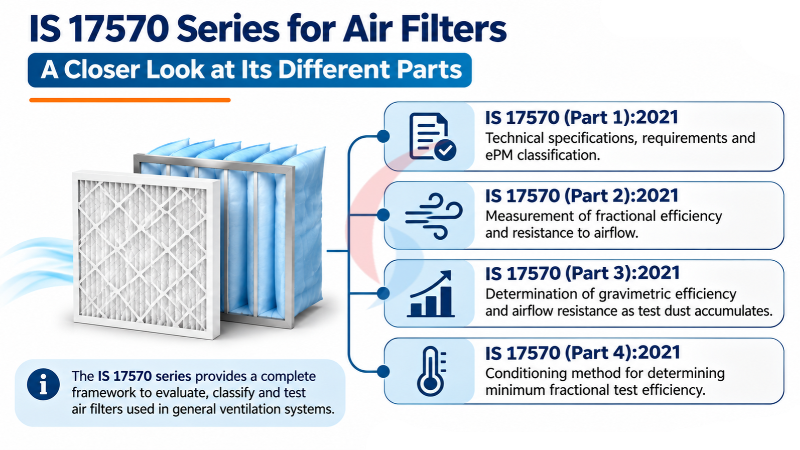
The IS 17570 series contains different technical parts dealing with air filter classification and the measurement of filtration performance. Each part has a specific role, and manufacturers must understand how they work together.
|
Indian Standard |
Technical coverage |
|
Technical specifications, requirements and ePM classification |
|
|
Measurement of fractional efficiency and resistance to airflow |
|
|
Determination of gravimetric efficiency and airflow resistance as test dust accumulates |
|
|
Conditioning method for determining minimum fractional test efficiency |
Part 1 establishes the main classification system, while the other parts support testing and performance evaluation. For example, determining an air filter's particulate efficiency involves measurement procedures specified in the related parts of the series. The distinction matters because a manufacturer cannot establish conformity merely by describing the filter material. The complete product needs to be assessed using applicable test methods. Manufacturers can search these standards through the official BIS Standards Portal.
For more information about adding new air filter models and product varieties under an existing BIS licence, read our article on BIS ISI Licence Scope Expansion.
Why Is IS 17570 Important for HVAC Air Filters?
Ventilation systems are designed to move a particular volume of air through a building. When filters are installed, they create resistance to airflow. This resistance affects the performance of the ventilation equipment and may influence electricity consumption. At the same time, a filter must capture the particulate matter for which it is intended. A filter with inadequate efficiency may allow fine particles to circulate, reducing the effectiveness of the overall air filtration system. IS 17570 addresses these considerations by providing a standardised system for evaluating particulate matter efficiency and other relevant performance characteristics.
For HVAC manufacturers and building maintenance companies, the standard helps in selecting filters suitable for their intended applications. For filter manufacturers, it provides measurable technical specifications that can support product development, quality control and certification. The standard also improves product comparability. Instead of selecting a filter only because it is described as high efficiency or premium grade, buyers can examine its declared ePM classification and operating characteristics.
IS 17570 ePM Classification System Explained
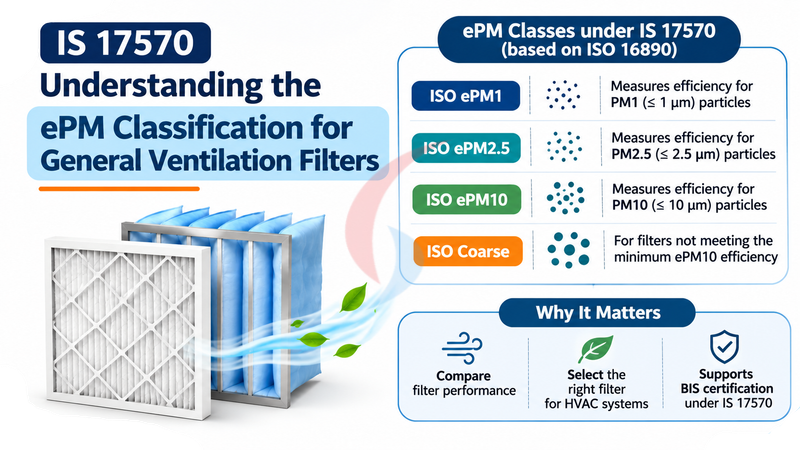
The ePM classification system is one of the most important aspects of IS 17570. The term ePM refers to efficiency measured in relation to particulate matter of specified size fractions. Airborne particles vary in diameter. Larger particles may include visible dust and pollen, while smaller particles may remain suspended in the air for longer periods. Because the behaviour of particles differs by size, a filter's performance should be evaluated across relevant size fractions.
The ISO 16890 classification system groups qualifying filters into categories such as ISO ePM1, ISO ePM2.5, ISO ePM10 and ISO Coarse.
|
Classification |
Meaning |
General application consideration |
|
ISO ePM1 |
Efficiency associated with the PM1 particle fraction |
Selection where fine-particle capture is important |
|
ISO ePM2.5 |
Efficiency associated with the PM2.5 fraction |
General ventilation requiring fine particulate filtration |
|
ISO ePM10 |
Efficiency associated with the PM10 fraction |
Filtration of larger particulate matter |
|
ISO Coarse |
Classification for filters below the prescribed minimum ePM10 efficiency threshold |
Coarse dust and preliminary filtration |
An ePM classification is not automatically equivalent to an air quality improvement percentage inside a particular room. Actual indoor performance depends on factors such as airflow, outdoor pollution, occupancy, ventilation design and maintenance.
For example, a filter classified ISO ePM2.5 65% has a declared efficiency rating determined through the relevant standardised testing and classification process. It does not mean that every room using the filter will experience a 65% reduction in PM2.5 concentration.
Difference Between ePM1, ePM2.5 and ePM10 Filters
Although these classifications are related, they should not be treated as identical. Each describes efficiency in relation to a different particle-size fraction. An ePM1 filter is evaluated for a finer particle fraction than an ePM10 filter. This distinction matters when selecting filtration systems for environments where small airborne particles are a concern. A commercial office building located near a busy road may require a different filtration arrangement from a facility operating in a relatively clean environment. Similarly, an industrial facility dealing with coarse airborne dust may have different requirements from a building that prioritises fine-particle filtration.
Filter selection should therefore consider the target particle fractions, system airflow requirements, pressure drop and relevant technical guidance. Manufacturers must also remember that the ISO 16890 classification is not interchangeable with specialised HEPA filter classifications. Products designed for specialised contamination-control applications may be subject to other standards.
For more information about BIS requirements, eligibility and exemptions for smaller businesses, refer to our article on BIS Certification for Small Manufacturers and MSMEs.
Technical Requirements Under IS 17570 (Part 1):2021
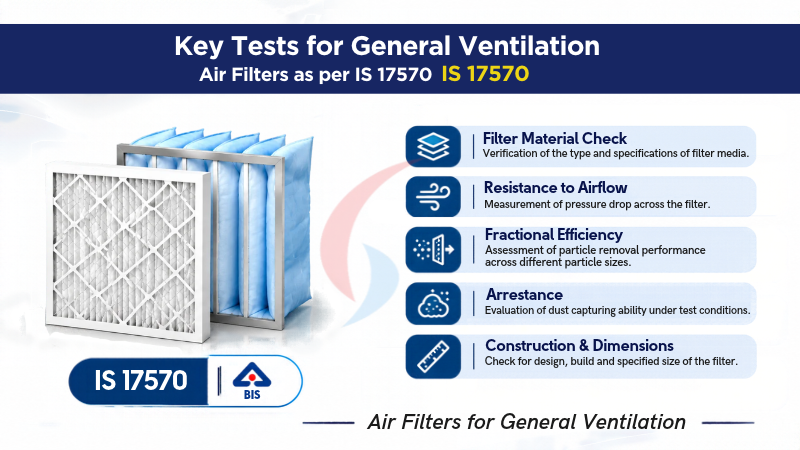
IS 17570 (Part 1):2021 establishes requirements that help evaluate the construction, materials and filtration performance of general ventilation air filters. The BIS product manual identifies several parameters relevant to certification, including filter materials, resistance to airflow, efficiency assessment and arrestance.
|
Technical requirement |
Purpose |
|
Filter material declaration |
Identifies materials used in manufacturing |
|
Airflow resistance |
Evaluates pressure resistance as air passes through the filter |
|
Filtration efficiency |
Measures particle capture performance |
|
ePM classification |
Establishes the declared particulate matter efficiency category |
|
Arrestance |
Evaluates relevant dust capture characteristics |
|
Nominal airflow rate |
Identifies the intended operating airflow |
|
Construction details |
Describes the physical configuration of the filter |
|
Dimensions |
Identifies the size of the product |
|
Marking information |
Supports identification and conformity declarations |
The manufacturer's declared values must be supported by the applicable technical assessment and records. Actual test limits and acceptance criteria should be taken from the current standard rather than from generic industry descriptions.
For example, if a manufacturer changes the filter medium to reduce production costs, the change may affect filtration efficiency and airflow resistance. The manufacturer should assess the impact on its declared classification and BIS-certified product scope before introducing the modified design.
BIS Testing Requirements Under IS 17570
Testing helps determine whether the manufactured air filter meets the declared technical characteristics. It also establishes whether the product complies with the applicable Indian Standard. The official BIS Product Manual, document PM/IS 17570 (Part 1)/1, dated February 2023, provides the Scheme of Inspection and Testing and the relevant sampling arrangements. It identifies filter materials, airflow resistance, efficiency and arrestance as important compliance parameters.
1. Resistance to Airflow Testing
Airflow resistance is important because an air filter creates a pressure drop as air passes through the filtration medium. Excessive resistance may affect ventilation system performance and energy consumption. Testing evaluates the filter's resistance under prescribed conditions. This helps manufacturers determine whether the product is suitable for its declared nominal airflow rate.
2. Fractional Efficiency Testing
Fractional efficiency testing evaluates particle removal performance across different particle-size ranges. It provides information required to determine filtration characteristics under the applicable ISO 16890 methodology. This is particularly important because a filter's efficiency is not necessarily the same for every particle size.
3. Arrestance Testing
Arrestance concerns the filter's ability to capture specified test dust under prescribed conditions. It is relevant to the assessment of coarse filtration performance and related classification requirements.
4. Filter Material Verification
Manufacturers must declare the materials used in producing the filter and provide evidence of conformity with the declared technical specifications. Filter materials can influence particle capture, airflow resistance and overall product consistency. Changes in materials should therefore be evaluated carefully.
5. Inspection and Testing Frequency
The BIS product manual contains a Scheme of Inspection and Testing that addresses testing during production. Manufacturers should establish their quality control arrangements according to the applicable control-unit definitions, test frequencies and permissible laboratory arrangements. The manual also permits specified testing to be subcontracted to eligible BIS-recognised or government-empanelled laboratories, subject to the relevant requirements.
Official testing reference: BIS Product Manual – Annex C.
Is IS 17570 BIS Certification Mandatory in India?
Yes. Products falling within the scope of the Air Cooler and Air Filters (Quality Control) Order, 2025 are subject to compulsory BIS Certification, unless an applicable exemption is available. The order was issued by DPIIT through Notification S.O. 529(E), dated 30 January 2025, under Section 16 of the Bureau of Indian Standards Act, 2016. The notification requires covered products to conform to the prescribed Indian Standards and carry the BIS Standard Mark under a valid licence issued under Scheme I of Schedule II to the BIS (Conformity Assessment) Regulations, 2018.
|
Legal requirement |
Applicable provision |
|
Principal legislation |
BIS Act, 2016 |
|
Power to notify compulsory certification |
Section 16 |
|
Restrictions relating to notified products |
Section 17 |
|
Statutory penalties |
Section 29 |
|
Certification procedure |
BIS (Conformity Assessment) Regulations, 2018 |
|
Relevant QCO |
Air Cooler and Air Filters (Quality Control) Order, 2025 |
|
BIS scheme |
Scheme I – ISI Mark Scheme |
The QCO's table cites IS 17570 (Part 1):2021 but also refers to ISO 16890-2:2016, whereas the BIS product manual identifies ISO 16890-1:2016 as the adopted Part 1 standard. This difference should be checked against the current BIS standards record or clarified with BIS when preparing technical documentation.
Official notification: Air Cooler and Air Filters (Quality Control) Order, 2025.
BIS Certification Implementation Dates for Air Filters
The 2025 QCO provides different implementation dates according to the manufacturer's enterprise category.
|
Manufacturer category |
Implementation date |
|
General manufacturers |
1 April 2025 |
|
Small enterprises |
1 July 2025 |
|
Micro enterprises |
1 October 2025 |
These implementation dates are part of the original notification. As of November 2026, the scheduled dates have passed, although qualifying manufacturers may be exempt under the amended QCO.
Latest Government Update on IS 17570 in 2026
The February 2026 amendment is particularly important for smaller manufacturers of ventilation air filters. The government amended the Air Cooler and Air Filters (Quality Control) Order, 2025 through S.O. 777(E), published on 13 February 2026. The amendment revised the exemption criteria for certain Udyam-registered manufacturing enterprises. Under the amended provision, the QCO does not apply to goods manufactured by an eligible enterprise satisfying both financial conditions:
Investment limit
Rs 1 crore
Maximum original cost of plant and machinery or equipment
Rs 5 crore
Maximum turnover in the previous financial year
The enterprise must be registered on Udyam, and previous-year turnover must be certified by a Chartered Accountant. Both thresholds must be satisfied. An enterprise exceeding either threshold should not assume that the exemption remains available.
For example, a filter manufacturer with an original machinery investment of Rs 70 lakh and previous-year turnover of Rs 4 crore may qualify, provided all other conditions are satisfied. Another manufacturer with the same investment but turnover of Rs 6 crore would not meet both financial conditions.
Official government amendment: S.O. 777(E) – QCO Amendment, February 2026.
Businesses can also read BIS Certification for Small Manufacturers and MSMEs to understand the broader certification considerations.
BIS Product Grouping and Model Classification Under IS 17570
An important part of IS 17570 certification is deciding which filter models can be included within the proposed BIS licence. Manufacturers often supply filters in numerous configurations, including different dimensions, airflow ratings and filtration materials. However, the presence of several models under one brand does not automatically mean that a single test report will cover every variety.
According to Annex A of the BIS product manual, the classification of product varieties considers five important technical parameters:
- ISO ePM rating.
- Nominal airflow rate.
- Physical construction, including details such as pocket configuration.
- Type of filter medium and relevant filtering-area information.
- Dimensions, including width, height and depth.
The manual defines varieties with reference to common technical parameters and requires the applicable testing and supporting factory reports when manufacturers seek to include models within the licence scope.
For instance, a manufacturer may produce two pocket filters of identical external dimensions but use different filtration media. Such a change can affect the declared efficiency and may also affect the grouping or testing requirements. Manufacturers should therefore prepare model-wise technical declarations instead of relying on a general product catalogue.
Documents Required for IS 17570 BIS Certification
A BIS application for general ventilation air filters requires appropriate legal, manufacturing and technical documentation.
|
Document |
Purpose |
|
Business registration certificate |
Establishes the applicant's legal status |
|
Manufacturing unit address proof |
Confirms factory details |
|
Manufacturing process flow chart |
Explains the production process |
|
Factory layout |
Identifies manufacturing and testing areas |
|
Machinery list |
Shows production capability |
|
Filter material specifications |
Establishes construction and raw material details |
|
Model-wise technical data |
Identifies ratings, airflow and dimensions |
|
Quality control plan |
Shows product inspection arrangements |
|
Testing equipment details |
Establishes available testing facilities |
|
Calibration records |
Supports measurement accuracy |
|
Laboratory reports |
Provides evidence of product testing |
|
Authorised signatory documents |
Establishes application authority |
|
Brand details |
Supports product identification |
|
AIR documents, if applicable |
Supports foreign manufacturer applications |
The final documentation requirements depend on the applicant category, certification procedure and BIS instructions.
For general guidance, manufacturers can read ISI Certification in India: Process, Documents and Fees.
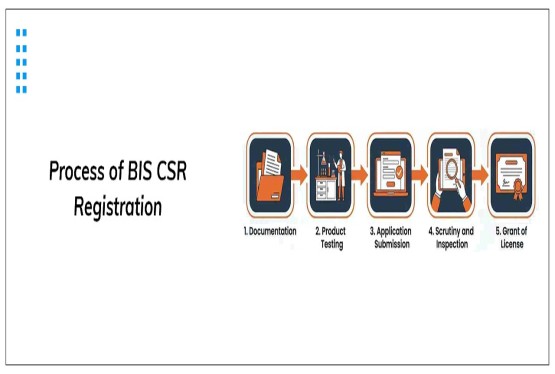
Step-by-Step Process to Obtain IS 17570 BIS Certification
Step 1: Confirm the Product Category
The manufacturer should first determine whether its products are covered by IS 17570 (Part 1):2021. Product specifications, filtration media, intended use and operating conditions should be examined before preparing the application.
Step 2: Review the Applicable QCO
The next step is to confirm whether compulsory BIS certification applies to the manufacturer's products and whether any exemption is available. Where the 2025 QCO applies, manufacturers must comply with the notified requirements and use the prescribed certification route.
Step 3: Prepare Manufacturing and Testing Facilities
The factory should have the necessary production machinery, qualified personnel, quality control records and testing arrangements. Manufacturers should review the BIS product manual to determine which testing capabilities must be maintained and which tests may be subcontracted under the applicable conditions.
Step 4: Apply Through BIS Manak Online
The manufacturer can submit the application through the official BIS Manak Online Portal. The application should include the relevant standard, factory information, product details, model declarations and required supporting documents.
Step 5: Complete Testing and Factory Assessment
BIS evaluates the applicant's manufacturing arrangements and may undertake a factory inspection and product sampling according to the applicable certification procedure. Samples must satisfy the requirements of IS 17570 and the relevant testing procedures.
Step 6: Respond to BIS Observations
If BIS raises queries regarding testing, manufacturing capability, documentation or model grouping, the manufacturer must provide appropriate clarification or corrective evidence. An incomplete response may delay the assessment.
Step 7: Obtain the BIS Licence
After satisfactory evaluation, BIS may grant a Scheme I licence authorising use of the prescribed Standard Mark on approved filter models. The manufacturer must comply with licence conditions, approved product scope and marking requirements.
Step 8: Maintain Compliance After Certification
Manufacturers should continue conducting prescribed testing, maintaining calibration records and monitoring production consistency. Changes in filtration media, efficiency ratings, construction or product specifications should be evaluated for their impact on the licence scope.
For additional information, read Why BIS ISI Certification Matters Before Selling Products.
IS 17570 BIS Certification Fees and Timeline
The total cost of certification depends on the manufacturing facility, proposed filter models, laboratory testing requirements, factory assessment and applicable marking fees.
|
Cost component |
Description |
|
Application fee |
As prescribed under the BIS Scheme I fee schedule |
|
Product testing |
Depends on the tests required under IS 17570 |
|
Inspection charges |
Based on applicable factory inspection requirements |
|
Annual licence fee |
As specified in the current BIS schedule |
|
Marking fee |
Depends on the applicable product-specific schedule |
|
Additional model testing |
May apply when introducing new varieties |
|
Professional assistance |
Depends on the documentation and coordination required |
There is no universal fixed total cost for all IS 17570 applications. Manufacturers should obtain current fee details from BIS and the selected testing laboratory. The certification timeline also varies. Factory readiness, testing facilities, product performance and completeness of documentation can significantly influence the process. BIS observations and retesting requirements may extend the time needed to obtain approval.
For related information, read ISI Certification Cost and Timeline in India.
IS 17570 for Imported General Ventilation Air Filters
Foreign manufacturers supplying general ventilation air filters to India must examine the compulsory certification provisions under the relevant QCO. Where BIS certification is mandatory, imported products must comply with the applicable requirements unless a specific exemption is available. Eligible foreign manufacturers may obtain the required certification through the BIS Foreign Manufacturers Certification Scheme (FMCS). The manufacturer generally needs to provide technical documentation, manufacturing details, product testing arrangements and an Authorised Indian Representative (AIR), where required.
Importers should verify that the overseas manufacturer's BIS licence covers the actual models being imported. A licence granted for one filter variety should not automatically be treated as approval for all other products sold by that manufacturer. The role of the AIR is also important because the representative helps coordinate with BIS and perform responsibilities prescribed under the applicable certification arrangements.
Related article: Roles and Responsibilities of AIR in BIS FMCS.
Common Compliance Mistakes Under IS 17570
One frequent mistake is assuming that every air filter used in an HVAC system automatically belongs to the same classification. General ventilation filters and specialised filtration systems may be governed by different technical standards. Another issue arises when manufacturers assign ePM ratings without completing the prescribed testing. A high-quality filter medium does not automatically establish the efficiency classification of the finished filter assembly.
Some businesses also overlook the importance of model grouping. Filters with different dimensions, construction or media may require additional technical evaluation before being included in the approved licence scope. Manufacturers should also avoid treating BIS certification as a one-time formality. Product quality must remain consistent with the applicable Indian Standard throughout the operation of the licence.
Legal Consequences of Non-Compliance With IS 17570
The BIS Act, 2016 provides the legal basis for compulsory certification and enforcement. Section 16 empowers the Central Government to notify specified products for compulsory conformity assessment. Section 17 addresses restrictions on activities involving notified products where statutory requirements have not been fulfilled, while Section 29 provides for penalties for specified contraventions. Manufacturers and importers dealing in air filters covered by the QCO must therefore ensure that the applicable certification requirements have been satisfied. Unauthorised use of the BIS Standard Mark or marketing products as certified without the necessary licence may also attract regulatory action.
Why Choose Compliance Calendar LLP for IS 17570 BIS Certification?
Understanding IS 17570 and completing the BIS certification process can be challenging for manufacturers dealing with multiple ventilation filter designs, performance ratings and product specifications. Compliance Calendar LLP provides professional assistance to manufacturers and importers seeking BIS ISI Certification in India.
Our team helps businesses identify applicable standards, prepare technical and legal documentation, understand product grouping requirements, coordinate laboratory testing and complete BIS certification applications. We also assist with factory inspection preparation, BIS queries, licence scope expansion and ongoing regulatory compliance. Whether your business manufactures pleated filters, pocket filters or other general ventilation filters, Compliance Calendar LLP can help simplify the certification process and reduce avoidable documentation errors.
For assistance, contact +91 9988424211 or info@ccoffice.in
Frequently Asked Questions
Q1. What is IS 17570 in India?
Ans. IS 17570 is an Indian Standard covering air filters used in general ventilation systems. Part 1 specifies technical requirements and a classification system based on particulate matter efficiency. It helps manufacturers establish consistent and measurable filtration performance.
Q2. Is IS 17570 mandatory for air filter manufacturers?
Ans. Yes, BIS certification is mandatory for products covered by the Air Cooler and Air Filters (Quality Control) Order, 2025, unless an applicable exemption is available. Manufacturers should verify product classification and exemption eligibility before determining their compliance obligations.
Q3. What is the relationship between IS 17570 and ISO 16890?
Ans. IS 17570 is based on the ISO 16890 series of international air filtration standards. IS 17570 (Part 1):2021 adopts ISO 16890-1:2016 and provides the relevant classification system for general ventilation filters.
Q4. What is ePM classification under IS 17570?
Ans. The ePM classification system describes filtration efficiency in relation to specified particulate matter size fractions. It includes categories such as ISO ePM1, ISO ePM2.5, ISO ePM10 and ISO Coarse, depending on the measured performance of the filter.
Q5. Which tests are required under IS 17570?
Ans. Testing may include airflow resistance, fractional efficiency, particulate matter efficiency, arrestance and verification of filter materials. The specific procedures and acceptance criteria are established in the applicable parts of IS 17570.
Q6. Can one BIS licence cover multiple HVAC filter models?
Ans. A licence may include multiple approved models, subject to the BIS grouping guidelines and licence scope. Models with different technical characteristics may require additional testing or assessment before they can be included.
Q7. Are small manufacturers exempt from IS 17570 certification in 2026?
Ans. Eligible Udyam-registered manufacturers may qualify for an exemption under the February 2026 amendment. The prescribed conditions include original plant and machinery or equipment investment not exceeding Rs 1 crore and previous-year turnover not exceeding Rs 5 crore, with turnover certified by a Chartered Accountant.
Q8. Is IS 17570 applicable to HEPA filters?
Ans. IS 17570 primarily addresses general ventilation air filters. Specialised HEPA filters may be governed by separate standards and testing requirements. Manufacturers should classify the product according to its intended use and technical characteristics.
Q9. Can imported air filters be sold in India without BIS Certification?
Ans. Where a product falls within a mandatory BIS QCO, the applicable certification requirements must be satisfied unless an exemption applies. Importers should verify that the overseas manufacturer's BIS licence covers the products being imported.
Q10. Where can manufacturers apply for IS 17570 certification?
Ans. Manufacturers can submit applications through the official BIS Manak Online Portal. The process includes preparation of technical documents, product testing, applicable factory assessment and BIS evaluation before grant of the licence.
Article last updated on : 20 Nov 2026.