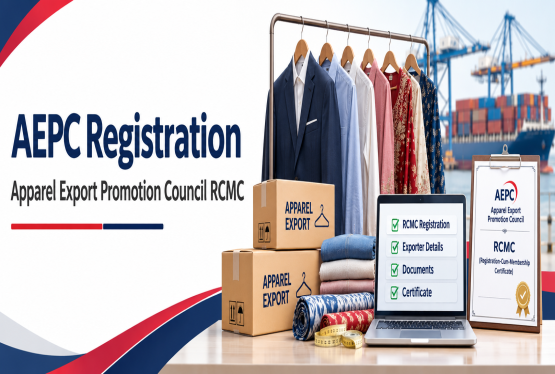



An Indian exporter may begin with one product and gradually expand into several business categories. A company initially exporting garments may start supplying home textiles, handicrafts and packaged food products to overseas buyers. Although the business operates under one Import Export Code (IEC), these products may fall under different Export Promotion Councils.
This creates an important question: Does an exporter dealing in multiple product categories need separate RCMC registrations for every product, or can one Registration-cum-Membership Certificate cover the business?
The answer depends on the exporter's main line of business, the products covered by the relevant councils and the requirements of the Foreign Trade Policy, 2023.
Under Paragraph 2.80 of the Handbook of Procedures, 2023, exporters generally obtain RCMC from the council responsible for their principal product category. However, a multi-product exporter that is not registered with any Export Promotion Council and has not yet established its main business category may choose registration with the Federation of Indian Export Organisations (FIEO).
What is RCMC Registration for Multiple Product Categories?
Registration-cum-Membership Certificate (RCMC Registration) is a certificate issued by an authorised Export Promotion Council (EPC), Commodity Board, Development Authority or other designated registering authority. It establishes an exporter's registration with the relevant organisation for specified foreign trade purposes.
Many businesses export products from one sector. For example, a company selling only engineering goods may approach EEPC India, while an exporter specialising in pharmaceutical products may approach PHARMEXCIL. However, some businesses handle products belonging to several sectors. A merchant exporter may supply agricultural commodities, plastic household goods and garments to customers in different countries. Such businesses are commonly referred to as multi-product exporters.
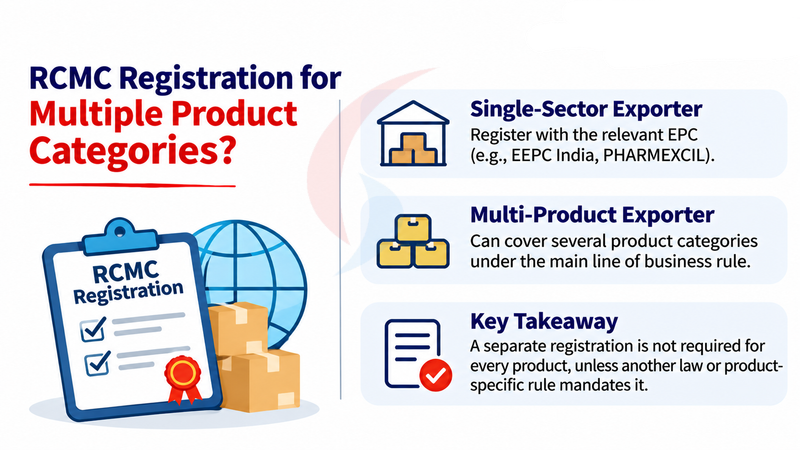
The RCMC system recognises that a business may deal in several products without requiring an entirely separate registration for every item under the general main-line-of-business rule. However, where another law or product-specific requirement independently requires registration with a particular authority, the exporter must comply with that requirement.
For a general introduction, read our guide on RCMC Registration Online in India.
Is One RCMC Sufficient for Multiple Export Products?
One RCMC may be sufficient for the general Foreign Trade Policy requirement where it has been obtained from the appropriate registering authority based on the exporter's main line of business.
For example, suppose a company exports cotton garments, bedsheets and other textile products. If the relevant council covers its principal product group, the company may not need separate membership with every possible trade organisation merely because its catalogue contains different items.
The applicable position can be understood as follows:
|
Export Business Situation |
RCMC Registration Position |
|
Multiple products within one council's jurisdiction |
RCMC from the relevant council may be appropriate. |
|
Different products, but one established main business category |
Generally obtain RCMC from the council responsible for the principal business. |
|
Multiple unrelated products, with no established main line of business |
FIEO registration may be available under Paragraph 2.80(b). |
|
Export product not covered by any EPC or Commodity Board |
FIEO generally acts as the registering authority. |
|
Products covered by a separate statutory registration requirement |
Additional product-specific registration may still be necessary. |
|
Qualifying small-value export consignment |
The September 2026 FTP exemption may apply. |
Important: A single FIEO RCMC should not be treated as a blanket exemption from APEDA, Spices Board, Tea Board, food safety or other independent product-specific requirements.
Laws and Legal Provisions Governing Multi-Product RCMC Registration
RCMC Registration is primarily governed by the Foreign Trade (Development and Regulation) Act, 1992, the Foreign Trade Policy, 2023 and the Handbook of Procedures, 2023.
|
Applicable Law or Policy |
Important Provisions |
Legal Requirements |
|
Sections 5 and 7 |
Governs foreign trade policy and Import Export Code requirements. |
|
|
Paragraphs 2.56 and 2.57 |
Provides for Export Promotion Councils and applicable RCMC requirements. |
|
|
Paragraphs 2.79 and 2.80 |
Governs RCMC applications and selection of the appropriate registering authority. |
|
|
Handbook of Procedures, 2023 |
Paragraphs 2.81 and 2.82 |
Governs RCMC validity and intimation of changes in business particulars. |
|
Dated 15 September 2026 |
Provides the specified RCMC exemption for consignments up to Rs 3 lakh FOB. |
Paragraph 2.80 is particularly important because it addresses exporters with multiple products and explains when FIEO registration may be selected. The Handbook also contains special provisions for certain multi-product exporters located in India's North-Eastern states.
How to Identify the Main Line of Business for RCMC
The main line of business is generally the principal export product category of the company. It helps determine which Export Promotion Council should issue the RCMC. An exporter should examine the goods it primarily exports, the nature of its business and the relevant council's jurisdiction.
For an established exporter, historical export turnover may help establish the principal business category. A new business may use its intended principal export activity and product information to identify the appropriate council. For example, a company may export garments worth Rs 80 lakh and handicrafts worth Rs 15 lakh during a year. If garments clearly represent its main export activity, it should generally examine the council responsible for the relevant garment products.
However, the Handbook does not prescribe a universal 50%, 60% or 75% turnover threshold for determining the main line of business. Therefore, the selection should be based on the actual business facts and the council's jurisdiction rather than an invented numerical rule.
Our article on How to Choose the Right Council for RCMC Registration explains how exporters can identify the appropriate registering authority.
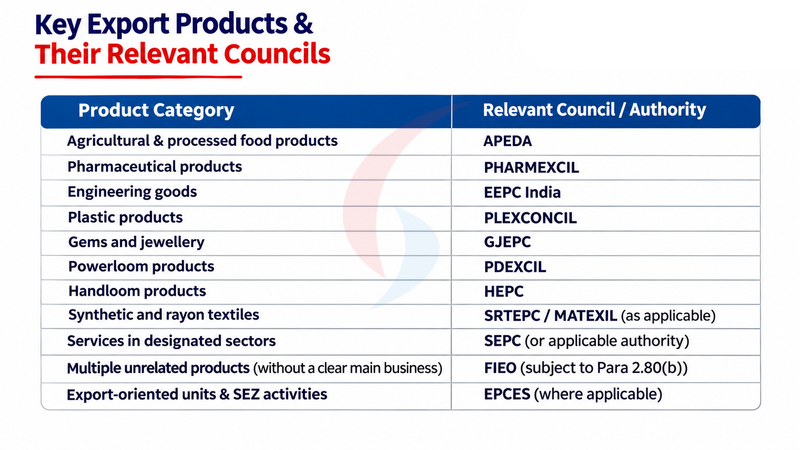
Which Export Promotion Council Covers Different Product Categories?
Different Export Promotion Councils and Commodity Boards support different export sectors. Businesses handling multiple products should classify their goods carefully before applying.
|
Product Category |
Relevant Council or Authority |
|
Agricultural and processed food products |
|
|
Pharmaceutical products |
PHARMEXCIL |
|
Engineering goods |
EEPC India |
|
Plastic products |
PLEXCONCIL |
|
Gems and jewellery |
GJEPC |
|
Powerloom products |
PDEXCIL |
|
Handloom products |
HEPC |
|
Synthetic and rayon textiles |
SRTEPC/MATEXIL, as applicable |
|
Services in designated sectors |
SEPC or another applicable authority |
|
Multiple unrelated products without an established main business |
FIEO, subject to Paragraph 2.80(b) |
|
Export-oriented units and SEZ-related activities |
EPCES, where applicable |
The correct authority depends on the precise product and its applicable classification. For example, different textile products may fall under different councils even though they are all commonly described as textiles. Exporters dealing in agricultural products should also examine the separate statutory requirements under the APEDA Act, 1985.
For more information, read our guides on PHARMEXCIL Registration, PLEXCONCIL Registration and GJEPC Registration.
Practical Story: A Delhi Exporter Selling Three Different Products
Consider ABC Private Limited, a fictional merchant trading company based in Delhi.
The company initially exports home textiles to customers in the United Kingdom. After a successful first year, it starts receiving enquiries for decorative handicrafts and packaged food products from buyers in Europe and the Middle East.
Its export portfolio now includes three separate categories:
- Home textiles worth Rs 45 lakh annually.
- Handicrafts worth Rs 25 lakh annually.
- Processed food products worth Rs 10 lakh annually.
The company's director assumes that three unrelated product categories automatically require three separate RCMC certificates.
During an export compliance review, the adviser explains that the general RCMC rule considers the principal line of business. Since home textiles account for the company's largest established export activity, the business must identify the appropriate textile-related registering authority.
Documents Required for RCMC Registration for Multiple Product Categories
The exact documents depend on the relevant council, membership category and whether the applicant is a manufacturer exporter or merchant exporter.
|
Required Document |
Purpose |
|
Import Export Code (IEC) |
Identifies the business for import-export activities. |
|
PAN and Business Registration Details |
Establishes the applicant's legal identity. |
|
GST Registration, Where Applicable |
Supports business and tax particulars. |
|
Product List with ITC(HS) Codes |
Identifies the exported product categories. |
|
Main Line of Business Declaration |
Supports selection of the appropriate council. |
|
Export Turnover Details |
May help establish the principal business and membership category. |
|
Bank Details |
Supports the relevant application information. |
|
Authorisation Letter |
Authorises the representative submitting the application. |
|
Additional Council-Specific Documents |
Supports product or membership requirements. |
For example, an exporter applying as a manufacturer may need to provide evidence of manufacturing activity. A merchant exporter may have different documentation requirements.
Applicants should ensure that their IEC profile, legal name, registered address and supporting records are consistent.
If you are starting an export business, read our guide on the Procedure for Obtaining Import Export Code (IEC).
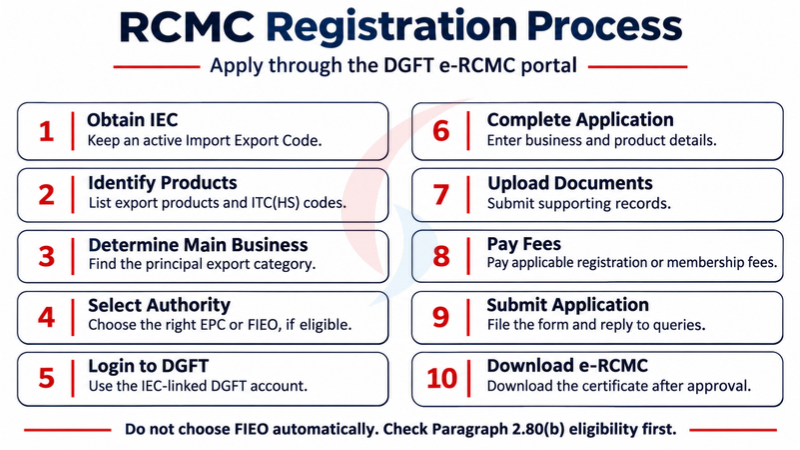
Step-by-Step RCMC Registration Process for Multi-Product Exporters
RCMC applications are submitted online through the DGFT e-RCMC portal. Exporters must select the appropriate Export Promotion Council (EPC) or FIEO based on their business activities.
|
Step |
Registration Process |
Description |
|---|---|---|
|
Step 1 |
Obtain IEC |
Ensure the business has a valid and active Import Export Code. |
|
Step 2 |
Identify Products |
Prepare a list of export products with their ITC(HS) codes. |
|
Step 3 |
Determine Main Business |
Identify the principal export category and relevant council. |
|
Step 4 |
Select Authority |
Choose the appropriate EPC or FIEO, where eligible. |
|
Step 5 |
Login to DGFT |
Access the e-RCMC service through the IEC-linked account. |
|
Step 6 |
Complete Application |
Enter business, product and membership details. |
|
Step 7 |
Upload Documents |
Submit the required supporting documents. |
|
Step 8 |
Pay Fees |
Pay the applicable registration and membership fees. |
|
Step 9 |
Submit Application |
Submit the form and respond to any authority queries. |
|
Step 10 |
Download e-RCMC |
Download the certificate after approval. |
The official application service is available through the DGFT e-RCMC Portal. Exporters should not select FIEO automatically merely because they sell more than one product. The eligibility conditions in Paragraph 2.80(b) must first be considered.
RCMC Registration Fees and Validity
There is no single government fee applicable to every multi-product RCMC application. Registration charges vary according to the selected Export Promotion Council, membership category and relevant turnover or other eligibility criteria. For example, an exporter applying through FIEO may face different membership charges from a business applying through APEDA, PHARMEXCIL or GJEPC.
|
Particulars |
General Position |
|
RCMC Registration Fee |
Depends on the chosen registering authority. |
|
FIEO Multi-Product Membership |
Subject to FIEO's current membership category and charges. |
|
Additional Council Membership |
Separate fees may apply where additional membership is obtained. |
|
RCMC Validity |
Generally five financial years, unless otherwise specified. |
|
Renewal |
Required according to the certificate's validity and council rules. |
|
Amendment Charges |
Depend on the applicable authority and procedure. |
Under Paragraph 2.81 of the Handbook of Procedures, 2023, an RCMC is generally deemed valid from 1 April of the licensing year in which it is issud and continues for five years ending on 31 March of the relevant licensing year, unless otherwise specified. Businesses should verify the certificate's exact expiry date and avoid assuming that its validity is always five full calendar years from the application date.
Latest RCMC Registration Updates in 2026
The most important recent change for multi-product exporters is DGFT Notification No. 36/2026-27 dated 15 September 2026, which amended Paragraph 2.57 of the Foreign Trade Policy, 2023. The amendment introduced an exemption from the RCMC or Certificate of Registration requirement under the FTP for export consignments whose Free-on-Board (FOB) value does not exceed Rs 3 lakh.
|
2026 Regulatory Update |
Importance for Exporters |
|
15 September 2026 – DGFT Notification No. 36/2026-27 |
Exempts qualifying export consignments up to Rs 3 lakh FOB from the specified FTP RCMC requirement. |
|
Consignments Above Rs 3 Lakh FOB |
Applicable RCMC requirements continue wherever otherwise required under the FTP. |
|
DGFT e-RCMC Facility |
Continues to support online applications, renewals and amendments. |
|
Main Line of Business Rule |
Paragraph 2.80 of HBP 2023 continues to guide selection of the registering authority. |
|
Product-Specific Registrations |
Independent statutory requirements remain relevant despite the low-value FTP exemption. |
The exemption applies to the value of the relevant export consignment, not automatically to the company's total annual turnover. or example, a multi-product merchant exporter may export household accessories worth Rs 2 lakh FOB and garments worth Rs 2.80 lakh FOB in separate qualifying consignments. The amended FTP exemption may apply to both, subject to the relevant conditions.
However, if a later shipment has an FOB value of Rs 4 lakh, the exporter must examine whether a valid RCMC is required for that transaction. The exemption does not remove IEC, customs clearance, export restrictions, product certifications or independent statutory registrations. This distinction is particularly important for agricultural, food and other regulated products
Why Choose Compliance Calendar LLP ?
At Compliance Calendar LLP, we assist exporters with RCMC applications, product classification reviews and related registration documentation.
|
Our Services |
How We Help |
|
Council Selection |
Identify the relevant EPC based on the principal export category. |
|
Multi-Product Eligibility Review |
Examine whether FIEO or a sector-specific council is appropriate. |
|
IEC Registration Assistance |
Support IEC applications and relevant updates. |
|
DGFT e-RCMC Filing |
Assist with online applications and supporting documents. |
|
RCMC Renewal and Amendment |
Support updates to eligible membership and business particulars. |
|
Export Compliance Guidance |
Identify related product-specific registration requirements. |
Businesses can explore our RCMC Registration Services and IEC Code Registration Services for assistance.
For professional guidance on RCMC Registration for Exporters with Multiple Product Categories, contact Compliance Calendar LLP at 9988424211 or info@ccoffice.in.
Frequently Asked Questions (FAQs)
Q1. Can one RCMC cover multiple export product categories?
Ans: Yes, one RCMC may satisfy the general FTP requirement where it is issued by the appropriate authority based on the exporter's main line of business. However, separate statutory registrations may still be required for certain products.
Q2. Is FIEO Registration available for multi-product exporters?
Ans: Yes. Under Paragraph 2.80(b) of HBP 2023, multi-product exporters not registered with any EPC and whose principal business category is not yet settled may obtain RCMC from FIEO.
Q3. Is separate RCMC Registration required for every product?
Ans: Not automatically. The general rule focuses on the principal line of business rather than requiring a separate RCMC for every product. Specific authorities may nevertheless impose independent registration requirements.
Q4. How should exporters choose the correct Export Promotion Council?
Ans: Exporters should identify their principal product category, review the relevant ITC(HS) codes and confirm the jurisdiction of the appropriate council. Their existing or planned export activities can help establish the main line of business.
Q5. What is the validity of RCMC Registration in 2026?
Ans: RCMC generally remains valid for five financial years, subject to the relevant authority's rules. Under Paragraph 2.81, its validity ordinarily starts from 1 April of the issuing licensing year and ends on the relevant 31 March.
Q6. Can an exporter obtain RCMC from FIEO and another council?
Ans: Additional memberships may be possible under the relevant organisations' rules. However, exporters should distinguish optional industry membership from the registering authority required under the FTP and any independent product-specific obligations.
Q7. Is RCMC required for exports below Rs 3 lakh in 2026?
Ans: DGFT Notification No. 36/2026-27 exempts qualifying export consignments with FOB value not exceeding Rs 3 lakh from the specified FTP requirement. Other applicable legal obligations remain unaffected.
Q8. What happens when an exporter starts exporting a new product?
Ans: The exporter should check whether the new product falls under its existing council's jurisdiction or requires additional registration. Where necessary, the exporter should follow the applicable amendment or fresh registration procedure.
Q9. What are the government fees for multi-product RCMC Registration?
Ans: There is no universal fee for all exporters. The amount depends on the selected EPC or registering authority, membership category and applicable charges. Applicants should verify the current fee before submitting the application.
Q10. Can Compliance Calendar LLP assist with multi-product RCMC Registration?
Ans: Yes. Compliance Calendar LLP assists businesses with determining the appropriate registering authority, preparing documents, filing DGFT e-RCMC applications and reviewing additional export compliance requirements.
Article last updated on : 20 Nov 2026.