


Indoor air pollution has become a growing concern in India, particularly in cities where dust, vehicle emissions, construction activities and seasonal pollution affect everyday life. Many households, offices, schools and commercial establishments now use electric indoor air purifiers to improve indoor air quality. As demand increases, manufacturers and importers are also facing greater expectations regarding product safety, performance and quality.
However, selling an electric air purifier involves more than designing a machine with a fan and filtration system. Manufacturers must understand the applicable Indian Standards, electrical safety requirements, product testing procedures and BIS certification rules. A product may look attractive and promise effective air cleaning, but those claims should be supported by reliable testing and appropriate technical documentation.
BIS Certification for Electric Indoor Air Purifiers is therefore an important consideration for businesses manufacturing, importing or marketing these products in India. The Bureau of Indian Standards (BIS) has published IS 17531:2021 – Portable Electric Indoor Air Purifier – Specification, which provides the relevant Indian product specification for portable electric indoor air purifiers. The standard was reaffirmed in June 2025.
What Is BIS Certification for Electric Indoor Air Purifiers?
BIS Certification is a conformity assessment process administered by the Bureau of Indian Standards, India's national standards body. It helps establish whether a product meets the requirements of the applicable Indian Standard. Depending on the certification scheme, the process may involve product testing, examination of manufacturing facilities, verification of quality control systems and review of technical documents. For electric indoor air purifiers, the relevant product specification is IS 17531:2021. It addresses portable electric air purifiers intended for indoor air cleaning.
Manufacturers can use the standard to understand the performance and technical requirements that should be considered when developing and evaluating their products. It is important to distinguish between the existence of an Indian Standard and a legal obligation to obtain BIS certification. A standard does not automatically become mandatory merely because BIS has published it. Compulsory certification normally arises when the Central Government issues an applicable Quality Control Order (QCO) or another binding notification.
Businesses can understand this distinction further through Compliance Calendar's article on Different Types of BIS Certification in India.
Applicable BIS Standard for Electric Indoor Air Purifiers: IS 17531:2021
The Indian Standard IS 17531:2021 is titled Portable Electric Indoor Air Purifier – Specification. BIS lists it under its Chemical Department, with the CHD 35 Air Quality technical committee responsible for the standard. The BIS standards database also identifies relevant electrical safety standards and international testing references associated with this product category. The standard provides a basis for evaluating portable electric indoor air purifiers in a consistent manner. Instead of relying only on advertising claims, manufacturers can assess product characteristics through recognised testing procedures and measurable performance parameters.
|
Particular |
Details |
|
Product |
Portable Electric Indoor Air Purifier |
|
Indian Standard |
IS 17531:2021 |
|
Standard title |
Portable Electric Indoor Air Purifier – Specification |
|
Issuing authority |
Bureau of Indian Standards |
|
Technical committee |
CHD 35 – Air Quality |
|
Department |
Chemical Department |
|
Reaffirmation |
June 2025 |
|
Certification route |
Depends on the applicable BIS scheme and notification |
|
Official standard reference |
Manufacturers should review the complete current edition of the standard before selecting testing methods or making product performance claims.
Is BIS Certification Mandatory for Electric Indoor Air Purifiers in India?
The legal position requires careful examination because an Indian Standard and a proposed Quality Control Order are not the same as a final, enforceable certification requirement. The Department for Promotion of Industry and Internal Trade (DPIIT) published a proposed Portable Electric Indoor Air Purifier (Quality Control) Order, 2025, referring to IS 17531:2021. The draft envisages compulsory use of the BIS Standard Mark under Scheme I of Schedule II to the BIS (Conformity Assessment) Regulations, 2018.
The draft contains implementation periods linked to publication in the Official Gazette. However, the available DPIIT document contains an unfilled notification date and Gazette notification number. Consequently, it cannot by itself establish that the proposed order has entered into force. A final notified QCO and any subsequent amendments must be verified before treating IS 17531:2021 certification as legally compulsory.
|
Manufacturer category |
Proposed implementation period |
|
General manufacturers |
6 months after Gazette notification |
|
Small enterprises |
9 months after Gazette notification |
|
Micro enterprises |
12 months after Gazette notification |
These are proposed periods, not confirmed enforcement deadlines. Separately, applicable household electrical appliance safety requirements must be examined for the purifier's electrical design, voltage and product category. Official reference: DPIIT Portable Electric Indoor Air Purifier Draft QCO, 2025.
For a broader discussion of appliance-related obligations, read Home Appliance Safety in India: BIS Certification and Manufacturer Accountability.
Why Is BIS Certification Important for Electric Air Purifiers?
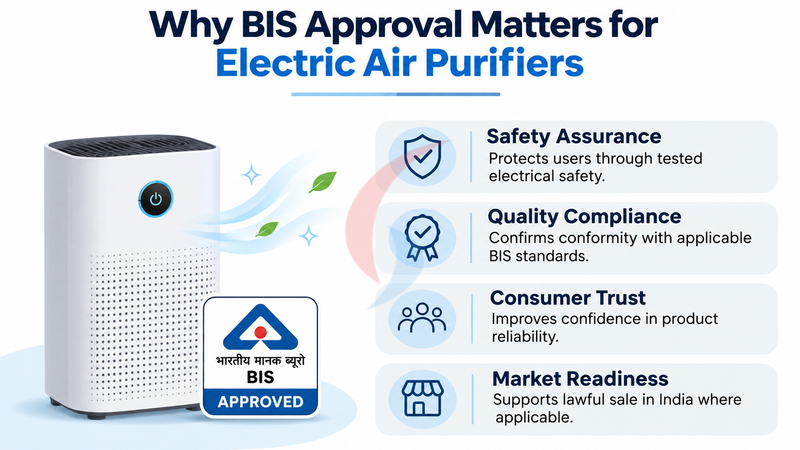
An air purifier may operate continuously for several hours each day, making both its electrical safety and air-cleaning performance important to users. The machine contains a motor, fan, electrical components, filtration materials and sometimes electronic sensors or wireless controls. Poor design, inadequate electrical insulation or unreliable components may affect safety, while weak filtration performance can create misleading expectations about indoor air quality. BIS standards help manufacturers work towards consistent product quality through measurable specifications and recognised assessment methods. Testing can also support claims about airflow, pollutant removal, energy use and other relevant characteristics, provided those claims fall within the verified testing scope.
For businesses, certification can support quality assurance, supplier evaluation, institutional procurement and customer confidence. Where a relevant QCO makes certification compulsory, obtaining the prescribed approval also becomes a legal requirement before carrying out regulated activities, subject to the order's scope and exemptions. Consumers benefit from more transparent product information, but BIS certification should not be presented as proof that an air purifier can eliminate every harmful pollutant or prevent illness. The actual performance of a purifier depends on room conditions, airflow, pollutant type, maintenance and proper operation.
Latest BIS Update for Electric Air Purifiers in 2026
An important regulatory development is the Safety of Household, Commercial and Similar Electrical Appliances (Quality Control) Order, 2026, issued through S.O. 1739(E), dated 6 April 2026.
This final notification came into force on 1 October 2026 and covers specified household, commercial and similar electrical appliances, including air-cleaning appliances and DC-supplied or battery-operated air purifiers, within the prescribed voltage limits. It requires eligible products to comply with IS 302 (Part 1):2024 / IEC 60335-1:2020 under BIS Scheme I, subject to the order's conditions and exclusions.
To understand how the latest safety regulations affect manufacturers and importers, read our detailed guide on Home Appliance Safety in India: BIS Certification and Manufacturer Accountability.
|
Manufacturer category |
Implementation date |
|
General manufacturers |
1 October 2026 |
|
Small enterprises |
1 January 2027 |
|
Micro enterprises |
1 April 2027 |
This notification concerns electrical appliance safety and must be distinguished from the separate proposed IS 17531:2021 product-performance QCO discussed earlier. The 2026 safety order also excludes products covered by another applicable QCO or mandatory BIS certification requirement. Manufacturers must therefore assess the relevant product category and all applicable notifications rather than assume that one certificate automatically satisfies every requirement.
Official notification: DPIIT Electrical Appliances QCO, 2026 – Gazette PDF.
Types of Electric Indoor Air Purifiers Covered Under BIS Standards
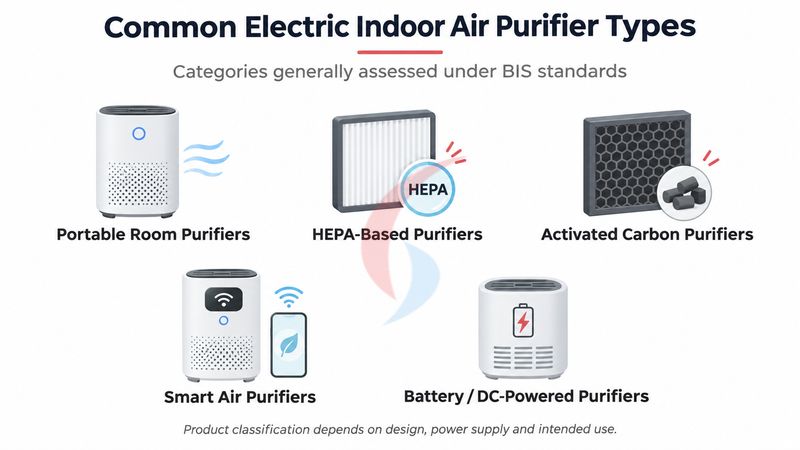
Electric indoor air purifiers are available in different sizes and technologies, from small desktop models to devices designed for larger offices. Their certification requirements depend on the product's construction, intended application, electrical characteristics and the scope of the relevant Indian Standard. Common product categories requiring assessment include portable room air purifiers, HEPA-based air purifiers, activated-carbon air purifiers, smart air purifiers with connected features, and battery-operated or DC-powered air-cleaning appliances.
Not every product marketed as an air purifier automatically falls within the exact scope of IS 17531:2021. For example, an integrated HVAC filtration system or industrial air-treatment installation may need a different classification from a standalone portable room purifier. Similarly, a separate replaceable filter and the complete electrical appliance are not necessarily regulated in the same way. Businesses should confirm the correct product category before laboratory testing or submission of a BIS application.
BIS Testing Requirements for Electric Indoor Air Purifiers
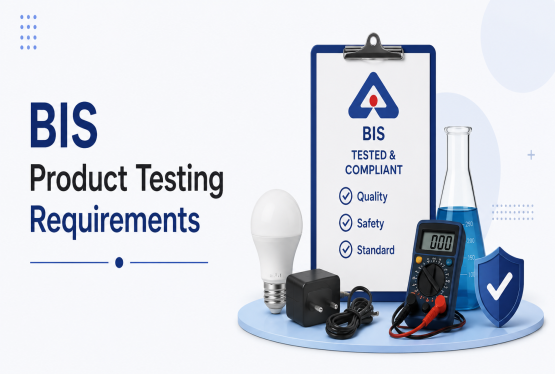
Testing is one of the most important stages of the certification process. The purpose is to determine whether the product meets the performance or safety requirements prescribed in the relevant Indian Standard.
For portable air purifiers, manufacturers should examine the test methods prescribed under IS 17531:2021. Electrical safety assessments must be carried out separately where required under IS 302 (Part 1):2024 or other applicable standards.
|
Testing parameter |
Purpose |
|
Clean Air Delivery Rate (CADR) |
Evaluates clean-air delivery under specified test conditions |
|
Particulate removal performance |
Assesses the ability to reduce specified airborne particles |
|
Airflow performance |
Examines air movement through the appliance |
|
Electrical safety |
Checks applicable protection against electrical hazards |
|
Temperature rise |
Evaluates heating of relevant components during operation |
|
Leakage current and insulation |
Assesses electrical insulation and related safety risks |
|
Noise emissions |
Evaluates operating noise where prescribed |
|
Power consumption |
Measures electrical energy use under specified conditions |
|
Construction and stability |
Evaluates relevant mechanical and constructional requirements |
|
Marking and instructions |
Checks prescribed product identification, warnings and user information |
The table is an overview of potentially relevant assessments, not a substitute for the complete clause-by-clause testing schedule. The exact tests, limits, procedures and acceptance criteria must come from the applicable standard and the current BIS product manual or certification instructions.
For example, an air purifier may have a high airflow rate but insufficient filtration performance. Another machine may provide effective air filtration while failing an applicable electrical safety test. Both performance and safety need to be evaluated according to the applicable requirements.
Documents Required for BIS Certification of Electric Indoor Air Purifiers
Proper documentation helps BIS establish the identity of the manufacturer, location of the manufacturing unit, product specifications and quality control arrangements. Incomplete or inconsistent documents may lead to additional queries or delays.
|
Document |
Purpose |
|
Company incorporation or business registration certificate |
Establishes the legal identity of the applicant |
|
Manufacturing unit address proof |
Verifies the production location |
|
Factory licence, where applicable |
Supports manufacturing establishment details |
|
Product technical specifications |
Identifies the air purifier's design and characteristics |
|
Model and brand details |
Establishes the proposed certification scope |
|
Electrical circuit diagram |
Provides information about electrical construction |
|
Product photographs and labels |
Supports product identification and marking review |
|
Machinery list |
Shows the available manufacturing facilities |
|
Testing equipment details |
Supports the manufacturer's quality control capabilities |
|
Calibration certificates |
Establishes calibration status of measuring equipment |
|
Quality control records |
Demonstrates production monitoring arrangements |
|
Laboratory test reports |
Provides evidence of conformity where required |
|
Authorisation documents |
Establishes the authority of the applicant's representative |
|
AIR documents, if applicable |
Supports foreign manufacturer representation in India |
The actual checklist may vary according to the BIS scheme, applicant category, manufacturer location and product scope. Manufacturers should use the current official checklist instead of relying entirely on a generic documentation list.
For a better understanding of certification documentation, application procedures and related expenses, read our detailed article on ISI Certification in India: Process, Documents & Fees.
Step-by-Step BIS Certification Process for Electric Indoor Air Purifiers
Step 1: Identify the Applicable Indian Standard
The manufacturer should begin by reviewing the construction and intended use of the air purifier. This includes identifying the power supply, filtration technology, model range, electrical ratings and product category.
IS 17531:2021 is the relevant portable electric indoor air purifier specification. The manufacturer must also assess applicable electrical safety obligations under the 2026 QCO. Correct classification at the beginning helps prevent unnecessary testing, incorrect applications and certification delays.
Step 2: Register on the BIS Online Portal
Manufacturers applying for Scheme I product certification can use the official BIS Manak Online Portal.
The applicant must complete the applicable registration and provide relevant manufacturer and factory details. Information regarding the business, authorised signatory and manufacturing unit should match the supporting records. BIS also provides guidance through its Manak Online applicant instructions.
Step 3: Arrange Product Testing
The manufacturer should arrange testing as prescribed under the applicable certification scheme. Testing may involve BIS-recognised laboratories, inspection-related sample collection and other assessments required by BIS. The applicable standard determines the relevant technical parameters. Test reports should accurately identify the product, model, manufacturer and testing scope. If a product fails an essential requirement, design corrections and additional testing may be necessary.
Step 4: Prepare and Submit the Application
Once the applicable documents and testing arrangements are ready, the manufacturer submits the certification application through the prescribed process. The application generally includes manufacturer information, the proposed Indian Standard, product details, manufacturing facilities, supporting technical records and applicable fees. A complete and properly prepared application reduces avoidable clarification requests.
Step 5: BIS Factory Inspection
Under the conventional Scheme I certification process, BIS may evaluate the manufacturing premises, production arrangements, testing facilities and quality control system.
The inspection helps establish whether the manufacturer can consistently produce goods that conform to the applicable Indian Standard. BIS may verify manufacturing equipment, testing infrastructure, personnel responsibilities and records relating to production quality.
For more details, read BIS Certification: What Happens During a BIS Factory Visit?.
Step 6: Review of Test Results and Application
BIS examines the submitted information and the results of applicable inspections and testing. If observations are raised, the manufacturer may need to provide clarification, correct documentation or demonstrate compliance through additional technical evidence. Certification cannot be assumed merely because the application has been submitted or testing has begun. The manufacturer must satisfy the relevant BIS requirements before receiving approval.
Step 7: Grant of BIS Licence
After satisfactory assessment, BIS may grant the relevant certification licence. The manufacturer may then use the prescribed BIS Standard Mark only on products within the approved licence scope, subject to applicable marking requirements. The approved licence normally identifies the relevant Indian Standard, manufacturing premises and permitted product scope. It should not be used to represent unapproved models or unrelated products as certified.
Step 8: Maintain Post-Certification Compliance
Obtaining a licence is not the final responsibility of the manufacturer. Certified products must continue to satisfy the applicable Indian Standard and conditions of the licence. Manufacturers should maintain inspection and testing records, address quality complaints, follow product marking requirements and seek BIS approval or scope extension when necessary. Changes in critical components, manufacturing location or product construction should be evaluated for their certification implications.
For additional guidance, see From Factory to Market: Why BIS ISI Certification Matters Before Selling.
BIS Certification Cost for Electric Indoor Air Purifiers
The cost of BIS Certification for Electric Indoor Air Purifiers cannot be determined through a single amount because it depends on the applicable Indian Standard, certification scheme, factory location, number of product varieties and testing requirements. For businesses planning certification, the budget generally includes application charges, testing costs, inspection-related expenses, applicable marking fees and ongoing compliance expenses.
|
Cost component |
Description |
|
BIS application fee |
As prescribed under the applicable scheme |
|
Product testing charges |
Depends on the standard and laboratory testing scope |
|
Factory inspection expenses |
As applicable under the BIS procedure |
|
Licence and marking fees |
As prescribed in the current BIS fee schedule |
|
Model or variety inclusion |
Depends on the approved scope and proposed changes |
|
Foreign manufacturer expenses |
May include AIR, overseas inspection and related costs |
|
Professional assistance |
Depends on the documentation and coordination services required |
Actual costs should be verified against the current BIS fee schedule rather than using estimated amounts from unrelated product categories.
The article BIS Scheme-I Marking Fees Update 2026 explains relevant updates to the Scheme I marking-fee schedule.
BIS Certification for Imported Electric Indoor Air Purifiers
Imported air purifiers may also be subject to mandatory BIS requirements when they fall within the scope of an applicable QCO. Importers should therefore verify product classification and certification requirements before placing commercial orders or making shipping arrangements. Under the Foreign Manufacturers Certification Scheme (FMCS), an eligible overseas manufacturer may apply for a BIS licence for products covered by the relevant scheme. BIS generally requires an identifiable overseas manufacturing location and compliance with the applicable Indian Standard.
Where required, the foreign manufacturer must appoint an Authorised Indian Representative (AIR) in India. The AIR supports communication and regulatory responsibilities in accordance with BIS requirements. Importantly, the manufacturer's BIS licence is distinct from a trader's or importer's ordinary business registration. A manufacturer located outside India should use the official BIS Foreign Manufacturers Certification Scheme guidance and verify product-specific eligibility.
Common Mistakes Manufacturers Should Avoid
One common mistake is assuming that all electrical appliances follow the BIS Compulsory Registration Scheme (CRS). BIS operates different schemes, including Scheme I and Scheme II, and the correct route is determined by the applicable notification and product classification. Using the wrong scheme can result in unnecessary expenses and incorrect application preparation.
Another mistake is testing only one attractive product feature while overlooking the wider requirements of the applicable standard. An air purifier's filtration performance, construction, electrical safety and product information may all be relevant. A successful marketing demonstration does not replace prescribed testing.
Manufacturers also sometimes overlook certification scope when introducing new models. Changes involving the motor, power supply, important electrical components or design may affect conformity. Before expanding a product line, the manufacturer should determine whether a new application, additional testing or licence-scope amendment is necessary.
Small manufacturers should also avoid assuming that MSME registration provides a permanent exemption from BIS requirements. Special implementation periods and fee concessions apply only when supported by the relevant notification or scheme.
The related article BIS Certification for Small Manufacturers and MSMEs explains these considerations in greater detail.
Why Choose Compliance Calendar LLP for BIS Certification of Electric Indoor Air Purifiers?
Obtaining BIS Certification for Electric Indoor Air Purifiers involves understanding the applicable Indian Standards, preparing technical documents, coordinating product testing and completing the required certification procedures. Compliance Calendar LLP provides professional assistance to manufacturers, importers and businesses seeking BIS certification in India.
Our team helps with product classification, documentation, BIS application filing, laboratory testing coordination and compliance-related queries. We focus on simplifying the certification process, reducing avoidable documentation errors and helping businesses meet applicable regulatory requirements. Whether you are an Indian manufacturer or a foreign company planning to enter the Indian market, Compliance Calendar LLP can guide you through the relevant BIS certification requirements.
For assistance, contact +91 9988424211 or info@ccoffice.in
Frequently Asked Questions
Q1. What is the BIS standard for electric indoor air purifiers in India?
Ans. IS 17531:2021 is the Indian Standard for portable electric indoor air purifiers. It provides product specifications relevant to air-cleaning performance and associated technical characteristics. Manufacturers must also check applicable electrical safety standards and government notifications.
Q2. Is BIS Certification mandatory for electric indoor air purifiers in 2026?
Ans. Covered air-cleaning appliances are subject to the 2026 household and commercial electrical appliance safety QCO, with implementation dates depending on manufacturer category. The separate proposed QCO referring specifically to IS 17531:2021 should not be treated as enforced without verification of a final notification.
Q3. What is the BIS certification process for air purifiers?
Ans. The process generally involves identifying the applicable standard, selecting the correct certification scheme, preparing technical documents, arranging required testing, submitting the application and completing any prescribed factory assessment. BIS grants a licence after satisfactory evaluation.
Q4. Can foreign manufacturers obtain BIS Certification for air purifiers?
Ans. Yes, eligible foreign manufacturers can seek BIS product certification through the applicable route, including FMCS where appropriate. They must comply with the relevant Indian Standard, documentation requirements, inspection conditions and AIR requirements.
Q5. How much does BIS Certification for electric air purifiers cost?
Ans. The total expense depends on testing requirements, applicable BIS fees, manufacturing location, product models and certification route. There is no single universal fee for all air purifiers. Applicants should check the current BIS fee schedule before budgeting.
Q6. Is BIS CRS Registration required for indoor air purifiers?
Ans. Not automatically. Certification requirements must be determined from the applicable product standard and government order. The 2026 electrical appliance safety QCO prescribes Scheme I for covered products, rather than treating them as ordinary CRS products.
Q7. Can an air purifier be imported without BIS Certification?
Ans. Where an applicable QCO makes BIS certification mandatory, imported products must meet the prescribed requirements unless a specific exemption applies. Importers should verify the product's certification status, implementation date and any relevant exemptions before shipment.
Q8. Does every air purifier model need a separate BIS licence?
Ans. Not necessarily. The approved licence scope and relevant product grouping rules determine whether additional models can be included. Manufacturers should seek clarification or approval when introducing designs that differ from existing certified models.
Q9. What happens if an air purifier fails BIS testing?
Ans. The manufacturer may need to investigate the failure, correct the product design or production process, and arrange additional testing as required. Certification is granted only when the applicable conformity requirements have been satisfactorily met.
Q10. How can a customer verify BIS certification of an air purifier?
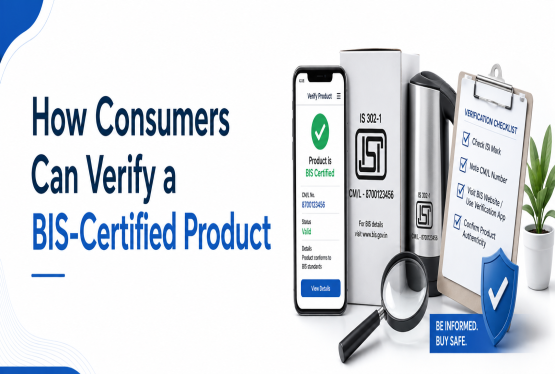
Ans. Customers can check the BIS licence number and relevant product information through official BIS verification services. They should confirm the manufacturer, licence status, applicable Indian Standard and whether the particular product falls within the approved scope.
Article last updated on : 20 Nov 2026.