


Imagine a hospital in Delhi during a sudden power failure. The regular lights go off, patients are being moved between departments, and medical staff need to reach emergency exits without delay. Within seconds, the emergency lighting system is expected to illuminate the corridors, staircases and evacuation routes. If these lights fail to operate, the situation can quickly become dangerous. This is why emergency lighting products cannot be treated in the same way as ordinary decorative or household lights. Their performance and electrical safety become particularly important during power failures and other emergencies. For manufacturers and importers in India, ensuring regulatory compliance is therefore a crucial part of bringing these products to market.
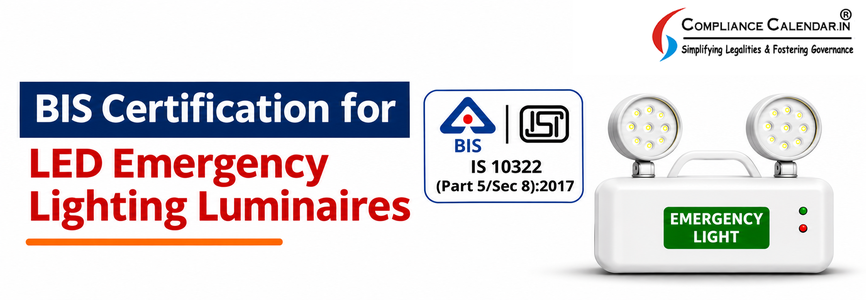
BIS Certification for LED Emergency Lighting Luminaires is mandatory for products covered under the notified category of the Bureau of Indian Standards (BIS) Compulsory Registration Scheme (CRS). Manufacturers must ensure that their products comply with the applicable Indian Standard and obtain the necessary registration before supplying them commercially in India. The requirements have become especially relevant in 2026 because BIS has revised the Indian Standard applicable to emergency lighting luminaires. The transition from IS 10322 (Part 5/Sec 8):2013 to IS 10322 (Part 5/Sec 8):2026 introduces updated requirements concerning emergency lighting systems, batteries, electrical safety and product testing.
LED Luminaires for Emergency Lighting are listed under the BIS Compulsory Registration Scheme product list.
What Are LED Emergency Lighting Luminaires?
LED emergency lighting luminaires are lighting fixtures designed to provide illumination when the normal electrical supply fails or when emergency operating conditions arise. These products use LED technology and may incorporate batteries, charging circuits, control equipment and switching arrangements to maintain illumination during a power interruption. Unlike ordinary lighting fixtures, emergency luminaires have an additional responsibility. They must operate in accordance with their intended emergency function when the normal lighting system cannot provide sufficient illumination. Their reliability can directly affect people's ability to move safely through buildings.
For example, a shopping mall may install emergency luminaires near staircases, exits and important passageways. During normal operations, some luminaires may remain illuminated, while others may activate when the regular electrical supply is interrupted. The configuration depends on the product's design and its intended emergency-lighting function.
Different emergency lighting products may have different technical arrangements. Some are self-contained and include their own energy storage, while others operate through a central emergency power system. Certain models are designed for maintained operation, whereas others operate primarily during emergency conditions.
Why Is BIS Certification Mandatory for LED Emergency Lighting Luminaires?
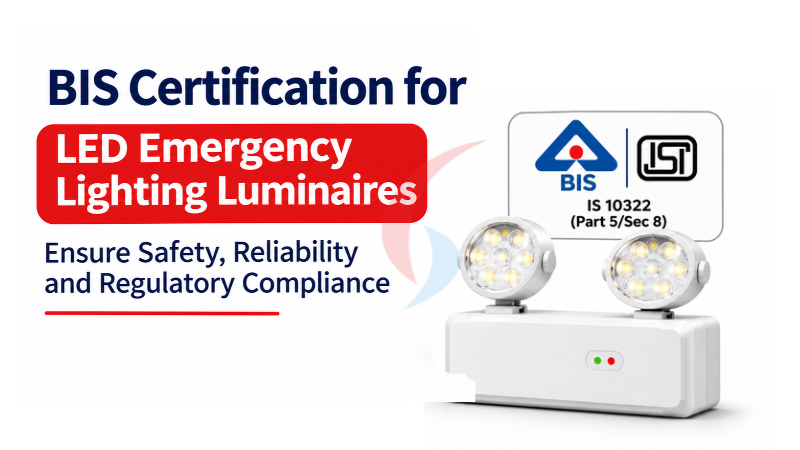
BIS Certification for LED Emergency Lighting Luminaires is mandatory because the product category is specifically notified under India's Compulsory Registration Scheme. The requirement was introduced through the relevant Electronics and Information Technology Goods compulsory registration provisions and continues under the applicable 2021 order, as amended.
The legal basis includes the Bureau of Indian Standards Act, 2016, the BIS (Conformity Assessment) Regulations, 2018, as amended, and the applicable compulsory registration order. The purpose of mandatory registration is to require manufacturers of notified products to demonstrate conformity with Indian Standards. Under Scheme II, manufacturers submit products for testing at BIS-recognised laboratories and apply for registration with the required supporting documentation. For emergency lighting products, this is particularly important because ordinary users cannot easily identify internal electrical defects, battery problems or inadequate insulation merely by looking at the product. Official Government Reference: Manufacturers can examine the BIS Act, Rules and Regulations alongside the official notified products list to understand the legal basis for compulsory registration.
Businesses dealing with related LED products can also explore the BIS CRS Registration in India service page for an overview of registration requirements, documentation and certification procedures.
Applicable BIS Standard for LED Emergency Lighting Luminaires
The applicable Indian Standard is IS 10322 (Part 5/Sec 8), which covers particular requirements for luminaires intended for emergency lighting. Previously, LED emergency lighting luminaires were covered under IS 10322 (Part 5/Sec 8):2013. In 2026, BIS introduced a revised edition, IS 10322 (Part 5/Sec 8):2026, aligned with the corresponding IEC 60598-2-22 requirements. The revised standard must be considered alongside the relevant general luminaire safety requirements under IS 10322 (Part 1):2026. Both the particular and general requirements are important for determining product conformity.
|
Particulars |
Details |
|
Product category |
LED Luminaires for Emergency Lighting |
|
Certification scheme |
BIS Compulsory Registration Scheme (CRS) |
|
Earlier Indian Standard |
IS 10322 (Part 5/Sec 8):2013 |
|
Revised Indian Standard |
IS 10322 (Part 5/Sec 8):2026 |
|
International reference |
IEC 60598-2-22 |
|
General safety standard |
IS 10322 (Part 1):2026 |
|
Regulating authority |
Bureau of Indian Standards |
|
Responsible ministry |
Ministry of Electronics and Information Technology (MeitY) |
|
Original mandatory registration date |
23 May 2018 |
|
Revised standard transition deadline |
2 February 2027 |
The official BIS standard dashboard lists both the earlier and revised editions. The revised edition's test report format is also available through BIS's recognised laboratory documentation system.
Why Does the 2026 Standard Revision Matter?
The revised requirements reflect developments in emergency lighting technology, particularly the use of modern batteries and energy storage systems. Manufacturers need to consider the safety characteristics of the luminaire as a complete system rather than focusing exclusively on the LED light source.
For example, an emergency luminaire may contain a lithium-based rechargeable battery, an electronic charging circuit and an automatic switching arrangement. The manufacturer must examine the interaction between these components and the applicable safety requirements. The revisions also make it important to review thermal performance, battery-related provisions, applicable emergency operating functions and electrical protection. BIS Update: Refer to the official Guidelines for Implementation of Revised Standards for LED Luminaires, dated 20 March 2026 for the applicable changeover requirements.
Manufacturers interested in the broader revision of Indian lighting standards can read Compliance Calendar LLP's BIS LED Luminaire Standards Update.
Who Needs BIS CRS Registration for LED Emergency Lighting Luminaires?
BIS registration is primarily issued to the actual manufacturer of the notified product. This means that businesses manufacturing LED emergency lighting luminaires in India must obtain registration covering their relevant manufacturing unit, brand and product scope.
-
Indian manufacturers must provide accurate factory details and ensure that the products submitted for testing represent the models intended for commercial sale. Registration associated with one manufacturing facility should not automatically be treated as covering another production location.
-
Foreign manufacturers exporting emergency luminaires to India are also required to comply with the applicable compulsory registration requirements. They generally appoint an Authorised Indian Representative (AIR), where required, to fulfil prescribed responsibilities and coordinate with BIS.
-
Importers, distributors and private-label businesses should verify that their suppliers hold valid BIS registration covering the products being supplied. An importer cannot automatically rely on a registration belonging to an unrelated manufacturer or a different brand.
-
For instance, suppose an Indian company imports LED emergency lights manufactured by a Chinese factory and markets them under its own trademark. The overseas factory must have appropriate registration covering the relevant brand and product scope. The Indian importer should verify these details before arranging commercial shipments.
Documents Required for BIS Certification for LED Emergency Lighting Luminaires
Documentation is an important part of the BIS CRS registration process. The documents establish the manufacturer's identity, the manufacturing location, the product's technical characteristics and its conformity with the applicable standard. A manufacturer should prepare the following documents according to the current BIS application instructions.
|
Required document |
Purpose |
|
Certificate of Incorporation or business registration |
Establishes the applicant's legal identity |
|
Factory address proof |
Confirms the manufacturing location |
|
Manufacturing unit information |
Identifies the actual product manufacturer |
|
Brand registration or authorisation |
Supports the brand declared in the application |
|
Product specifications |
Describes the luminaire and its electrical ratings |
|
Circuit diagrams |
Explains the electronic and electrical design |
|
Battery specifications |
Provides information about the energy storage system |
|
Electronic controlgear details |
Identifies relevant control components |
|
Product photographs and marking artwork |
Establishes product identification and proposed labelling |
|
BIS-recognised laboratory test report |
Provides evidence of conformity |
|
Authorised signatory details |
Identifies the application representative |
|
AIR nomination documents, if applicable |
Supports foreign manufacturer representation |
|
Prescribed undertaking and declarations |
Confirms compliance with BIS requirements |
Additional information may be necessary depending on the product's construction, testing arrangements and model-grouping requirements.
For example, a manufacturer offering emergency lights with different battery types or capacities should carefully examine the applicable grouping guidelines before assuming that all variants can be covered through one representative sample.
Step-by-Step BIS Certification Process for LED Emergency Lighting Luminaires
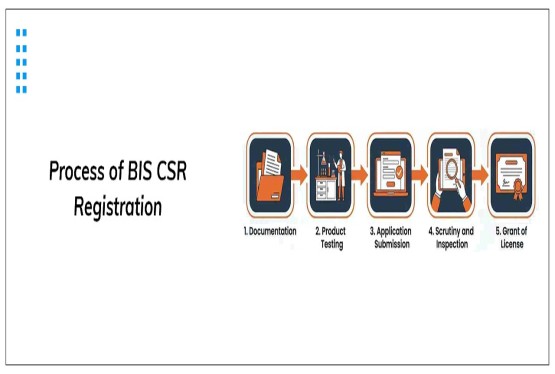
The BIS registration process involves product classification, laboratory testing, preparation of supporting documentation and formal registration approval. Manufacturers should begin the process before scheduling large-scale production or commercial imports.
Step 1: Identify the Applicable Indian Standard
The manufacturer must first confirm that the product falls under the LED Luminaires for Emergency Lighting category. Its construction, energy storage system, emergency operating function and electrical characteristics must be examined against IS 10322 (Part 5/Sec 8). The applicable 2026 transition guidelines should also be reviewed before choosing the standard edition for testing.
Step 2: Select a BIS-Recognised Laboratory
Manufacturers must select a laboratory recognised by BIS for the applicable standard. A laboratory recognised for other LED products may not necessarily have the testing scope required for emergency lighting luminaires. The laboratory's current recognition and testing scope can be checked through the official BIS Laboratory Information Management System.
Step 3: Submit Samples for Testing
Representative product samples must be submitted to the laboratory along with the required technical documentation. The laboratory evaluates the product against applicable safety requirements. If the samples fail any mandatory requirement, the manufacturer may need to modify the product and undertake further testing.
Step 4: Prepare the Registration Application
After receiving a satisfactory test report, the manufacturer prepares the online application with factory information, brand details, product specifications, relevant authorisations and prescribed declarations. All information should be consistent with the laboratory test report and other supporting documents.
Step 5: Submit the Application and Pay Fees
The application is submitted through the official BIS CRS registration portal along with the prescribed government fees. BIS examines the application and may request clarifications or corrections before granting registration.
Step 6: Obtain BIS Registration
Following satisfactory scrutiny, BIS grants registration covering the applicable manufacturing unit, product category, brand and approved scope. The manufacturer must thereafter comply with the prescribed Standard Mark, product identification and ongoing registration requirements.
Official Application Guidance: Manufacturers should consult the BIS CRS Application Procedure before submitting an application.
What Safety Tests Are Required for LED Emergency Lighting Luminaires?
Emergency lighting luminaires are expected to function safely under their prescribed operating conditions, including relevant emergency modes. Therefore, laboratory testing examines more than the LED light source itself. The applicable standard addresses the safety of components, insulation, wiring, mechanical construction, batteries and emergency operating arrangements. The exact tests depend on the product design and classification.
|
Testing area |
Purpose |
|
Electric strength |
Evaluates insulation under prescribed electrical stress |
|
Insulation resistance |
Verifies the effectiveness of electrical insulation |
|
Protection against electric shock |
Assesses safeguards against accessible hazardous live parts |
|
Temperature and endurance |
Evaluates safety during specified operating conditions |
|
Battery-related requirements |
Assesses applicable energy storage and charging provisions |
|
Emergency operating performance |
Evaluates relevant emergency-mode functions |
|
Mechanical strength |
Examines resistance to prescribed mechanical stresses |
|
Wiring and terminals |
Checks the safety of electrical connections |
|
Creepage distances and clearances |
Evaluates required electrical separation |
|
Heat and fire resistance |
Checks applicable material safety requirements |
|
Marking |
Verifies required identification and safety information |
The official BIS-recognised laboratory scope for IS 10322 (Part 5/Sec 8):2026 includes testing areas such as marking, electric shock protection, terminals, wiring, electrical clearances, thermal performance and insulation.
Why Are Battery Requirements Particularly Important?
Many modern emergency luminaires contain rechargeable batteries that supply electricity during a power interruption. Their performance can influence whether the light operates when it is needed.
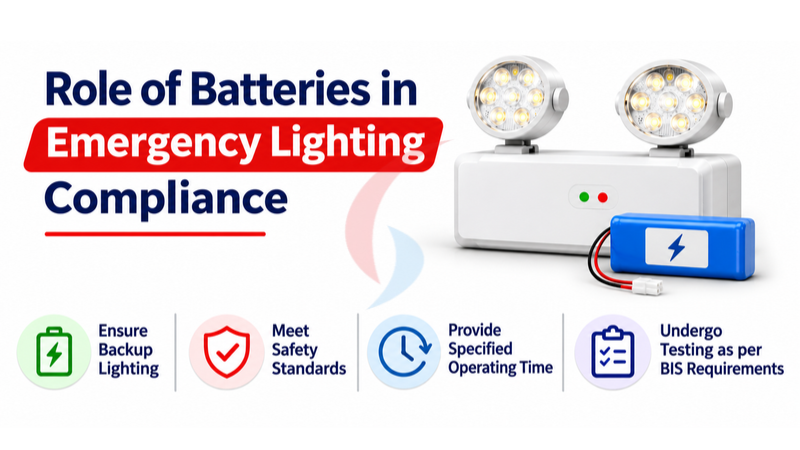
For example, a rechargeable emergency luminaire may function normally during testing but develop problems if its battery management circuit is unsuitable or the battery experiences excessive heating. This makes the interaction between the battery, charging circuitry and luminaire construction an important part of design evaluation.
The revised 2026 requirements introduce changes concerning lithium batteries and Electric Double Layer Capacitors (EDLCs), along with related technical provisions. Manufacturers using these components should examine the relevant clauses carefully. Separate compulsory registration requirements may also apply to certain batteries or electronic components. The final luminaire's BIS registration does not automatically replace any independent component-level obligation.
BIS Marking and Labelling Requirements
After BIS registration is granted, the manufacturer must apply the prescribed CRS Standard Mark and registration number in accordance with the applicable marking requirements. Depending on the product and standard, additional marking information may include manufacturer identification, model designation, electrical ratings, emergency operating classification and relevant safety instructions. The marking must be clear and applied in the prescribed manner. Businesses should ensure that registration details are accurate and that the marked products fall within the approved scope.
For example, where a manufacturer produces several emergency luminaire models with different electrical characteristics, it should confirm that each model is appropriately covered before using the same registration details.
Can Multiple LED Emergency Lighting Models Be Covered Under One Registration?
Yes, eligible models may be grouped for registration purposes, subject to applicable BIS series guidelines and testing requirements.
However, the grouping rules for emergency lighting luminaires specifically consider several technical parameters, including the class of construction, relevant electronic controlgear, input voltage, enclosure material, battery type, battery nominal voltage and battery capacity. These factors are particularly important because emergency lighting products may use different energy storage arrangements.
For example, a manufacturer producing two emergency luminaires with the same enclosure but different battery capacities should not assume that both can automatically be covered under identical testing arrangements. The applicable series guidelines must be examined before deciding how the models should be tested and included.
Official BIS Reference: The BIS Series Guidelines for Compulsory Registration contain product-specific grouping provisions for LED Luminaires for Emergency Lighting under Item No. 37.
BIS Certification Fees for LED Emergency Lighting Luminaires
The total cost of BIS Certification for LED Emergency Lighting Luminaires consists of the applicable government charges, laboratory testing expenses and other costs associated with the application. Under the revised 2026 Scheme II provisions, government charges depend on the applicant's eligibility and current fee schedule. For a standard large-enterprise application, the published structure includes an application fee of Rs 1,000, a processing fee of Rs 25,000 and an annual licence fee of Rs 1,000, subject to applicable concessions, taxes and conditions.
Laboratory testing fees are separate and may vary significantly depending on the testing scope, product complexity and recognised laboratory.
|
Fee component |
Cost considerations |
|
BIS application fee |
Prescribed government fee |
|
Processing fee |
Applicable Scheme II charge |
|
Annual licence fee |
Payable under current provisions |
|
Product testing |
Depends on laboratory and standard |
|
Additional model testing |
Based on grouping and technical differences |
|
Professional assistance |
Separate, where engaged |
|
Foreign manufacturer requirements |
May involve additional authorised representation and documentation costs |
The official BIS laboratory system lists different testing fees for IS 10322 (Part 5/Sec 8):2026. Manufacturers should request a current quotation and verify the laboratory's recognition scope before finalising their compliance budget.
Latest BIS Certification Updates for LED Emergency Lighting Luminaires in 2026
Several regulatory developments in 2026 are particularly important for manufacturers, importers and existing BIS registration holders.
1. Revision of IS 10322 (Part 5/Sec 8)
BIS introduced IS 10322 (Part 5/Sec 8):2026 to replace the earlier 2013 edition. The revised standard covers particular requirements for emergency lighting luminaires and includes changes relevant to batteries, electrical safety and emergency operating functions. Manufacturers should assess their existing product designs and testing records against the revised requirements.
2. Implementation Guidelines Issued on 20 March 2026
BIS published formal guidelines explaining how existing licensees, new applicants and manufacturers seeking changes in registration scope should transition to the revised LED luminaire standards. The guidelines address applicable testing and documentation requirements, including arrangements for demonstrating conformity with the revised standard.
3. Implementation Deadline Extended to 2 February 2027
The original implementation guidelines specified 2 August 2026 as the end of the concurrent-running period. BIS subsequently issued an extension notice, listed on 5 August 2026, extending the deadline to 2 February 2027 for the specified LED luminaire categories. The extended period provides additional time for completing necessary testing and registration transition formalities. It does not remove the existing obligation to maintain mandatory BIS registration for covered emergency lighting products.
4. Revised CRS Registration Validity and Annual Compliance
The 2026 amendments to the BIS conformity assessment provisions also changed aspects of registration validity, renewal and annual fee payment. The amended provisions allow registration for periods of up to five years, subject to the applicable conditions. Manufacturers must continue to comply with prescribed annual payment, production reporting and conformity requirements.
Important BIS Compliance Update 2026: Manufacturers holding registration under IS 10322 (Part 5/Sec 8):2013 should review the requirements for transition to the 2026 edition before 2 February 2027, unless BIS issues a further extension. The official BIS Circulars and Notifications page includes both the March 2026 implementation guidelines and the August 2026 extension notice.
What Happens If LED Emergency Lighting Luminaires Are Sold Without BIS Certification?
Manufacturing, importing or selling covered LED emergency lighting luminaires without the required BIS registration may lead to regulatory action under the BIS Act, 2016 and the applicable compulsory registration provisions. Depending on the nature of the violation, enforcement action may involve seizure of non-compliant goods, restrictions on sale, prosecution or applicable statutory penalties. Importers may also encounter customs clearance difficulties when the products do not satisfy mandatory certification requirements.
For businesses supplying emergency lighting systems to hospitals, hotels, factories or infrastructure projects, non-compliance can also create commercial problems. Institutional buyers may require evidence of valid BIS registration before accepting products. Businesses should therefore verify certification status before commercial supply rather than relying entirely on supplier declarations or overseas testing documents.
Common Mistakes Manufacturers Should Avoid
One common mistake is confusing ordinary LED luminaires with emergency lighting luminaires. Although both products use LED technology, their intended purposes and applicable Indian Standards can differ substantially. Manufacturers should identify the proper product classification before submitting samples for testing.
Another mistake is overlooking battery specifications when preparing the registration application. Emergency lighting products may have several variants, and differences in battery chemistry, nominal voltage or capacity can affect the permitted model grouping. Manufacturers sometimes also choose testing laboratories without verifying their current recognition for the applicable standard. Incomplete factory documentation, inconsistent brand details and incorrect product markings may further delay applications.
Why Choose Compliance Calendar LLP for BIS Certification?
Obtaining BIS Certification for LED Emergency Lighting Luminaires requires an understanding of Indian Standards, laboratory testing, product classification, technical documentation and current regulatory procedures.
Compliance Calendar LLP provides professional assistance with BIS CRS Registration in India, including application documentation, coordination with BIS-recognised laboratories, product classification and regulatory compliance support. Manufacturers, foreign suppliers, importers and businesses introducing new emergency lighting products can seek guidance on BIS registration, testing documentation, additional model inclusion and compliance with revised standards.
For assistance, contact Compliance Calendar LLP at +91 9988424211 or info@ccoffice.in
Frequently Asked Questions (FAQs)
Q1. Is BIS Certification mandatory for LED Emergency Lighting Luminaires in India?
Ans. Yes. LED Luminaires for Emergency Lighting are included under the BIS Compulsory Registration Scheme. The mandatory registration requirement became effective on 23 May 2018. Manufacturers must obtain the required registration for covered products before commercially supplying them in India.
Q2. Which Indian Standard applies to LED Emergency Lighting Luminaires?
Ans. The applicable product standard is IS 10322 (Part 5/Sec 8). The earlier edition was published in 2013, while the revised standard was introduced in 2026. Manufacturers must comply with the applicable edition and relevant BIS transition instructions.
Q3. What is the latest BIS update for LED Emergency Lighting Luminaires in 2026?
Ans. BIS revised the applicable Indian Standard to IS 10322 (Part 5/Sec 8):2026. It also issued implementation guidelines and subsequently extended the concurrent-running deadline to 2 February 2027 for the specified LED luminaire standards.
Q4. Can foreign manufacturers obtain BIS CRS Registration?
Ans. Yes. Foreign manufacturers producing covered LED emergency lighting luminaires for the Indian market can apply for BIS registration. They must satisfy the applicable testing, documentation and Authorised Indian Representative requirements.
Q5. What documents are required for BIS Certification?
Ans. Common requirements include factory details, business registration information, product specifications, technical diagrams, battery information, brand documents and a satisfactory test report from a BIS-recognised laboratory. Foreign manufacturers may require additional AIR documentation.
Q6. How much does BIS Certification for LED Emergency Lighting Luminaires cost?
Ans. The total cost depends on the applicable BIS government fees, laboratory testing expenses, number of models and other documentation requirements. Businesses should obtain a current quotation and verify the latest government fee schedule before budgeting.
Q7. How long does BIS CRS Registration take?
Ans. The duration depends on laboratory testing, application completeness and BIS scrutiny. Manufacturers requiring additional testing or corrections may experience longer processing times. Beginning certification during product development can help reduce avoidable delays.
Q8. Can multiple LED emergency lighting models be covered under one registration?
Ans. Multiple eligible models may be included under a registration subject to applicable BIS grouping requirements. Important factors include enclosure material, construction class, input voltage, battery type, nominal battery voltage and capacity.
Q9. Are lithium battery-powered LED emergency luminaires covered under BIS requirements?
Ans. LED emergency lighting luminaires falling within the notified product category require BIS CRS registration regardless of whether they use lithium batteries or another permitted energy storage arrangement. Their specific design and components must satisfy the applicable technical requirements.
Q10. What happens if emergency lighting luminaires are sold without BIS registration?
Ans. Manufacturing, importing or selling notified products without complying with compulsory registration requirements can result in regulatory action under applicable Indian law. Businesses may face product restrictions, enforcement proceedings and commercial difficulties.
Article last updated on : 20 Nov 2026.