


India has a strong international market for agricultural and processed food products, including rice, fruits, vegetables, cereals, honey, processed foods and various other commodities. Many businesses want to explore these opportunities but do not own a farm, factory or food-processing unit. Instead, they purchase products from Indian manufacturers or suppliers and sell them to customers in foreign countries.
Consider a trader in Delhi who receives an order for 20 tonnes of processed food products from a buyer in Dubai. The trader has reliable Indian suppliers and a valid Import Export Code (IEC), but the overseas buyer asks for details of the exporter's registration with the Agricultural and Processed Food Products Export Development Authority (APEDA).
The trader initially assumes that APEDA registration is available only to manufacturers. However, merchant exporters can also obtain APEDA Registration when they deal in eligible scheduled products, even if they do not manufacture the goods themselves.
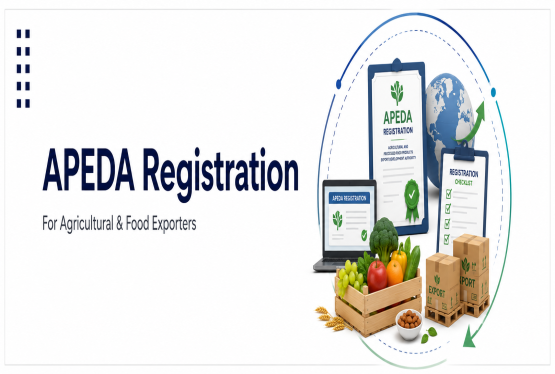
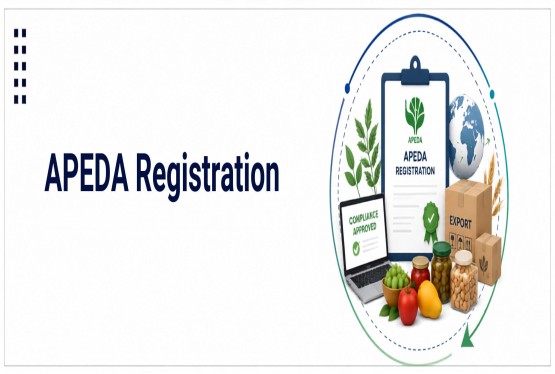
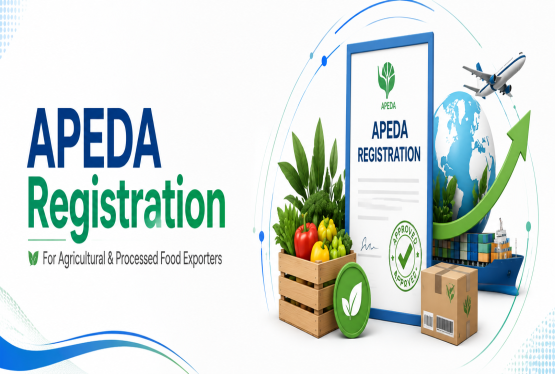
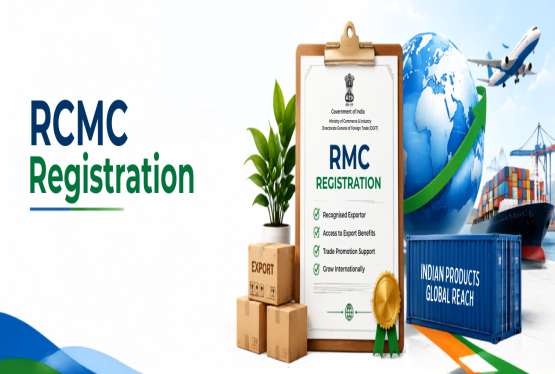
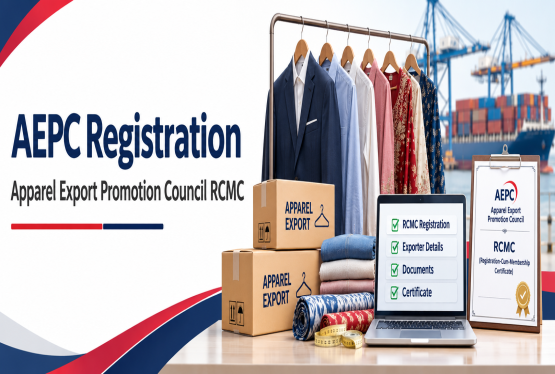
APEDA Registration for Merchant Exporters helps qualifying businesses establish their registration with the relevant export development authority and obtain a Registration-cum-Membership Certificate (RCMC Registration). It can also support access to export promotion activities and applicable government schemes.
What is APEDA Registration for Merchant Exporters?
The Agricultural and Processed Food Products Export Development Authority (APEDA) is a statutory authority established under the Agricultural and Processed Food Products Export Development Authority Act, 1985. APEDA works under the Ministry of Commerce and Industry, Government of India. Its responsibilities include registration of exporters dealing in scheduled products, export promotion, quality improvement, market development and other activities specified under the Act.
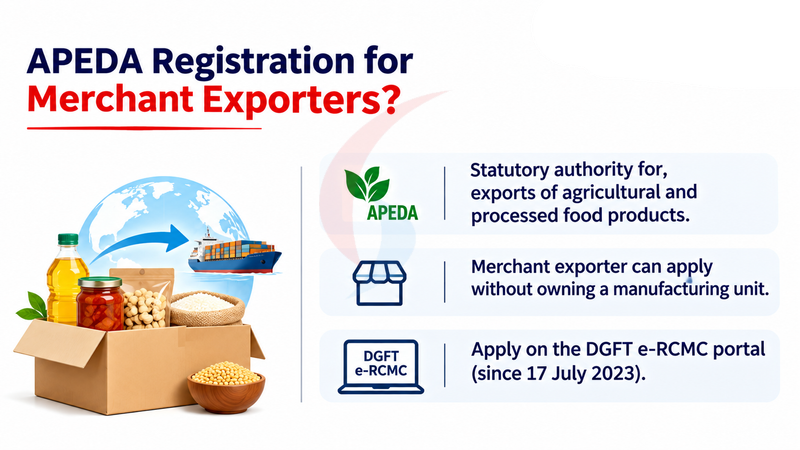
A merchant exporter is a business that purchases goods from manufacturers, farmers, processors or other suppliers and exports those goods to overseas customers. Unlike a manufacturer exporter, a merchant exporter does not necessarily operate its own production facility. For example, a company may purchase packaged food products from a licensed manufacturer in Gujarat and export them under a commercial agreement to customers in the United Arab Emirates.
APEDA has used the DGFT e-RCMC portal for issuing its Registration-cum-Membership Certificates since 17 July 2023. Therefore, new applicants should use the current DGFT online facility rather than relying on outdated standalone APEDA registration instructions.
For further guidance, read our article on How to Apply for APEDA Registration Online, which explains the electronic application procedure.
Who is Eligible for APEDA Registration as a Merchant Exporter?
APEDA Registration is available to eligible businesses exporting products covered by the APEDA Act and its schedules. The applicant does not necessarily need to manufacture the products. A proprietorship, partnership firm, LLP, private limited company or another legally eligible business may seek registration, provided it meets the applicable requirements.
The exporter must generally have a valid IEC issued by the Directorate General of Foreign Trade (DGFT). The product being exported should also fall within APEDA's jurisdiction.
For instance, a Delhi-based trading firm purchasing processed food products from manufacturers in Punjab may qualify for merchant exporter registration. Similarly, an Indian exporter sourcing fresh fruits from farmers and supplying them to overseas supermarkets may be eligible, subject to relevant product-specific requirements.
Difference Between Merchant Exporter and Manufacturer Exporter
Merchant exporters and manufacturer exporters may deal in the same agricultural or processed food products, but their business activities and registration documentation differ.
|
Particulars |
Merchant Exporter |
Manufacturer Exporter |
|
Business Activity |
Purchases products from suppliers for export. |
Manufactures or processes products for export. |
|
Own Manufacturing Unit |
Generally not required. |
Operates or controls relevant manufacturing activities. |
|
APEDA Registration |
Available for eligible scheduled products. |
Available for eligible scheduled products. |
|
Principal Registration Document |
Signed and sealed IEC copy, as prescribed. |
IEC and applicable manufacturing proof. |
|
Product Quality Responsibility |
Must ensure exported goods satisfy applicable requirements. |
Must ensure production and exported goods satisfy applicable requirements. |
|
Export Documentation |
Maintains supplier, purchase, shipping and commercial records. |
Maintains relevant manufacturing, quality and shipping records. |
APEDA's published e-RCMC procedure specifically distinguishes merchant exporters from manufacturers and manufacturer-cum-merchant exporters. this distinction is useful for small businesses because they can enter international markets without investing immediately in factories or extensive production infrastructure.
Products Covered Under APEDA Registration
APEDA's statutory jurisdiction covers several agricultural and processed food product groups. The correct product classification is important because some commodities fall within the jurisdiction of other export promotion authorities.
|
APEDA Product Category |
Examples |
|
Fruits and Vegetables |
Fresh produce and specified processed products |
|
Cereals and Cereal Products |
Rice and other eligible cereal products |
|
Processed Foods |
Biscuits, confectionery and bakery products |
|
Meat and Poultry Products |
Specified meat and poultry products |
|
Dairy Products |
Eligible milk-based products |
|
Honey, Jaggery and Sugar Products |
Specified honey and sugar-related products |
|
Groundnuts and Other Nuts |
Groundnuts, peanuts, walnuts and covered cashew products |
|
Pickles, Papads and Chutneys |
Processed and packaged food products |
|
Floriculture Products |
Flowers, plants and specified related products |
|
Other Scheduled Products |
Guar gum, cocoa products and other notified commodities |
Basmati rice is specifically included in the Second Schedule of the APEDA Act. Certain products may also be subject to additional export procedures, including contract registration, inspection, certification or traceability requirements. Merchant exporters should verify the relevant ITC(HS) classification and APEDA product coverage before applying.
Laws and Legal Provisions Governing APEDA Registration
APEDA Registration is governed by the APEDA Act, the applicable registration rules and India's foreign trade legislation.
|
Applicable Act or Rules |
Important Provisions |
Legal Requirements |
|
Sections 10, 12 and 13 |
Covers APEDA functions, exporter registration and registration procedures. |
|
|
Applicable exporter registration provisions |
Governs registration conditions, certificates and related procedures. |
|
|
Sections 3, 5 and 7 |
Governs foreign trade regulation, policy and IEC requirements. |
|
|
Paragraphs 2.56 and 2.57 |
Addresses Export Promotion Councils and RCMC requirements, including applicable exemptions. |
|
|
Relevant e-RCMC provisions |
Governs prescribed application and registration procedures. |
|
|
Applicable provisions |
Governs food safety licensing and compliance where relevant. |
Section 12 of the APEDA Act, 1985
Section 12 provides for the registration of persons exporting scheduled products. Its text generally requires an exporter to apply for registration within one month of undertaking the relevant export, subject to the statutory provisions and the authority's power to extend the period for sufficient reason.
The statutory registration provision must be read alongside the current Foreign Trade Policy, product-specific export requirements and the September 2026 RCMC exemption. For regular commercial exports, obtaining the applicable registration before shipment can help avoid documentation difficulties.
Documents Required for APEDA Registration for Merchant Exporters
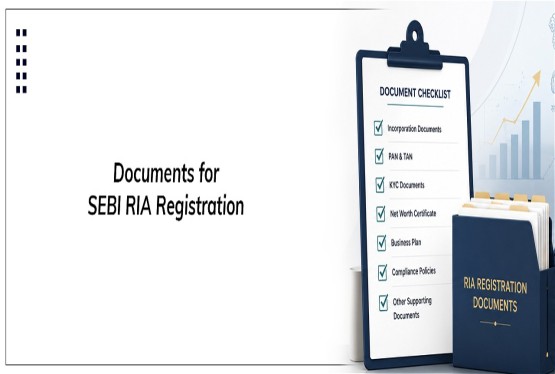
The documentation requirements for merchant exporters are generally simpler than those applicable to manufacturers. APEDA's published e-RCMC procedure identifies a signed and sealed copy of the IEC issued by DGFT as the principal prescribed document for a merchant exporter. The online application also requires relevant business information. Applicants should therefore keep their business identification and contact records available.
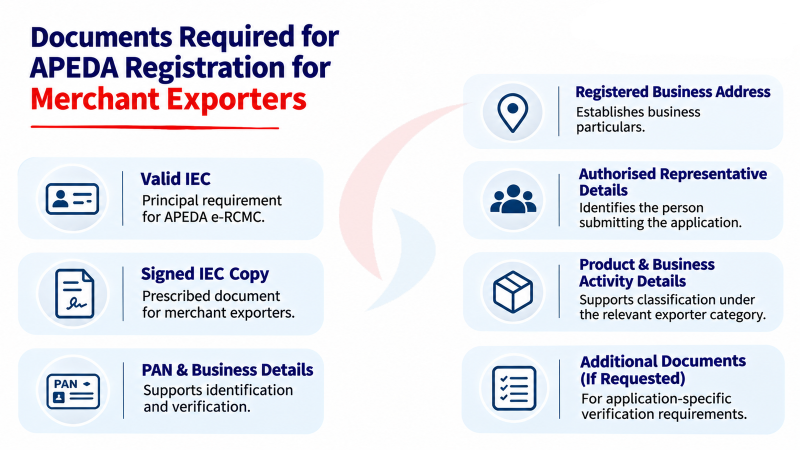
|
Document or Information |
Purpose |
|
Valid Import Export Code (IEC) |
Principal requirement for APEDA e-RCMC registration. |
|
Signed and Sealed IEC Copy |
Prescribed document for merchant exporters. |
|
PAN and Business Details |
Supports identification and verification through DGFT records. |
|
Registered Business Address |
Establishes the applicant's business particulars. |
|
Authorised Representative Details |
Identifies the person submitting the application. |
|
Product and Business Activity Details |
Supports classification under the relevant exporter category. |
|
Additional Documents, If Requested |
Addresses application-specific verification requirements. |
A manufacturer exporter may need to provide additional manufacturing proof such as an applicable FSSAI, Udyam or other relevant certificate, depending on the product category. A merchant exporter should not automatically be told that factory ownership documents, manufacturing licences or plant photographs are mandatory for its basic APEDA RCMC application. Separate food safety or shipment-specific documents may nevertheless be required for the actual export activity.
For a detailed checklist, read Which Documents Are Required for APEDA Registration?.
APEDA Registration Process for Merchant Exporters in 2026
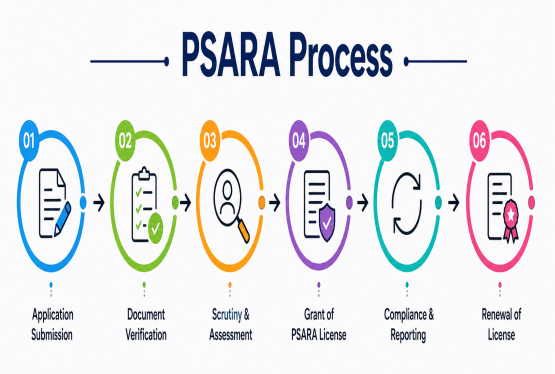
The registration process is conducted online through DGFT's e-RCMC facility. The applicant must first obtain an IEC and ensure that the relevant business information is correct.
|
Step |
Particular |
Registration Procedure |
|
Step 1 |
Obtain IEC |
Apply for a valid Import Export Code through DGFT. |
|
Step 2 |
Access DGFT Portal |
Log in at the official DGFT website. |
|
Step 3 |
Select e-RCMC |
Open the Registration-cum-Membership Certificate service. |
|
Step 4 |
Choose APEDA |
Select APEDA as the registering authority for eligible scheduled products. |
|
Step 5 |
Select Merchant Exporter |
Choose the correct exporter category. |
|
Step 6 |
Enter Business Details |
Provide IEC-linked information, products and required particulars. |
|
Step 7 |
Upload Documents |
Upload the prescribed signed IEC document and any other requested records. |
|
Step 8 |
Pay Registration Fee |
Make the applicable online payment. |
|
Step 9 |
Submit Application |
Submit the application for verification. |
|
Step 10 |
Download e-RCMC |
Obtain the certificate after approval through the designated online facility. |
The official application facility is available at website. Before submission, the exporter should carefully check its legal name, IEC, product category and authorised representative details. Selecting the wrong registration authority or exporter category can cause delays or unnecessary clarification requests.
APEDA Registration Government Fees and Validity in 2026
APEDA publishes the registration charges and certificate validity under its official e-RCMC procedure.
|
Particulars |
Fees or Requirements |
|
APEDA Registration Fee |
Rs 5,000 |
|
GST at 18% |
Rs 900 |
|
Total Government Registration Fee |
Rs 5,900 |
|
RCMC Validity |
5 years, subject to applicable certificate terms |
|
Online Renewal Fee |
Rs 5,900, as published |
|
RCMC Amendment or Modification Fee |
No fee under APEDA's published procedure |
|
Application Portal |
DGFT e-RCMC |
The five-year validity should be checked against the exact commencement and expiry dates shown on the issued certificate. Under the general RCMC system, validity is ordinarily linked to financial years. The government registration fee is separate from professional assistance charges, shipping expenses, customs costs and product-specific certifications. Although the standard fee is publicly stated, an exporter should verify the payable amount displayed on the DGFT portal when applying.
Practical Example: ABC Exports – A Merchant Exporter
Consider ABC Exports, a fictional trading company based in Jaipur that plans to export pickles, papads and ready-to-eat food products to Dubai. The company receives its first order worth Rs 8 lakh but does not own a manufacturing facility. After obtaining an IEC, ABC Exports discovers that it can apply for APEDA Registration as a merchant exporter. The company submits its application through the DGFT e-RCMC portal, completes the required documentation and verifies its suppliers' food safety compliance.
After obtaining the necessary approvals, ABC Exports successfully ships its products to Dubai. Merchant exporters can obtain APEDA Registration without owning a manufacturing facility, provided they meet the applicable registration and export compliance requirements.
Is APEDA Registration Mandatory for Small Exporters in 2026?
One of the most important changes introduced in 2026 concerns low-value export consignments.
Under DGFT Notification No. 36/2026-27 dated 15 September 2026, paragraph 2.57 of the Foreign Trade Policy, 2023 was amended to provide a de minimis exemption from the RCMC or Certificate of Registration requirement for qualifying export consignments having an FOB value not exceeding Rs 3 lakh.
The exemption is intended to reduce the compliance burden on small exporters, MSMEs and businesses exploring international markets through courier, postal and other emerging export channels.
|
FOB Value of Export Consignment |
Position Under Amended FTP 2023 |
|
Up to Rs 3 lakh |
RCMC or Certificate of Registration is not required under the specified FTP exemption. |
|
Above Rs 3 lakh |
Applicable RCMC requirements continue. |
Example: Suppose a merchant exporter sends a qualifying food shipment worth Rs 2.50 lakh FOB to an overseas customer. The September 2026 exemption may remove the RCMC requirement otherwise imposed under paragraph 2.57 of the FTP.
However, if the next shipment has an FOB value of Rs 5 lakh, the exemption will not apply to that consignment.
Important Legal Clarification: The exemption relates to the RCMC or Certificate of Registration requirement under the Foreign Trade Policy. It should not automatically be interpreted as cancelling every independent obligation under Section 12 of the APEDA Act or any product-specific export approval. Exporters should verify how the provisions apply together before relying on the exemption.
APEDA Registration and Other Export Licences: What is the Difference?
Businesses often confuse APEDA Registration with IEC, FSSAI licensing and customs-related documentation. Each serves a different purpose.
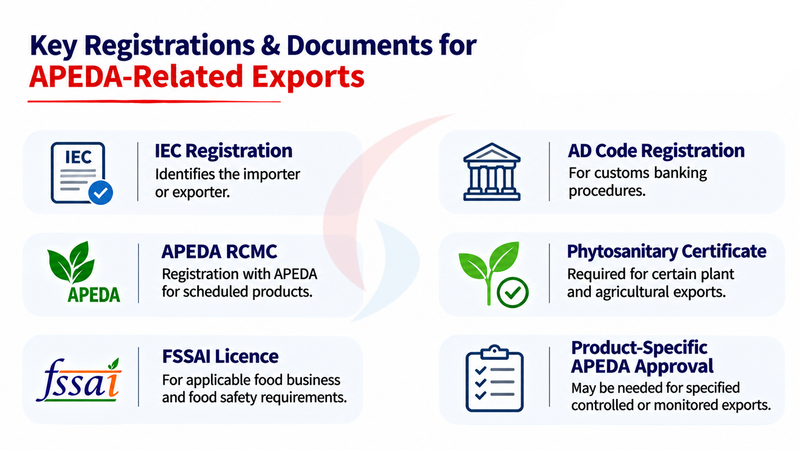
|
Registration or Document |
Purpose |
|
IEC Registration |
Identifies the importer or exporter under India's foreign trade system. |
|
APEDA RCMC |
Establishes registration with APEDA for applicable scheduled products. |
|
Covers applicable food business activities and food safety obligations. |
|
|
Supports applicable customs banking procedures. |
|
|
Phytosanitary Certificate |
Required for certain plant and agricultural exports, depending on the goods and destination. |
|
Product-Specific APEDA Approval |
May be necessary for specified controlled, certified or monitored exports. |
For example, a merchant exporter dealing in fresh mangoes may need to satisfy applicable plant quarantine, inspection and destination-country requirements in addition to its business registration.
Similarly, a business exporting processed foods should confirm whether its activities require FSSAI licensing and whether the importing country imposes special labelling or testing conditions.
For general export formalities, read our guide on How to Apply for an RCMC Registration Online in India.
Benefits of APEDA Registration for Merchant Exporters
APEDA Registration offers several benefits to merchant exporters dealing in agricultural and processed food products. It supports export promotion, market access and business development.
|
Benefits |
Description |
|---|---|
|
Export Recognition |
Provides an official RCMC confirming registration with APEDA. |
|
Business Credibility |
Helps establish credibility with overseas buyers, banks and trade partners. |
|
Export Promotion Support |
Offers opportunities to participate in trade fairs, exhibitions and promotional programmes. |
|
Market Information |
Provides access to information on international markets, export opportunities and trade requirements. |
|
Quality Improvement |
Supports awareness of product standards, packaging and quality requirements. |
|
Financial Assistance Schemes |
Eligible exporters may apply for APEDA financial assistance schemes, subject to prescribed conditions. |
Important: APEDA Registration does not automatically guarantee financial assistance or export incentives. Exporters must satisfy the eligibility requirements of the relevant schemes.
For businesses starting international trade, our article on Planning to Export? Start with RCMC Registration explains how registration supports export readiness.
Latest APEDA and DGFT Updates in 2026
Several developments are relevant to merchant exporters preparing their APEDA applications in 2026.
|
Recent Update |
Importance for Exporters |
|
September 2026 – DGFT Notification No. 36/2026-27 |
Introduced the specified RCMC exemption for export consignments up to Rs 3 lakh FOB. |
|
DGFT e-RCMC System |
Continues as the official application facility for APEDA RCMC. |
|
2026 APEDA Registration Guidance |
Confirms documentation differences between merchant and manufacturer exporters. |
|
Five-Year RCMC Validity |
Exporters must monitor certificate validity and renewal requirements. |
|
Product-Specific Export Controls |
Rice and certain other products remain subject to additional requirements where applicable. |
The September 2026 exemption is particularly important for small merchant exporters testing overseas demand. However, businesses planning regular or higher-value shipments should review the continuing advantages and requirements of APEDA registration.
Why Choose Compliance Calendar LLP ?
At Compliance Calendar LLP, we assist merchant exporters, manufacturers and export-oriented businesses with registration and regulatory documentation.
|
Our Services |
How We Help |
|
APEDA Eligibility Assessment |
Identify the relevant product category and exporter classification. |
|
IEC Registration Assistance |
Support businesses with obtaining or updating IEC details. |
|
APEDA e-RCMC Filing |
Assist with online applications and document preparation. |
|
Document Verification |
Review supporting business records and registration information. |
|
RCMC Renewal and Amendment |
Assist with relevant renewal and modification procedures. |
|
Export Compliance Guidance |
Help identify applicable documentation and related registration requirements. |
Businesses can explore our APEDA Registration Services and RCMC Registration Services for professional assistance.
For assistance with APEDA Registration for Merchant Exporters, contact Compliance Calendar LLP at 9988424211 or info@ccoffice.in
Frequently Asked Questions (FAQs)
Q1. Can a merchant exporter apply for APEDA Registration without a factory?
Ans: Yes. A merchant exporter can apply for APEDA Registration for eligible scheduled products without owning a manufacturing facility. The business may purchase goods from third-party suppliers and export them to overseas buyers, subject to applicable product and regulatory requirements.
Q2. Is APEDA Registration mandatory for merchant exporters in 2026?
Ans: APEDA Registration is relevant for businesses exporting products covered under its statutory jurisdiction. However, DGFT introduced an RCMC exemption for qualifying consignments up to Rs 3 lakh FOB in September 2026. Separate APEDA Act and product-specific obligations must also be examined.
Q3. What is the government fee for APEDA Registration?
Ans: APEDA's published registration fee is Rs 5,000 plus 18% GST of Rs 900, making the total Rs 5,900. Professional service fees and other product-specific registration charges are separate.
4. Which document is mainly required for merchant exporter registration?
Ans: APEDA's published e-RCMC procedure identifies a signed and sealed copy of the IEC issued by DGFT as the principal document for merchant exporters. Additional business details are entered through the online application.
Q5. What is the validity of an APEDA RCMC?
Ans: APEDA's published procedure specifies a general validity of five years. Exporters should check the exact validity dates mentioned on their issued certificate and follow the applicable renewal procedure.
Q6. Can a merchant exporter export processed food products with APEDA Registration?
Ans: Yes, where the products are covered under APEDA's jurisdiction and the exporter satisfies applicable requirements. However, APEDA RCMC does not replace FSSAI licensing, product safety standards, customs documentation or destination-country requirements.
Q7. Is APEDA Registration required for export shipments below Rs 3 lakh?
Ans: DGFT Notification No. 36/2026-27 provides an exemption from the relevant FTP RCMC or Certificate of Registration requirement for qualifying consignments with FOB value not exceeding Rs 3 lakh. Other independent legal requirements may still apply.
Q8. Is APEDA Registration different from IEC Registration?
Ans: Yes. IEC is the basic identification code issued by DGFT for import-export activities. APEDA RCMC establishes registration with the relevant agricultural and processed food export development authority for applicable products.
Q9. Can APEDA Registration be amended after a company name change?
Ans: Modification of an existing APEDA RCMC may be available through the prescribed procedure. APEDA's published instructions specify no amendment fee. The applicant should provide supporting documents and assess whether the underlying legal entity remains unchanged.
Q10. Can Compliance Calendar LLP help merchant exporters obtain APEDA Registration?
Ans: Yes. Compliance Calendar LLP assists businesses with eligibility assessment, IEC documentation, APEDA e-RCMC applications, renewal-related procedures and other applicable export registration requirements.
Article last updated on : 20 Nov 2026.