


Employee Stock Option Plans (ESOPs) have become a popular way for Indian companies to attract talented professionals, retain experienced employees and reward individuals who contribute to long-term business growth. Instead of offering compensation entirely through salaries and bonuses, companies provide employees with an opportunity to acquire shares at a predetermined price. As the company grows, these shares may become more valuable, allowing employees to benefit financially from the success of the organisation.
However, receiving ESOPs does not mean that an employee immediately becomes a shareholder. Employees must fulfil certain conditions before acquiring shares, which involves two important stages known as vesting and exercise. These stages determine when employees become eligible to purchase shares, how much they must pay and what happens to their options when they leave the organisation. Companies must also ensure that their ESOP Scheme Compliance meets the applicable statutory requirements.
Employees and business owners who are unfamiliar with equity-based compensation can also read about ESOPs for Employees in India to understand their benefits and practical implications.
What is ESOP Vesting?
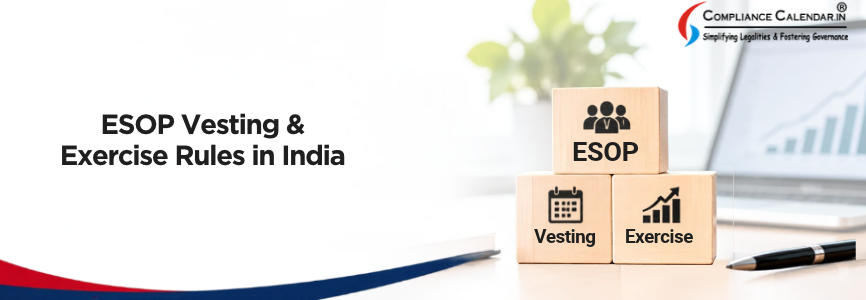
ESOP vesting is the process through which employees earn the right to exercise the stock options granted by their employer. When a company grants stock options, employees generally need to complete a specified period of employment or achieve predetermined performance targets before becoming eligible to purchase shares. This waiting period is known as the vesting period. Companies use vesting conditions to encourage employee retention and reward consistent contributions rather than providing immediate ownership benefits.
For example, a technology startup grants 4,000 stock options to an employee under a four-year vesting schedule. Instead of receiving all the options immediately, the employee becomes eligible to exercise a specified number of options each year. If the employee leaves before completing the vesting requirements, the remaining unvested options may lapse according to the approved scheme and applicable law.
Startups planning to reserve equity for their employees should also understand ESOP Pool Creation and Dilution before deciding their vesting structure.
What is ESOP Exercise?
ESOP exercise refers to the process through which an employee uses vested stock options to acquire actual shares of the company. Once the options become vested, the employee can submit an exercise request and pay the predetermined exercise price within the permitted exercise period. After completing the required formalities and receiving the shares, the employee becomes a shareholder and acquires the rights associated with those shares.
Suppose an employee has 1,000 vested stock options with an exercise price of Rs 50 per share, while the current fair market value is Rs 200 per share. The employee can acquire those shares by paying Rs 50,000 as the exercise consideration. However, the difference between the exercise price and fair market value may also create a tax liability, even if the employee has not sold the shares.
Understanding ESOP Valuation Methods and Compliance can help employees and employers determine the financial implications of exercising stock options.
Difference Between ESOP Vesting and Exercise
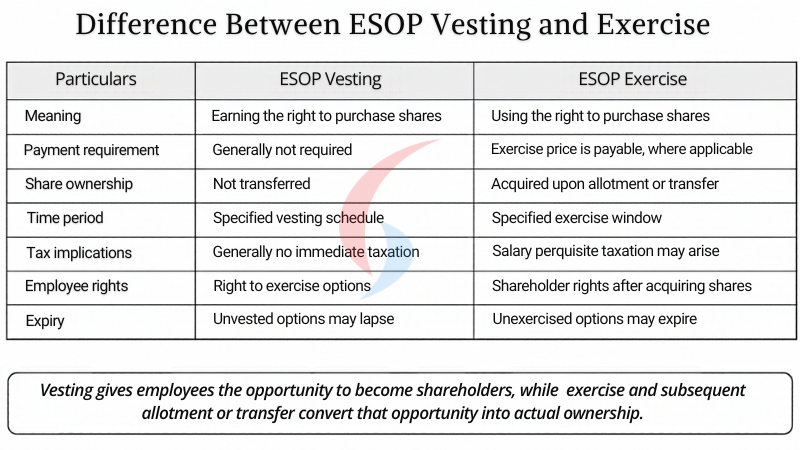
Although vesting and exercise are closely connected, they represent different stages of employee stock ownership. Vesting establishes the employee's eligibility to acquire shares, whereas exercise involves actually using that eligibility. Understanding this distinction is particularly important when employees are considering resignation, retirement or participation in an upcoming company acquisition.
Legal Provisions Governing ESOP Vesting and Exercise in India
ESOP vesting and exercise in India are regulated through the Companies Act, 2013, applicable company law rules, SEBI regulations and income-tax provisions. Although companies have considerable flexibility in designing their vesting schedules and exercise conditions, these arrangements must comply with statutory requirements. The legal provisions also protect employee interests and ensure transparency in the issuance and administration of stock options.
|
Legal Provision |
Applicability |
|---|---|
|
Section 62(1)(b), Companies Act, 2013 |
Issuance of shares under ESOP schemes |
|
Rule 12, Companies (Share Capital and Debentures) Rules, 2014 |
ESOP conditions for unlisted companies |
|
Regulation 17, SEBI SBEB and SE Regulations, 2021 |
Exercise price |
|
Regulation 18, SEBI SBEB and SE Regulations, 2021 |
Vesting period |
|
Regulation 9, SEBI SBEB and SE Regulations, 2021 |
Employee rights and obligations |
|
Section 17(1)(d), Income-tax Act, 2025 |
ESOP perquisite taxation |
|
Ind AS 102 |
Accounting for share-based payments |
As of November 2026, companies should also consider the SEBI regulations last amended on December 4, 2025, and the Income-tax Act, 2025, effective from April 1, 2026.
Businesses preparing employee stock option schemes can refer to the ESOP Compliance Checklist and Procedure under the Companies Act, 2013 for a better understanding of statutory obligations.
Minimum Vesting Period for ESOPs in India
Under Rule 12(6)(a) of the Companies (Share Capital and Debentures) Rules, 2014, there must generally be a minimum gap of one year between the grant and vesting of stock options. Regulation 18 of the SEBI (Share Based Employee Benefits and Sweat Equity) Regulations, 2021, provides a similar minimum vesting requirement for listed companies. However, companies can prescribe longer vesting periods depending on their employee retention policies and business objectives.
Certain exceptions and adjustments are available under applicable regulations, particularly in cases involving mergers, amalgamations, death or permanent incapacity. Companies should examine these circumstances before modifying or accelerating an existing vesting schedule.
Different Types of ESOP Vesting Schedules
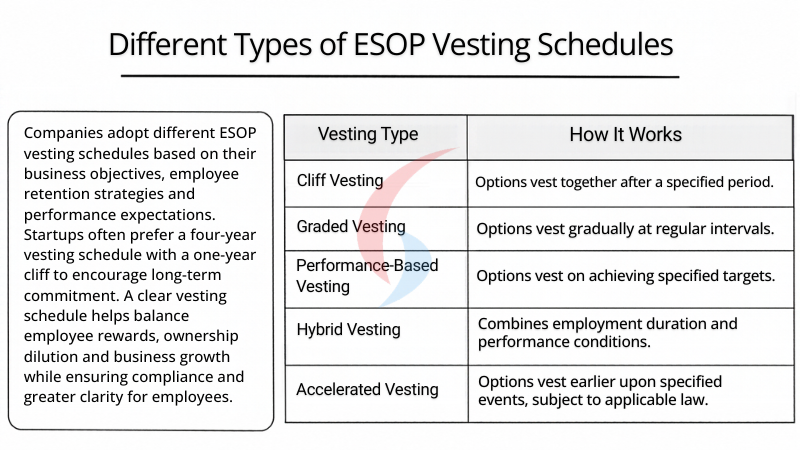
Companies adopt different ESOP vesting schedules depending on their business objectives, employee retention strategies and performance expectations. While some companies allow employees to earn stock options gradually over a specified period, others link vesting to the achievement of individual or organisational targets. Startups generally prefer a four-year vesting schedule with a one-year cliff to encourage long-term employee commitment. The selection of an appropriate vesting schedule helps companies balance employee rewards, ownership dilution and business growth while complying with applicable legal requirements. A clearly defined vesting schedule also reduces misunderstandings and provides employees with greater clarity regarding their future ownership rights.
How Does ESOP Vesting Work? A Practical Example
Imagine a fictional Bengaluru-based startup, NovaTech Private Limited, which hires Rohan as a software developer and grants him 8,000 stock options at an exercise price of Rs 20 per share. The company follows a four-year vesting schedule with a one-year cliff. During the first year, Rohan receives no vested options, but upon completing twelve months of employment, 2,000 options become vested.
After completing three years, Rohan has earned 6,000 vested options. During this period, the company's fair market value increases to Rs 150 per share. If he decides to exercise all his vested options, he must pay Rs 1,20,000 towards acquiring shares worth Rs 9,00,000 at the assumed valuation. The remaining difference of Rs 7,80,000 represents a potential financial benefit before applicable taxes, but it is not guaranteed cash income.
|
Particulars |
Amount |
|---|---|
|
Total options granted |
8,000 |
|
Options vested after three years |
6,000 |
|
Exercise price per share |
Rs 20 |
|
Fair market value per share |
Rs 150 |
|
Total exercise consideration |
Rs 1,20,000 |
|
Fair market value of shares |
Rs 9,00,000 |
|
Difference before taxation |
Rs 7,80,000 |
Professional Valuation Services can help companies determine appropriate share values for applicable corporate, accounting and regulatory purposes.
Procedure for Exercising ESOPs in India
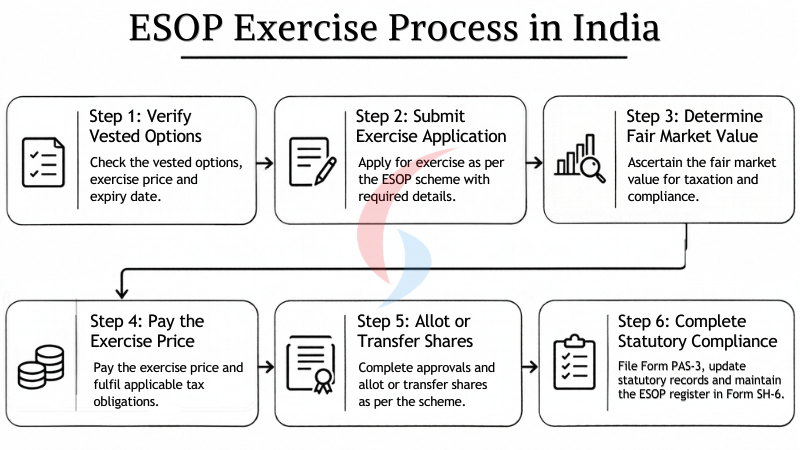
The exercise process requires coordination between employees, management, finance teams and compliance professionals. Employees must comply with the terms of their grant letters, while companies must ensure that share allotment, taxation and statutory filings are completed correctly.
Step 1: Verify Vested Options
The employee should check the number of vested options, applicable exercise price and expiry date. The company should verify these details against its ESOP register and individual grant records before accepting the exercise request.
Step 2: Submit an Exercise Application
The employee must submit an exercise application in the manner prescribed under the ESOP scheme. The application generally specifies the number of options being exercised and includes the necessary declarations.
Step 3: Determine Fair Market Value
The company must determine the applicable fair market value for taxation and other regulatory purposes. Businesses can obtain professional Merchant Banking Valuation Services wherever the applicable valuation provisions require such expertise.
Step 4: Pay the Exercise Consideration
The employee pays the exercise price for the selected number of options. The company also determines the applicable tax withholding obligations and communicates the financial requirements to the employee.
Step 5: Allot or Transfer Shares
The company completes the necessary corporate approvals and allots shares or arranges their transfer through the ESOP trust, depending on the approved structure. Applicable dematerialisation and ownership records must also be updated.
Step 6: Complete Statutory Compliance
The company files Form PAS-3 within 30 days of allotment, where applicable, updates the register of members and maintains the ESOP register in Form SH-6 for companies covered by Rule 12.
Companies administering employee benefits through a trust can also read about ESOP Trust Structure and Compliance in India to understand alternative methods of share administration.
What Happens to ESOPs When an Employee Resigns?
Resignation is one of the most important circumstances affecting employee stock options. Under Rule 12(8) of the Companies (Share Capital and Debentures) Rules, 2014, unvested options generally expire when an employee resigns or their employment is terminated. Vested options may be exercised within the period specified in the approved ESOP scheme, subject to applicable conditions. Employees should therefore carefully review their grant agreements before leaving an organisation.
For instance, an employee holding 5,000 options may have completed the vesting requirements for only 3,000 options at the time of resignation. The remaining 2,000 options would ordinarily lapse. If the scheme provides a 90-day post-employment exercise window, the employee must exercise the eligible vested options within that period. However, 90 days is a contractual condition and not a universally prescribed statutory deadline. An employee may lose even vested stock options by failing to exercise them before the applicable expiry date.
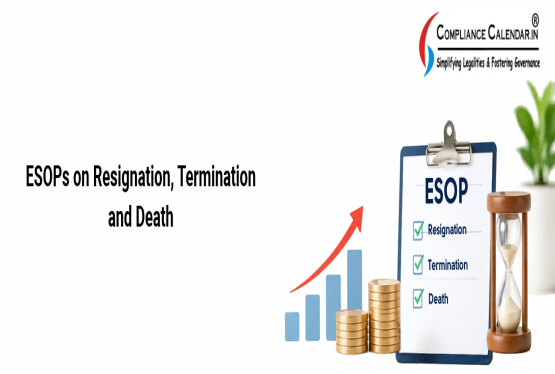
Employees planning to change jobs should understand the provisions relating to ESOPs on Resignation, Termination and Death before making employment decisions.
ESOP Vesting in Case of Death or Permanent Incapacity
Indian company law provides special protection in situations involving employee death or permanent incapacity. Under Rule 12(8)(d), if an employee dies while in employment, the options granted up to the date of death vest in the employee's legal heirs or nominees. Similarly, under Rule 12(8)(e), options granted to an employee suffering permanent incapacity while in employment vest on the date of such incapacity.
These provisions protect employees and their families from losing potential financial benefits because of unexpected personal circumstances. Listed companies must separately comply with the relevant provisions of Regulation 9 of the SEBI SBEB and SE Regulations, 2021.
ESOP Taxation at the Time of Exercise
ESOPs generally involve taxation at two stages. The first arises when shares are allotted or transferred following exercise, with the taxable salary perquisite calculated using the fair market value on the exercise date minus the amount paid by the employee. The second arises when the employee subsequently sells the shares, potentially resulting in capital gains or losses.
From April 1, 2026, Section 17(1)(d) of the Income-tax Act, 2025, governs the relevant perquisite taxation. Eligible startups covered under Section 140 may qualify for deferred ESOP tax payment under Sections 289(3) and 392(3), subject to statutory conditions. This benefit represents a postponement of tax payment rather than a complete tax exemption.
Employees can read further about ESOP Taxation for Employees and Startups in India to understand the financial consequences of acquiring and selling shares.
Common Mistakes in ESOP Vesting and Exercise
Many businesses introduce employee stock option schemes without adequately defining exercise deadlines, performance requirements, resignation conditions or share valuation procedures. Employees may also misunderstand vested options as immediate share ownership or assume that exercising options guarantees financial returns. These misunderstandings can result in disputes, unexpected tax liabilities and difficulties during investment rounds or acquisitions.
Companies should maintain transparent documentation, accurate employee-wise records and appropriate accounting disclosures throughout the ESOP lifecycle.
Understanding ESOP Accounting under Ind AS 102 can also help businesses recognise employee compensation expenses correctly.
Why Choose Compliance Calendar LLP?
Compliance Calendar LLP assists startups, private limited companies and growing businesses with the preparation, implementation and administration of employee stock option schemes. From defining vesting schedules and exercise conditions to drafting grant letters, preparing corporate resolutions and managing statutory filings, our professionals help businesses establish legally compliant and transparent employee compensation arrangements.
Our ESOP Scheme Compliance and Valuation Services support businesses throughout the ESOP lifecycle. Companies can establish employee-friendly stock option policies while managing regulatory obligations, ownership dilution and documentation requirements effectively.
Frequently Asked Questions (FAQs)
Q1. What is the minimum ESOP vesting period in India?
Ans. The minimum vesting period is generally one year from the grant date under applicable company law and SEBI regulations. Specified statutory exceptions and adjustments may apply.
Q2. Can employees exercise unvested ESOPs?
Ans. Generally, employees cannot exercise options until they satisfy the applicable vesting conditions. Exercise eligibility depends on the approved ESOP scheme and statutory requirements.
Q3. Is a four-year ESOP vesting period mandatory in India?
Ans. No, a four-year vesting period is a common industry practice rather than a statutory requirement. Companies can determine their own schedules within applicable legal limits.
Q4. Can vested ESOPs expire?
Ans. Yes, vested options may expire if employees fail to exercise them within the prescribed exercise period. Employees should regularly check their grant letters and exercise deadlines.
Q5. Are ESOPs taxable at the time of vesting?
Ans. ESOP vesting generally does not create an immediate income-tax liability. Perquisite taxation ordinarily arises when shares are allotted or transferred following exercise.
Q6. Can a company change its ESOP vesting conditions?
Ans. Companies may modify applicable ESOP terms subject to statutory approvals and restrictions. Such modifications must comply with employee protection requirements under the relevant regulations.
Q7. Can employees exercise ESOPs after resignation?
Ans. Employees may exercise eligible vested options within the post-employment exercise period specified in the scheme. Unvested options generally lapse upon resignation.
Q8. Can foreign employees participate in Indian ESOP schemes?
Ans. Yes, eligible foreign employees may participate subject to applicable company law and FEMA requirements. Companies must also comply with relevant foreign investment and reporting obligations.
Article last updated on : 24 Nov 2026.







































































_learn_crop10_thumb.jpg)