


Acquiring an Indian company can offer investors an established customer base, experienced employees, valuable licences and an opportunity to enter a growing market. However, buying a company without examining its foreign investment history can expose the buyer to regulatory problems that may not appear in ordinary financial statements.
for example a foreign investor planning to acquire 70% of an Indian technology company. The target has strong revenue, a growing customer base and promising business contracts. Its financial records appear satisfactory, but during the legal review, the investor discovers that the company received foreign investment three years earlier without completing certain RBI reporting requirements.
The company may still be commercially attractive, but its acquisition now involves additional compliance questions. The buyer must determine whether the earlier transactions complied with FEMA, whether reporting defaults can be regularised, and whether the proposed share transfer satisfies India's foreign investment rules.
This is why FEMA Due Diligence for Acquiring Indian Companies is an important part of mergers, acquisitions, foreign investments and cross-border share transfers.
Under Indian law, a foreign investor cannot acquire shares in every Indian company without restrictions. The transaction may be subject to sectoral investment limits, government approval, pricing guidelines, beneficial ownership restrictions and reporting requirements.
What Is FEMA Due Diligence in an Indian Company Acquisition?
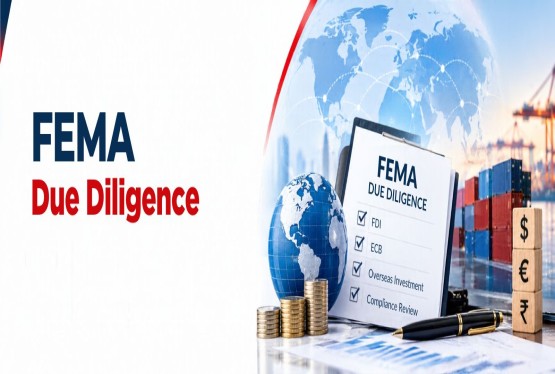
FEMA Due Diligence is the examination of a company's foreign exchange transactions, overseas investment arrangements, foreign shareholders and regulatory filings to determine whether it complies with the Foreign Exchange Management Act, 1999 and applicable rules.
During an acquisition, the buyer reviews both the target company's historical transactions and the legal requirements applicable to the proposed investment.
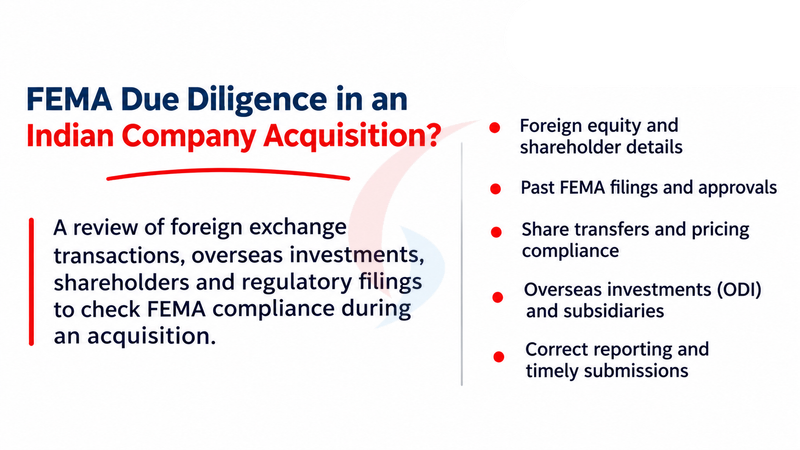
For example, a company may have received foreign equity investment, issued compulsorily convertible preference shares, transferred shares to non-residents or invested in overseas subsidiaries. Each transaction may involve different FEMA requirements.
The due diligence process verifies whether the relevant approvals were obtained, investment amounts were correctly reported, pricing conditions were followed and prescribed forms were submitted within the applicable deadlines.
Businesses can read FEMA Due Diligence: Process, Checklist and Compliance for a broader understanding of foreign exchange compliance reviews.
Why Is FEMA Due Diligence Important Before Acquiring an Indian Company?
A company may have a clean financial audit report but still carry unresolved FEMA compliance issues. For example, an Indian company may have issued shares to a Singapore investor in 2023 but submitted Form FC-GPR late. It may also have completed a resident-to-non-resident share transfer without the necessary FC-TRS reporting.
These transactions could affect regulatory verification during a subsequent acquisition. An investor should therefore examine the target company's ownership history, capital structure, previous foreign investments and reporting records before committing to the purchase.
FEMA due diligence also helps buyers understand whether government approval is required, whether the acquisition price complies with valuation rules and whether the proposed ownership structure is permitted. A transaction that appears simple from a commercial perspective may involve more complex legal requirements when the buyer or beneficial owner is resident outside India.
Legal Provisions Governing FEMA Due Diligence for Acquisitions
The legal requirements depend on the nature of the transaction, the investor's residential status, the business sector and the securities being acquired.
|
Act / Regulation |
Relevant Provision |
Importance for Acquisition |
|
Section 6 |
Regulation of capital account transactions |
|
|
Section 13 |
Penalties for contraventions |
|
|
Section 15 |
Compounding of eligible contraventions |
|
|
Rules 6 and 9, where applicable |
Foreign investment and transfer of equity instruments |
|
|
Rule 21 |
Pricing guidelines |
|
|
Regulation 4 |
Prescribed foreign investment reporting |
|
|
Applicable chapters and annexures |
Investment conditions, pricing and related compliance |
|
|
Sections 56 and 58 |
Transfer and registration of securities |
|
|
Sections 89 and 90 |
Beneficial interest and significant beneficial ownership |
|
|
Sections 5 and 6 |
Combination thresholds and prior approval |
|
|
Applicable capital gains and withholding provisions |
Tax consequences of the acquisition |
For listed companies, applicable SEBI regulations, including takeover and insider trading requirements, may also need examination.
These legal provisions operate together. FEMA compliance does not replace requirements under company law, competition law, securities regulations or taxation.
The RBI's Master Direction on Foreign Investment in India, updated through 15 June 2026, and the FEMA Non-Debt Instruments Rules, updated through 2 September 2026, are important references for transactions involving foreign investors.
Indian companies with foreign shareholders must maintain proper investment records and complete applicable RBI filings. Explore FEMA/RBI Compliance Checklist for Indian Companies with FDI
A Practical Example: How FEMA Due Diligence Helped an Acquisition
ABC Solutions Private Limited, a Pune-based software company, received Rs 1.5 crore from a foreign investor in 2022. In 2026, a Singapore-based company offered Rs 12 crore to acquire a controlling stake in NovaTech. During FEMA due diligence, the buyer discovered that ABC could not provide its earlier FC-GPR and FC-TRS filing acknowledgements. Before completing the acquisition, the buyer asked the company to review and resolve the pending compliance issues. This example shows why checking past FEMA records is important before acquiring an Indian company.
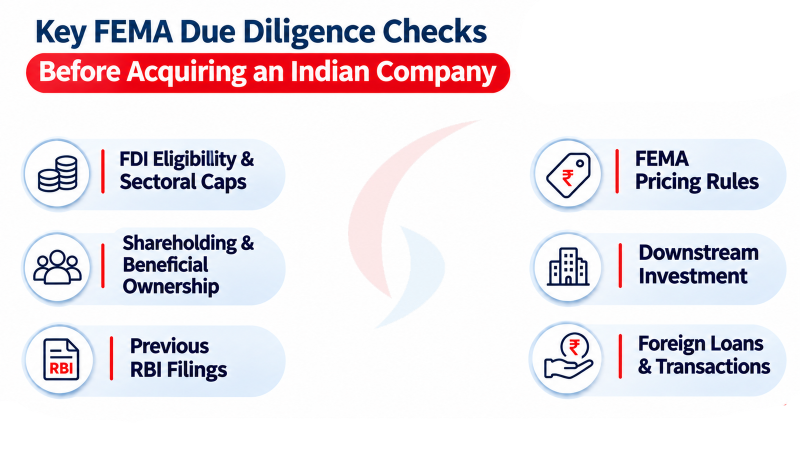
Key FEMA Due Diligence Checks Before Acquiring an Indian Company
A buyer should examine the target company's foreign investment history, ownership details, RBI filings and financial transactions. These checks help identify regulatory risks and determine whether additional approvals or corrective filings are required.
|
Due Diligence Check |
What Should Be Verified? |
|---|---|
|
1. FDI Eligibility and Sectoral Caps |
Check whether foreign investment is permitted under the automatic or government approval route and whether sectoral limits apply. |
|
2. Shareholding and Beneficial Ownership |
Verify the company's shareholders, ultimate beneficial owners and any applicable land-border investment restrictions. |
|
3. Previous RBI Filings |
Review FC-GPR, FC-TRS, FLA Return and other applicable filings to identify pending compliance issues. |
|
4. FEMA Pricing Guidelines |
Check whether the proposed share price complies with Rule 21 of the FEMA (Non-Debt Instruments) Rules, 2019. |
|
5. Downstream Investment |
Examine investments made by the target company in other Indian companies and the applicable reporting requirements. |
|
6. Foreign Loans and Transactions |
Review external commercial borrowings (ECB), overseas investments, foreign guarantees and related-party transactions. |
Important RBI Reporting Forms and Deadlines
|
RBI Form |
Purpose |
General Filing Deadline |
|---|---|---|
|
FC-GPR |
Reporting issue of shares to non-residents |
Within 30 days of issue |
|
FC-TRS |
Reporting specified share transfers |
Generally within 60 days of the prescribed trigger |
|
FLA Return |
Annual foreign liabilities and assets reporting |
15 July every year |
|
Form DI |
Reporting applicable downstream investments |
Within 30 days of allotment |
|
Reporting foreign investment in LLPs |
Within 30 days of receipt of consideration |
|
|
LLP(II) |
Reporting specified LLP investment transfers |
Generally within 60 days |
The filing requirement depends on the nature of the transaction and applicable FEMA provisions. Buyers should verify that previous returns were successfully submitted and accepted through the RBI reporting system.
For more information, read Difference Between FC-GPR Filing and FC-TRS Filing
FEMA Pricing Guidelines for Share Acquisitions
Rule 21 of the FEMA (Non-Debt Instruments) Rules, 2019 prescribes pricing requirements for applicable transactions involving residents and non-residents. These conditions help determine whether shares are being issued or transferred at a legally acceptable price.
|
Type of Transaction |
General Pricing Requirement |
|---|---|
|
Resident to Non-Resident |
Price should generally not be below the prescribed fair value. |
|
Non-Resident to Resident |
Price should generally not exceed the prescribed fair value. |
|
Issue of Shares to Non-Resident |
Issue price must generally satisfy the applicable valuation floor. |
|
Listed Company Share Transfer |
Relevant SEBI pricing requirements apply. |
For example, if the prescribed fair value is Rs 110 per share, a resident generally cannot sell those unlisted shares to a foreign investor for Rs 80 per share under the ordinary FEMA pricing rules.
Additional FEMA Compliance Checks
Apart from share transfers and pricing, buyers should examine whether the Indian company has invested in subsidiaries or received foreign loans. These transactions may involve separate reporting and approval requirements.
For example, if a foreign investor acquires control of an Indian company that owns another Indian company, the transaction may affect downstream investment compliance. Similarly, an existing overseas loan must be reviewed for applicable ECB conditions and reporting obligations.
For related information, read Annual Compliance for Foreign Holding Companies and FDI from China and Bordering Nations After the 2026 Policy Revision
Key takeaway: Before acquiring an Indian company, investors should verify FDI eligibility, previous RBI filings, share valuation, beneficial ownership and foreign financial transactions. Identifying these issues early can help prevent regulatory difficulties after the acquisition.
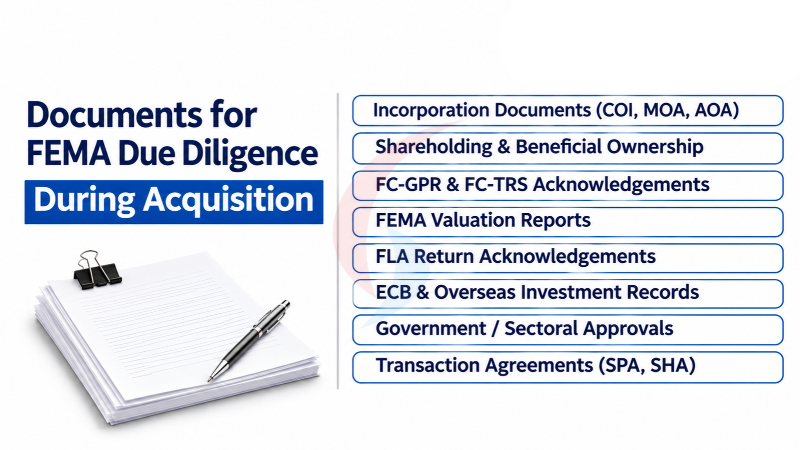
Documents Required for FEMA Due Diligence During Acquisition
A buyer should request a complete set of corporate, investment, banking and foreign exchange compliance documents.
|
Documents |
Purpose of Verification |
|
Certificate of Incorporation, MOA and AOA |
Corporate identity and restrictions |
|
Current and Historical Shareholding Patterns |
Ownership and changes in control |
|
Share Certificates and Register of Members |
Evidence of share ownership |
|
FC-GPR and FC-TRS Acknowledgements |
Historical RBI reporting compliance |
|
FIRC and Bank KYC Records |
Foreign investment remittance verification |
|
FEMA Valuation Reports |
Compliance with pricing requirements |
|
FLA Return Acknowledgements |
Annual foreign investment reporting |
|
Form DI and Downstream Investment Records |
Indirect foreign investment compliance |
|
ECB Loan Agreements and Reporting Records |
Foreign borrowing compliance |
|
Overseas Investment and APR Records |
Foreign asset and subsidiary compliance |
|
Government and Sectoral Approvals |
Investment eligibility and permissions |
|
Beneficial Ownership Declarations |
Ownership and control verification |
|
Board Resolutions and Shareholder Approvals |
Corporate authorisation |
|
Share Purchase and Shareholders' Agreements |
Transaction rights and obligations |
The buyer should also obtain a list of pending regulatory notices, outstanding reporting defaults, bank queries and earlier compounding orders. Incomplete documentation does not always prove that a violation occurred. However, it creates a verification issue that should be addressed before the acquisition is completed.
FEMA Due Diligence Process for Acquiring an Indian Company
A structured review helps the buyer identify legal risks before funds are transferred and shares change hands.
|
Step |
Due Diligence Process |
Important Action |
|
Step 1 |
Understand the Acquisition |
Identify buyer, seller, target, securities and proposed ownership |
|
Step 2 |
Check FDI Eligibility |
Verify sectoral caps, entry route and approval requirements |
|
Step 3 |
Review Corporate Records |
Examine shareholding, allotments and transfers |
|
Step 4 |
Verify FEMA Filings |
Review FC-GPR, FC-TRS, FLA, DI and other applicable records |
|
Step 5 |
Examine Valuation |
Confirm compliance with FEMA pricing requirements |
|
Step 6 |
Identify Outstanding Defaults |
Review pending reporting, approvals and regulatory notices |
|
Step 7 |
Prepare Due Diligence Report |
Classify risks and recommend corrective actions |
|
Step 8 |
Complete Acquisition Compliance |
Obtain approvals, execute transfer documents and make prescribed filings |
The process should begin before signing binding acquisition documents or, at minimum, before completion. Matters requiring prior government or regulatory approval must be addressed at the legally appropriate stage.
After completing an acquisition, companies should check their applicable foreign investment reporting obligations. Explore RBI Reporting of FC-GPR, FC-TRS, FLA, ODI and ECB
FEMA Due Diligence Checklist: Red Flags That Buyers Should Examine
Some regulatory issues deserve special attention because they can affect transaction feasibility, valuation or completion.
|
Red Flag |
Possible Consequence |
|
Missing FC-GPR Acknowledgement |
Historical foreign investment reporting default |
|
Unreported Share Transfer |
Possible FC-TRS non-compliance |
|
Incorrect FEMA Valuation |
Pricing-rule contravention |
|
Sectoral Investment Limit Exceeded |
Investment eligibility issue |
|
Missing Government Approval |
Transaction may require prior regularisation or approval |
|
Unreported Downstream Investment |
Indirect foreign investment compliance risk |
|
Inconsistent Shareholding Records |
Ownership verification difficulty |
|
Incorrect FLA Return |
Annual reporting discrepancy |
|
Undisclosed Overseas Borrowing |
ECB or other FEMA exposure |
|
Unclear Beneficial Ownership |
Potential FDI policy approval and disclosure issues |
A buyer should classify these issues according to their financial impact, legal seriousness and available remedy. For example, a delayed reporting form may be capable of regularisation, while an investment into a prohibited sector can raise a fundamentally different legal problem.
Latest FEMA and FDI Updates Affecting Acquisitions in 2026
Several regulatory developments in 2026 have affected foreign investment, beneficial ownership, reporting requirements and acquisitions of Indian companies. Buyers should review these updates before completing cross-border transactions.
|
Regulatory Update |
Date |
Key Changes and Requirements |
|---|---|---|
|
DPIIT Press Note No. 2 (2026 Series) |
15 March 2026 |
Revises FDI policy relating to countries sharing a land border with India. Clarifies beneficial ownership and introduces reporting requirements for certain investments. The changes take effect through the relevant FEMA notification. |
|
RBI Foreign Investment Master Direction |
15 June 2026 |
Updates guidance on foreign investment, share transfers, pricing conditions, payment arrangements and related FEMA compliance. |
|
FEMA Reporting Amendment – Notification No. FEMA 395(4)/2026-RB |
13 June 2026 |
Amends payment and reporting provisions for certain foreign investments, including specified transactions involving non-resident individuals and international exchanges. |
|
FEMA Non-Debt Instruments Rules, 2019 |
Updated through 2 September 2026 |
Reflects amendments concerning foreign investment eligibility, share transfers, pricing requirements and sectoral restrictions. |
|
Competition Commission of India (CCI) Approval |
Applicable in 2026 |
Certain acquisitions require prior CCI approval when prescribed thresholds are met. A deal-value threshold applies to transactions exceeding Rs 2,000 crore where the target has substantial business operations in India. |
Why Choose Compliance Calendar LLP ?
Compliance Calendar LLP assists Indian and foreign businesses with FEMA due diligence, foreign investment compliance, RBI reporting and related regulatory documentation. Our professionals help investors examine historical share allotments, foreign investment records, reporting acknowledgements, pricing documentation, beneficial ownership and relevant approval requirements.
The review helps businesses identify unresolved compliance matters before completing acquisitions and provides a clearer understanding of the reporting requirements that may arise after the transaction. For professional assistance, explore our FEMA Due Diligence Services and Share Transfer Services.
Contact Compliance Calendar LLP: 9988424211 or info@ccoffice.in
Frequently Asked Questions (FAQs)
Q1. What is FEMA Due Diligence for acquiring an Indian company?
Ans: FEMA Due Diligence examines foreign investment transactions, regulatory approvals, RBI reporting and the target company's compliance history. It helps buyers identify legal risks before completing an acquisition.
Q2. Is FEMA Due Diligence mandatory for every acquisition?
Ans: There is no universal statutory requirement to obtain a standalone FEMA due diligence report for every acquisition. However, the buyer must ensure that the transaction complies with all applicable FEMA provisions.
Q3. Can a foreign company acquire 100% shares in an Indian company?
Ans: Yes, in sectors permitting 100% foreign investment, subject to the applicable entry route and conditions. Certain sectors have restrictions, approval requirements or complete prohibitions.
Q4. Is RBI approval required for foreign acquisitions in India?
Ans: Not every acquisition requires prior RBI approval. The applicable requirements depend on the investor, sector, transaction structure and relevant FEMA provisions, including cases requiring government approval.
Q5. What is Form FC-TRS in an acquisition?
Ans: Form FC-TRS is used for specified transfers of equity instruments between residents and non-residents. It must be submitted through the prescribed RBI reporting system within the applicable deadline.
Q6. Why is FEMA valuation important during a share acquisition?
Ans: FEMA pricing guidelines regulate the consideration payable in applicable cross-border share transactions. The buyer must ensure that the acquisition price complies with the relevant pricing floor or ceiling.
Q7. Can an acquisition proceed if the target has pending FEMA filings?
Ans: It depends on the seriousness of the default and the applicable legal requirements. Certain reporting delays may be regularised, while substantive investment violations may require different action or prevent completion.
Q8. Does FEMA Due Diligence include beneficial ownership verification?
Ans: Yes. Beneficial ownership is particularly important where investment restrictions depend on the ultimate owner's citizenship, location or control over the investing entity.
Q9. What are the major FEMA changes relevant to acquisitions in 2026?
Ans: Important developments include DPIIT's March 2026 land-border investment policy revision, RBI's June 2026 reporting amendment and the updated FEMA Non-Debt Instruments Rules.
Q10. Can Compliance Calendar LLP assist with FEMA Due Diligence?
Ans: Yes. Compliance Calendar LLP assists with foreign investment record reviews, RBI reporting verification, share transfer documentation, valuation compliance and identification of applicable regulatory requirements.
Article last updated on : 26 Nov 2026.






























































_learn_crop10_thumb.jpg)