


Imagine a Singapore-based company planning to establish a wholly owned subsidiary in India. The foreign parent wants complete ownership of the Indian business, but an ordinary private limited company requires at least two members under the Companies Act, 2013. To meet this requirement, the foreign parent holds most shares directly, while one share is registered in the name of an individual nominee. Although the nominee appears as a shareholder, the beneficial interest remains with the foreign parent.
This arrangement creates an important compliance requirement under Section 89 of the Companies Act, 2013. The registered shareholder and beneficial owner must make prescribed declarations, and the Indian subsidiary must file Form MGT-6 with the Registrar of Companies (ROC).
What Is Form MGT-6 Under the Companies Act, 2013?
Form MGT-6 is a statutory return filed by a company with ROC to report declarations concerning beneficial interest in shares. Under Section 89(6) of the Companies Act, 2013, a company receiving the prescribed declaration must record the information in its register of members and file a return with ROC.
For example, if a foreign parent holds 99,999 shares directly and one share through an individual nominee, the registered and beneficial ownership of the nominee share differs. In such cases, the parties must examine their declaration obligations under Section 89, and the Indian subsidiary must complete the applicable MGT-6 filing.
Purpose of Nominee Shareholding in Foreign Subsidiaries
Under Section 3(1)(b) of the Companies Act, 2013, an ordinary private limited company requires at least two members. However, a foreign holding company may want to retain complete beneficial ownership of its Indian subsidiary. Section 187(1) permits shares in a subsidiary to be held through nominees where necessary to ensure that the subsidiary maintains the statutory minimum number of members.
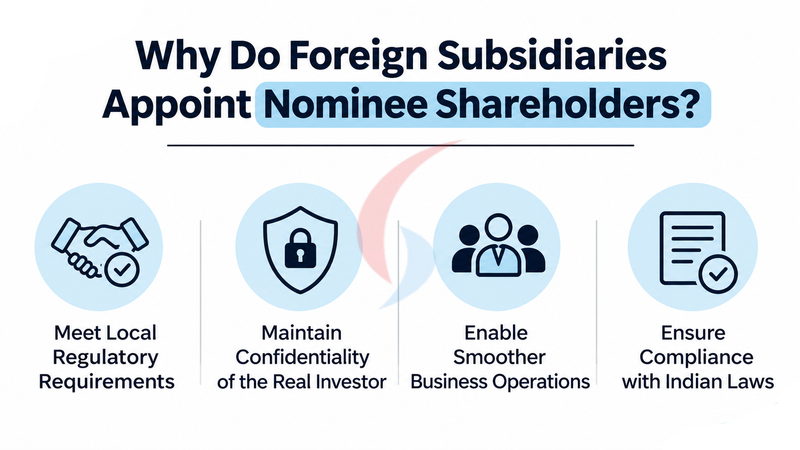
For example, a German holding company may directly hold 9,999 shares while its nominee holds one share on its behalf. Although the nominee's name appears in the register of members, the foreign parent retains the beneficial interest according to the underlying arrangement.
For related information, read Foreign Subsidiary Company/WOS Registration in India.
Legal Provisions Governing MGT-6 Compliance
The Companies Act, 2013 and the Companies (Management and Administration) Rules, 2014 prescribe the disclosure requirements for nominee shareholding.
|
Legal Provision |
Compliance Requirement |
|
Section 3(1)(b) |
Minimum two-member requirement for ordinary private companies |
|
Section 89(1) |
Declaration by registered shareholders without beneficial interest |
|
Section 89(2) |
Declaration by beneficial owners |
|
Section 89(3) |
Disclosure of changes in beneficial interest |
|
Section 89(6) |
Recording declarations and filing returns with ROC |
|
Section 89(7) |
Penalties for failure to file the required company return |
|
Section 89(10) |
Definition of beneficial interest in shares |
|
Section 187(1) |
Nominee holding in specified subsidiary arrangements |
|
Forms MGT-4, MGT-5 and MGT-6 |
These provisions ensure that companies disclose the difference between registered ownership and actual beneficial interest.
Difference Between Registered Owner and Beneficial Owner
A registered owner is the person whose name appears in the company's register of members. A beneficial owner is the person or entity entitled to exercise relevant shareholding rights or receive benefits attached to those shares.
Under Section 89(10), beneficial interest includes rights relating to voting, dividends and other distributions, as specified in the provision.
|
Particulars |
Registered Owner |
Beneficial Owner |
|
Meaning |
Name recorded in the register |
Holds beneficial interest |
|
Declaration |
Form MGT-4 |
Form MGT-5 |
|
Example |
Individual nominee |
Foreign parent company |
For example, an individual may hold one share in an Indian subsidiary, while the foreign parent retains the beneficial interest.
MGT-4, MGT-5 and MGT-6: Key Differences
These three forms serve different purposes and are submitted by different parties.
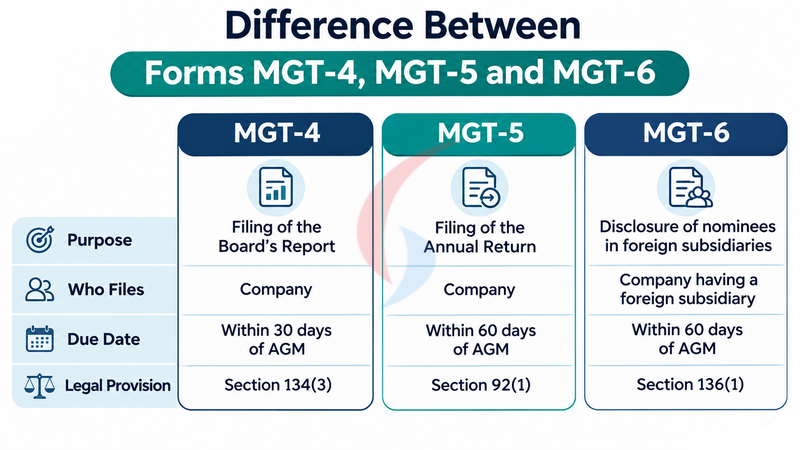
|
Form |
Submitted By |
General Deadline |
|
MGT-4 |
Registered shareholder without beneficial interest |
Within 30 days of entry in the register or relevant change |
|
MGT-5 |
Person holding beneficial interest |
Within 30 days of acquiring interest or relevant change |
|
MGT-6 |
Indian company to ROC |
Within 30 days of receiving the declaration |
MGT-4 and MGT-5 are declarations submitted to the company. MGT-6 is the return filed by the company with ROC. The general MGT-6 deadline is calculated from the date the company receives the declaration, not automatically from incorporation.
When Is MGT-6 Mandatory for Foreign Subsidiaries?
MGT-6 becomes applicable when registered ownership and beneficial interest differ and the relevant declarations under Section 89 are received by the company. A common example is an Indian subsidiary where one share is registered in the name of a nominee for its foreign holding company.
The requirement may also arise following a change of nominee, transfer of nominee shares or alteration of beneficial interest. However, foreign investment alone does not make MGT-6 mandatory. If registered shareholders themselves hold the beneficial interest, Section 89 nominee declarations may not be required. The actual ownership arrangement determines the applicability.
Step-by-Step MGT-6 Filing Procedure for Foreign Subsidiaries
The company should complete the relevant declarations and ROC filing whenever a qualifying nominee arrangement arises.
Step 1 – Review the Shareholding Structure
Examine the register of members, share certificates and foreign parent company records. Identify the nominee shareholder and confirm the actual beneficial owner.
Step 2 – Obtain Form MGT-4
The registered shareholder must submit Form MGT-4, declaring that the beneficial interest belongs to another person or entity.
Step 3 – Obtain Form MGT-5
The beneficial owner must provide Form MGT-5, identifying the relevant shares and explaining the nature of the beneficial interest.
Step 4 – Update the Register of Members
The company must record the declaration details in its statutory register as required under Section 89(6).
Step 5 – File Form MGT-6
Submit the prescribed return through the MCA Portal within the applicable deadline, with the necessary attachments and fees.
Step 6 – Maintain Filing Records
Preserve the Service Request Number (SRN), payment acknowledgement, declarations and updated shareholding records. The general statutory deadline for MGT-6 is 30 days from receipt of the relevant declaration.
MGT-6 Filing: Document Checklist
The documents required depend on the shareholding arrangement and the details requested in the current MCA webform. Generally, the company should maintain its Certificate of Incorporation, register of members, shareholding records, nominee arrangement documents and Forms MGT-4 and MGT-5.
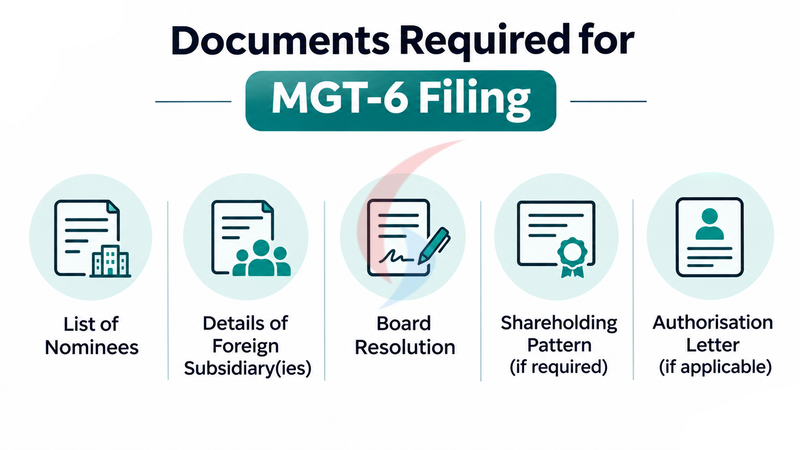
Identification details of the nominee and foreign beneficial owner should also be available. These may include registration numbers, country of incorporation, addresses and authorised representative information.
The MCA webform requires relevant share particulars, including class of shares, face value, paid-up value and declaration dates. Accurate supporting documents help avoid inconsistencies during filing.
Case Study: One Nominee Share Creates an MGT-6 Obligation
Consider the fictional example of GlobalTech Solutions Pte. Ltd., a Singapore-based company establishing its Indian subsidiary.The Indian company has 1,00,000 equity shares. The foreign parent directly holds 99,999 shares, while one share is registered in an individual nominee's name.
The nominee holds the share on behalf of the foreign parent, which retains the beneficial interest.
|
Particulars |
Case Details |
|
Indian Company |
GlobalTech India Private Limited |
|
Foreign Parent |
GlobalTech Solutions Pte. Ltd. |
|
Direct Shareholding |
99,999 shares |
|
Nominee Shareholding |
1 share |
|
Registered Owner |
Individual nominee |
|
Beneficial Owner |
Singapore parent company |
|
Required Compliance |
MGT-4, MGT-5 and MGT-6, as applicable |
During a compliance review, the Company Secretary discovers that the nominee declarations were missing. Although only one share is involved, Section 89 of the Companies Act, 2013 still applies.The company must obtain the required declarations, complete the MGT-6 filing and address any delay to ensure proper compliance.
Latest MCA Updates on MGT-6 Applicable in 2026
The Companies (Management and Administration) Amendment Rules, 2024, notified on July 15, 2024, introduced a revised Form MGT-6. The updated form became part of MCA's V3 filing system and requires detailed information about registered shareholders, beneficial owners and relevant shares.
It also introduced Beneficial Owner Identification Number (BO ID) functionality.
|
MCA Update |
Key Change |
|
July 2024 Amendment |
Revised Form MGT-6 |
|
MCA V3 Filing |
Web-based filing system |
|
BO ID |
Beneficial Owner ID functionality |
|
Share Details |
Expanded shareholding particulars |
|
Owner Information |
Additional identification details |
As of November 2026, companies should follow the current MCA webform and instruction kit instead of using outdated filing formats.
MGT-6 Government Filing Fees in 2026
The normal filing fee depends on the company's nominal share capital under the applicable MCA fee rules.
|
Nominal Share Capital |
Normal Filing Fee |
|
Below Rs 1 lakh |
Rs 200 |
|
Rs 1 lakh to below Rs 5 lakh |
Rs 300 |
|
Rs 5 lakh to below Rs 25 lakh |
Rs 400 |
|
Rs 25 lakh to below Rs 1 crore |
Rs 500 |
|
Rs 1 crore or above |
Rs 600 |
Additional filing fees apply when the return is submitted after the prescribed deadline. The actual payable amount should be checked through the MCA portal before filing.
Difference Between MGT-6 and BEN-2
Although both forms concern beneficial ownership, they arise under different provisions.
|
Particulars |
MGT-6 |
BEN-2 |
|
Legal Provision |
Section 89 |
Section 90 |
|
Purpose |
Reports beneficial interest declarations |
Reports significant beneficial ownership |
|
Declaration |
MGT-4 and MGT-5 |
BEN-1, where applicable |
|
Focus |
Registered versus beneficial ownership |
Qualifying individual beneficial owners |
For example, an individual nominee holding one share for a foreign parent may create Section 89 compliance.
The subsidiary must separately examine whether any individual qualifies as a Significant Beneficial Owner under Section 90.
Filing MGT-6 does not automatically satisfy BEN-2 requirements.
MGT-6 and FEMA Compliance for Foreign Subsidiaries
Foreign subsidiaries may also have obligations under the Foreign Exchange Management Act, 1999. However, MGT-6 and FEMA reporting address different matters. MGT-6 discloses beneficial interest in shares, while FEMA reporting concerns regulated foreign investment transactions.
For example, an Indian subsidiary issuing shares to its overseas parent may need to complete the applicable FC-GPR reporting alongside nominee declarations under Section 89. Compliance with one requirement does not automatically fulfil the other.
For related information, read RBI Mandatory Compliances for Wholly Owned Subsidiaries in India.
Why Choose Compliance Calendar LLP for MGT-6 Compliance?
MGT-6 compliance requires an understanding of nominee shareholding, beneficial ownership declarations and MCA filing procedures.
Compliance Calendar LLP provides professional assistance relating to foreign subsidiary incorporation, ROC filings, corporate documentation and beneficial ownership compliance. Businesses can seek assistance with reviewing nominee arrangements, preparing declarations and identifying applicable filing obligations.
For professional assistance, contact 9988424211or email info@ccoffice.in
Frequently Asked Questions (FAQ’S)
Q1. What is Form MGT-6 in a foreign subsidiary?
Ans. MGT-6 is a return filed with ROC under Section 89(6). It reports beneficial interest declarations where registered and beneficial ownership of shares differ.
Q2. Is MGT-6 mandatory for every foreign subsidiary?
Ans. No. Foreign ownership alone does not make MGT-6 mandatory. It applies where the relevant Section 89 declaration requirements arise.
Q3. Who files Form MGT-6?
Ans. The Indian company files MGT-6 with ROC. The registered shareholder submits MGT-4, while the beneficial owner provides MGT-5.
Q4. What is the due date for MGT-6?
Ans. The general deadline is 30 days from receipt of the relevant declaration by the company. Certain IFSC companies have a prescribed 60-day period.
Q5. Is MGT-6 required for one nominee share?
Ans. Yes, it may be required even for one share. Section 89 does not provide a general minimum shareholding threshold for these declarations.
Q6. Can a foreign company be a beneficial owner?
Ans. Yes. A foreign holding company can beneficially own shares registered in a nominee's name, subject to the applicable declaration requirements.
Q7. What is the penalty for late MGT-6 filing?
Ans. Section 89(7) provides a penalty of Rs 1,000 per day, subject to maximum limits of Rs 5 lakh for the company and Rs 2 lakh for an officer.
Q8. Is BEN-2 required along with MGT-6?
Ans. Not automatically. BEN-2 is governed by Section 90 and depends on the applicable significant beneficial ownership requirements.
Q9. What changed in MGT-6 in 2024?
Ans. MCA introduced a revised web-based form with additional beneficial owner information, share details and BO ID functionality.
Q10. Can MGT-6 be filed through MCA V3 in 2026?
Ans. Yes. MGT-6 is available through MCA's V3 filing system. Companies should use the current webform and follow the prescribed instructions.
Article last updated on : 25 Nov 2026.


































































_learn_crop10_thumb.jpg)