


Indian companies receiving foreign investment or investing in overseas businesses are required to comply with various reporting requirements prescribed by the Reserve Bank of India (RBI). One such important annual compliance is the Foreign Liabilities and Assets (FLA) Return, which provides information about the foreign assets and liabilities of Indian entities.
However, companies may sometimes submit their FLA Returns using provisional financial statements because their statutory audit has not been completed before the filing deadline. In other situations, incorrect valuations, foreign shareholding details, exchange rate calculations or accounting errors may result in inaccurate reporting. These situations may require the company to revise its previously submitted FLA Return.
The RBI allows eligible entities to submit revised FLA Returns through its Foreign Liabilities and Assets Information Reporting (FLAIR) portal. Companies must follow the prescribed revision procedure, obtain permission wherever required and ensure that the revised information accurately reflects their financial position.
What is a Revised FLA Return?
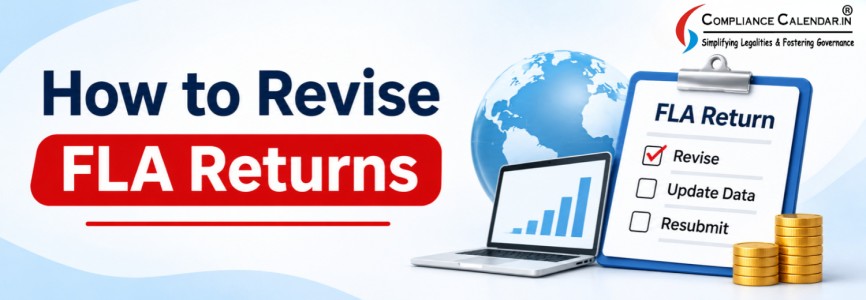
A revised FLA Return refers to an updated version of an annual Foreign Liabilities and Assets Return previously submitted to the RBI. It allows an entity to correct inaccurate financial information, replace provisional figures with audited figures or rectify omissions in its earlier submission.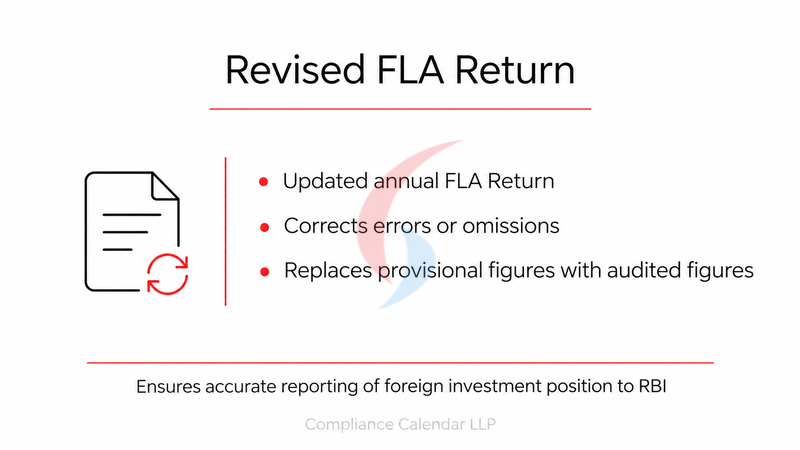
The primary purpose of revising an FLA Return is to ensure that information reported to the RBI correctly represents the company's foreign investment position. It is particularly important for companies having foreign shareholders, overseas subsidiaries, joint ventures or other reportable cross-border investments. A revised return does not eliminate the original filing obligation. Instead, it updates the financial and investment information reported for a particular financial year.
Companies must understand the original FLA Return filing requirements before initiating a revision. Accurate reporting of foreign assets and liabilities helps prevent unnecessary discrepancies. Read more about FLA Return Filing Online 2026: RBI FLAIR Guide to understand the filing requirements.
Legal Provisions Governing FLA Return Revision
FLA Return filing and revision are governed by FEMA regulations and reporting instructions issued by the RBI. Indian entities must comply with the applicable provisions while submitting or correcting their annual returns.
| Legal provision | Applicability |
|---|---|
| Foreign Exchange Management Act, 1999 | Governs foreign exchange transactions and reporting obligations. |
| RBI A.P. (DIR Series) Circular No. 45, dated 15 March 2011 | Introduced annual FLA reporting requirements. |
| RBI Circular dated 28 June 2019 | Introduced online reporting through the FLAIR portal. |
| FEMA Reporting Regulations, 2019 | Prescribes reporting requirements relating to foreign investment. |
| FEMA Overseas Investment Regulations, 2022 | Governs applicable overseas investment reporting. |
| RBI FLA FAQs updated on 1 July 2026 | Provides guidance on filing, revision and reporting requirements. |
Companies can refer to the official RBI FAQs on FLA Returns for the latest revision-related instructions.
Who is Required to Revise an FLA Return?
An entity that has previously submitted an FLA Return containing incorrect, incomplete or provisional information may be required to submit a revised return. This requirement may arise across different categories of Indian entities having reportable foreign investments.
These entities generally include:
-
-
Limited Liability Partnerships (LLPs).
-
Eligible registered partnership firms.
-
Companies having foreign shareholders.
-
Indian entities having overseas subsidiaries or joint ventures.
-
SEBI-registered Alternative Investment Funds (AIFs).
-
Other eligible entities having outstanding FDI or ODI.
The requirement depends on the nature of the entity's foreign investment position and the information submitted in its original return. AIFs should follow their separately prescribed reporting arrangements.
FLA Return filing obligations depend on the foreign investment position of an Indian entity. Companies and LLPs must examine their reporting requirements under FEMA before submitting their returns. Learn more about the Applicability of FLA Returns under FEMA Laws in India
When Does a Company Need to Revise Its FLA Return?
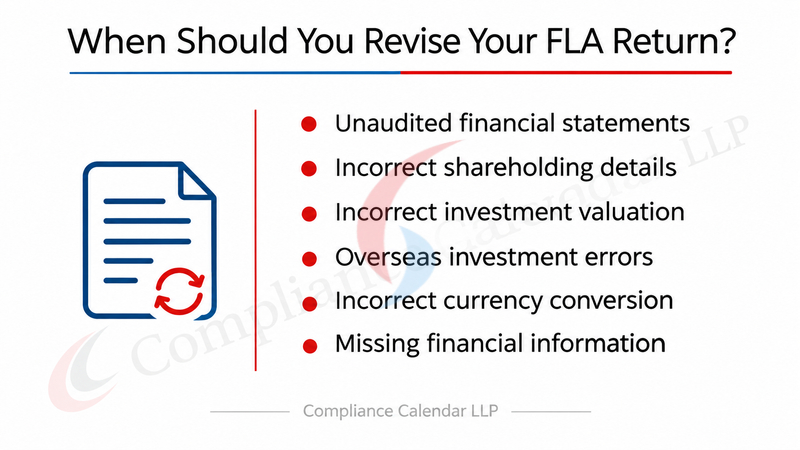
Companies may need to revise their FLA Returns for several reasons. Although completing the statutory audit is one of the most common reasons, errors in investment reporting or financial calculations may also require correction.
| Reasons for Revision | Description |
|---|---|
| Unaudited Financial Statements | Updating provisional financial figures after the completion of the statutory audit. |
| Incorrect Foreign Shareholding Details | Correcting errors in shareholding percentage, number of shares or investment value. |
| Incorrect Valuation of Foreign Investments | Revising incorrect calculations of equity capital, reserves, net worth or investment values. |
| Errors in Overseas Investment Reporting | Correcting investment balances relating to overseas subsidiaries or joint ventures. |
| Incorrect Exchange Rate or Currency Conversion | Rectifying currency conversion errors as per the applicable RBI reporting methodology. |
| Omission of Financial Information | Including previously omitted intercompany balances, foreign investments or other reportable financial details. |
Companies having accumulated losses may face difficulties while reporting their financial position in FLA Returns. Accurate calculation of net worth is important while revising previously submitted financial information. Read more about FLA Return for Companies with Negative Net Worth
Due Date for Filing and Revising FLA Returns
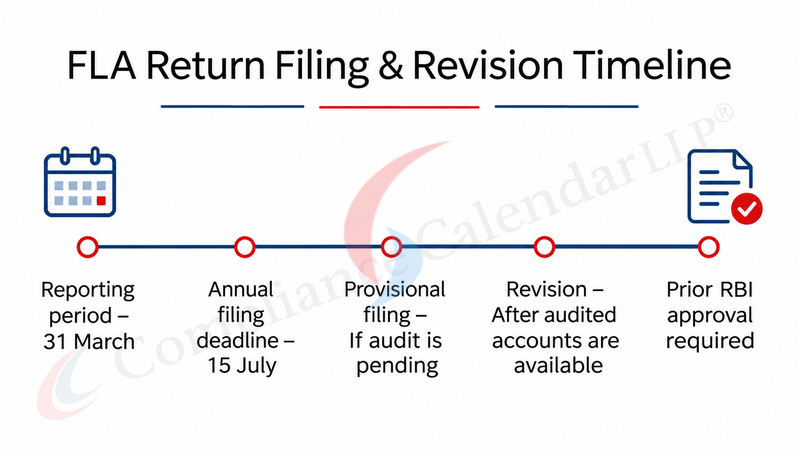
The annual FLA Return must ordinarily be submitted by 15 July every year. If audited financial statements are unavailable, companies can submit the return using provisional financial information and revise it after completion of the statutory audit. According to the RBI FAQs updated on 1 July 2026, entities should submit their revised FLA Returns as soon as audited financial statements become available after obtaining RBI approval.
| Particulars | Applicable timeline |
|---|---|
| Annual FLA Return | 15 July every year |
| Provisional FLA Return | 15 July, if audited accounts are unavailable |
| Revised FLA Return | As soon as audited accounts become available, after RBI approval |
| Revision of previous years' returns | After obtaining RBI approval |
| Reporting period | Financial year ending 31 March |
| Filing platform | RBI FLAIR portal |
Businesses should not assume that 30 September is a universal statutory deadline for revision. The latest RBI FAQs emphasise prompt revision following the availability of audited accounts.
Companies should maintain a compliance calendar to monitor their annual foreign investment reporting obligations. Timely preparation of financial records can help prevent filing delays and reporting errors. Refer to FLA Return Filing and Due Dates with the Checklist for additional guidance.
Storytelling: How a Growing Indian Company Corrected Its FLA Return
Consider an illustrative example of GreenNova Technologies Private Limited, a growing renewable energy company based in Bengaluru. The company received Rs 5 crore from a Singapore-based investor to expand its manufacturing operations and develop energy-efficient products.
In July 2026, the finance team realised that the statutory audit for FY 2025–26 was still incomplete. To avoid missing the annual reporting deadline, the company submitted its FLA Return using provisional financial statements.
When the audit was completed in September, the management discovered significant differences in the reported reserves, net worth and financial liabilities. The previously submitted FLA Return no longer reflected the company's audited financial position.
The management approached a FEMA compliance professional, who reviewed the original return, reconciled the audited financial statements and submitted a revision request through the RBI FLAIR portal. After receiving approval, the company submitted its corrected FLA Return and preserved the acknowledgement for future reference.
This example highlights why FLA compliance does not necessarily end with the original submission. Companies must also ensure that their reported financial information remains accurate after the statutory audit.
Difference Between Original and Revised FLA Returns
| Particulars | Original FLA Return | Revised FLA Return |
|---|---|---|
| Purpose | Annual reporting | Correction or updating of information |
| Financial information | Audited or provisional | Corrected or audited |
| Filing deadline | Generally 15 July | Following RBI approval |
| Revision approval | Not applicable to routine timely filing | Required from RBI |
| Frequency | Annual | As required |
| Filing platform | FLAIR portal | FLAIR portal |
Documents Required for Revising FLA Returns
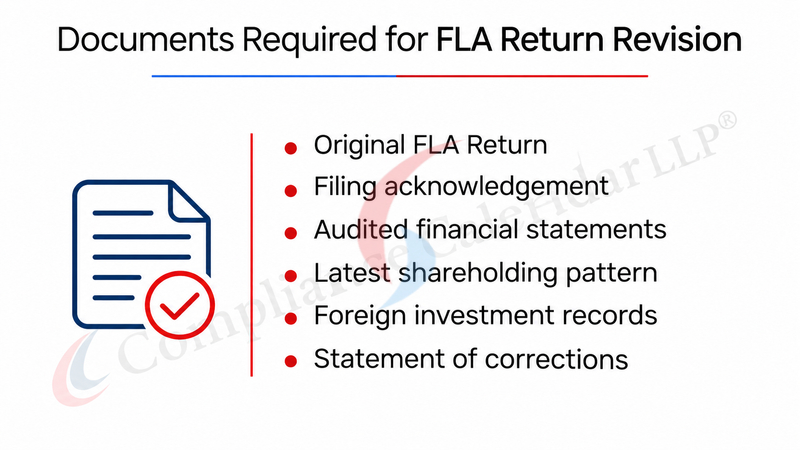
Before initiating the revision process, companies should collect the necessary financial and investment records. Proper documentation helps reconcile discrepancies and ensures that revised information is supported by appropriate evidence.
-
Previously submitted FLA Return.
-
Original FLA filing acknowledgement.
-
Audited balance sheet.
-
Audited profit and loss account.
-
Latest shareholding pattern.
-
Foreign investor details.
-
Overseas investment records.
-
Relevant Form FC-GPR and FC-TRS filings.
-
Overseas subsidiary financial statements, wherever applicable.
-
Foreign currency conversion calculations.
-
Statement explaining the proposed corrections.
-
FLAIR portal login credentials.
These documents are generally required for preparation and verification. The RBI does not ordinarily require companies to upload their balance sheet or profit and loss account along with the annual FLA Return.
A detailed FEMA compliance review helps companies identify discrepancies in their foreign investment records. Reviewing historical filings and financial statements also supports accurate FLA Return revision. Learn more about FEMA Due Diligence: Process, Checklist & Compliance
Procedure to Revise FLA Returns on the RBI FLAIR Portal
The revision process involves identifying incorrect information, obtaining permission from the RBI and submitting updated financial details. Companies should follow the latest instructions available on the FLAIR portal to complete the revision successfully.
Step 1: Review the Previously Submitted FLA Return
Download the original FLA Return and examine the financial and foreign investment information reported earlier. Compare these details with the audited financial statements and identify the entries requiring modification.
Step 2: Reconcile Financial and Investment Records
Verify share capital, reserves, foreign liabilities, overseas investments and other reportable balances against supporting records. Prepare a reconciliation statement explaining the differences between the original and revised figures.
Step 3: Log in to the RBI FLAIR Portal
Visit the official RBI FLAIR portal and log in using the entity's registered credentials. Ensure that the registered entity details and authorised person's contact information are correct.
Step 4: Submit a Request for FLA Revision
Open the Menu section and navigate to the “Multiple Year CIN Enable Screen” on the portal. Select the relevant reporting year and submit the request for permission to revise the previously filed FLA Return.
Step 5: Obtain Approval from the RBI
Monitor the revision request and check whether permission has been granted for the selected financial year. If the portal does not allow the request to be raised, share the error screenshot with the RBI at flareturn@rbi.org.in.
Step 6: Update the Required Financial Information
Once permission is granted, access the return for the relevant financial year and enter the corrected financial and investment details. Ensure that the revised figures follow the applicable RBI valuation and reporting instructions.
Step 7: Validate and Submit the Revised Return
Review all applicable sections and resolve any validation errors displayed on the portal. After verifying the information against the supporting documents, submit the revised FLA Return electronically.
Step 8: Download and Preserve the Acknowledgement
Save the revised return, submission acknowledgement and relevant correspondence with the RBI. Maintain these documents along with reconciliation statements for future audits, due diligence and regulatory verification.
Understanding the FLAIR portal is essential for completing original and revised return submissions. Companies should familiarise themselves with registration, data entry and submission requirements. Explore How to File Foreign Liabilities and Assets (FLA) on the FLAIR Portal of RBI
Can FLA Returns for Previous Financial Years Be Revised?
Yes, companies can revise FLA Returns for earlier financial years after obtaining permission from the RBI. This may become necessary when historical reporting errors are identified during statutory audits, fundraising, business acquisitions or FEMA compliance reviews.
Companies should examine each affected financial year separately because FLA reporting captures financial information relating to both the current and preceding reporting periods. An incorrect figure reported in one financial year may therefore affect subsequent returns. It is also important to distinguish between revising an existing return and submitting a return that was never filed. Outstanding historical filings may attract additional regulatory consequences for delayed reporting.
Common Mistakes While Revising FLA Returns
Even during the revision process, companies may make mistakes that result in further discrepancies. A detailed review of financial and investment records can help prevent repeated corrections.
| Common mistake | Correct approach |
|---|---|
| Selecting the wrong financial year | Verify the applicable reporting period. |
| Incorrect shareholding percentage | Reconcile with statutory shareholding records. |
| Incorrect investment valuation | Follow RBI valuation instructions. |
| Wrong currency conversion | Apply the prescribed conversion methodology. |
| Reporting consolidated figures incorrectly | Follow the entity-level reporting requirements. |
| Ignoring previous-year discrepancies | Reconcile both reporting periods. |
| Incorrect reporting of negative net worth | Report figures according to applicable RBI instructions. |
| Not preserving the acknowledgement | Maintain complete submission records. |
Penalty for Incorrect or Delayed FLA Returns
Incorrect reporting, failure to submit mandatory FLA Returns or failure to rectify material discrepancies may expose an entity to regulatory action under FEMA. Under Section 13 of FEMA, penalties for contraventions may extend to three times the amount involved where it is quantifiable, or up to Rs 2 lakh where it cannot be quantified. Continuing contraventions may attract an additional penalty of up to Rs 5,000 per day after the first day.
The RBI circular dated 30 September 2022 prescribes a Late Submission Fee (LSF) of Rs 7,500 per FLA Return for eligible reporting delays. Companies should approach the jurisdictional Foreign Exchange Department of the RBI for applicable payment instructions. However, submitting a revised return after filing a timely provisional return does not automatically attract a late submission fee. The circumstances and nature of the reporting default must be examined separately.
Companies receiving foreign investment must comply with both transaction-based and annual RBI reporting requirements. Incorrect or delayed submissions may expose businesses to regulatory consequences. Refer to FC-GPR and FLA Return: Filing Rules and Penalties
Does Revising an FLA Return Correct Other FEMA Filings?
Revising an FLA Return does not automatically correct information previously submitted through Form FC-GPR, Form FC-TRS, Annual Performance Reports (APR) or other FEMA reporting forms. If discrepancies arise from incorrect foreign investment reporting, companies must examine whether separate corrections are required through the relevant RBI reporting systems. Maintaining consistency between statutory records, financial statements and FEMA filings is particularly important during investment transactions and regulatory due diligence.
Why Choose Compliance Calendar LLP?
Revising an FLA Return requires an understanding of financial statements, foreign investment regulations, valuation methods and RBI reporting requirements. Even a minor error in financial information can create discrepancies across multiple reporting years. Compliance Calendar LLP assists businesses with original and revised FLA Return filing, RBI revision requests, financial data reconciliation, historical return filing, FEMA due diligence and regulatory advisory. Our professionals help companies identify reporting discrepancies and complete the necessary compliance procedures.
Whether a company needs to update provisional financial figures or correct historical foreign investment information, Compliance Calendar LLP provides professional assistance throughout the revision process.
For professional assistance, contact +91 9988424211 or email info@ccoffice.in
Frequently Asked Questions (FAQs)
Q1. Can an FLA Return be revised after submission?
Ans. Yes, a previously submitted FLA Return can be revised after obtaining RBI approval. The company must submit corrected information through the FLAIR portal and maintain the revised acknowledgement.
Q2. What is the due date for revising an FLA Return?
Ans. According to the RBI FAQs updated on 1 July 2026, companies should revise provisional returns as soon as audited accounts become available. Prior RBI permission is required for revision.
Q3. Is RBI approval mandatory for revising an FLA Return?
Ans. Yes, companies must obtain RBI permission before submitting a revised FLA Return. The revision request can be raised through the relevant option on the FLAIR portal.
Q4. Can FLA Returns be filed using unaudited financial statements?
Ans. Yes, companies can use provisional or unaudited financial statements if audited accounts are unavailable by 15 July. The return must subsequently be updated with audited information.
Q5. Can previous years' FLA Returns be revised?
Ans. Yes, companies can revise FLA Returns for previous financial years after obtaining RBI approval. Each affected reporting year should be reviewed and corrected appropriately.
Q6. What is the fee for revising an FLA Return?
Ans. A routine revision does not automatically attract a separate statutory fee. However, eligible delayed FLA filings may attract a Late Submission Fee of Rs 7,500 per return.
Q7. Is it mandatory to upload audited financial statements?
Ans. No, audited financial statements are not ordinarily required to be uploaded with the FLA Return. However, companies should preserve them as supporting records for the revised information.
Q8. Is revision necessary if audited and unaudited figures are identical?
Ans. Yes, RBI's latest FAQs require entities to update provisional reporting after audited figures become available, irrespective of the extent of variation. Companies should obtain permission and complete the revision accordingly.
Q9. Can an LLP revise its FLA Return?
Ans. Yes, an eligible LLP having FLA reporting obligations can revise its previously submitted return. It must follow the applicable RBI approval and online submission procedure.
Q10. Whom should companies contact for FLA revision issues?
Ans. Companies facing technical or reporting issues can contact the RBI FLA team at flareturn@rbi.org.in. Professional FEMA compliance assistance may also help resolve documentation and reporting discrepancies.
Article last updated on : 24 Nov 2026.































































_learn_crop10_thumb.jpg)