


Foreign investment helps Indian companies expand their operations, access international markets and raise capital. However, receiving investment from overseas investors involves several legal responsibilities under the Companies Act, 2013 and the Foreign Exchange Management Act, 1999 (FEMA).
Consider an Indian startup that receives investment from a Singapore-based company. The startup completes its FC-GPR filing with the RBI and assumes that all foreign investment compliances have been completed. However, during a compliance review, its Company Secretary discovers that the individuals who ultimately own the Singapore-based company have not been examined for significant beneficial ownership.
What is Form BEN-2?
Form BEN-2 is a statutory return filed with the Registrar of Companies (ROC) for reporting Significant Beneficial Owners (SBOs). It is governed by Section 90(4) of the Companies Act, 2013, read with Rule 4 of the Companies (Significant Beneficial Owners) Rules, 2018.
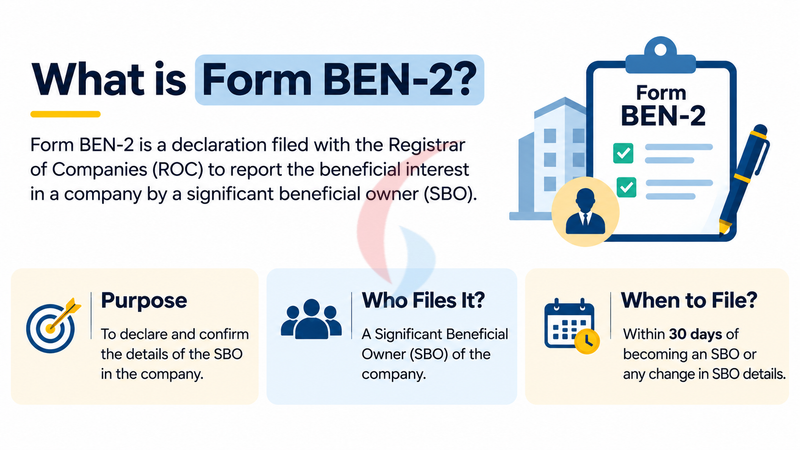
When an individual qualifies as an SBO, they must submit a declaration in Form BEN-1 to the reporting company. The company must subsequently file BEN-2 within 30 days of receiving the declaration.
The objective is to identify the individuals behind corporate ownership structures, irrespective of whether they reside in India or abroad.
Legal Provisions Governing BEN-2 Applicability
The Companies Act, 2013 and the amended SBO Rules prescribe the identification, declaration and reporting requirements for significant beneficial ownership.
|
Legal provision |
Applicability |
|
Section 89 |
Declaration of beneficial interest in shares |
|
Section 90 |
Significant beneficial ownership disclosure |
|
Section 2(27) |
Definition of control |
|
Rule 2(1)(d) |
Definition of majority stake |
|
Rule 2(1)(h) |
Identification of an SBO |
|
Rule 2A |
Duties of reporting companies |
|
Rule 3 |
BEN-1 declaration |
|
Rule 4 |
BEN-2 filing |
|
Rule 5 |
Maintenance of BEN-3 register |
|
Rule 6 |
Issuance of BEN-4 notice |
|
Rule 7 |
Application to the NCLT |
|
Rule 8 |
Exemptions from SBO requirements |
Companies can refer to the official Ministry of Corporate Affairs (MCA) website for applicable statutory provisions and filing requirements.
When is BEN-2 Applicable in Case of Foreign Investment?
Under Rule 2(1)(h), an individual may qualify as a Significant Beneficial Owner if they satisfy any of the following conditions:
Hold at least 10% of shares indirectly or through combined direct and indirect holdings.- Hold at least 10% of voting rights through qualifying indirect arrangements.
- Have an entitlement to at least 10% of distributable dividends or other distributions through qualifying indirect arrangements.
- Exercise significant influence or control otherwise than through direct holdings alone.
An individual holding shares directly in their own name does not ordinarily qualify as an SBO solely because their direct shareholding exceeds 10%. The company must examine indirect ownership and control arrangements before determining applicability.
How to Identify an SBO in a Foreign Company?
When a foreign corporate entity invests in an Indian company, the reporting company must examine its ownership structure and, where applicable, the ownership of its ultimate holding company.
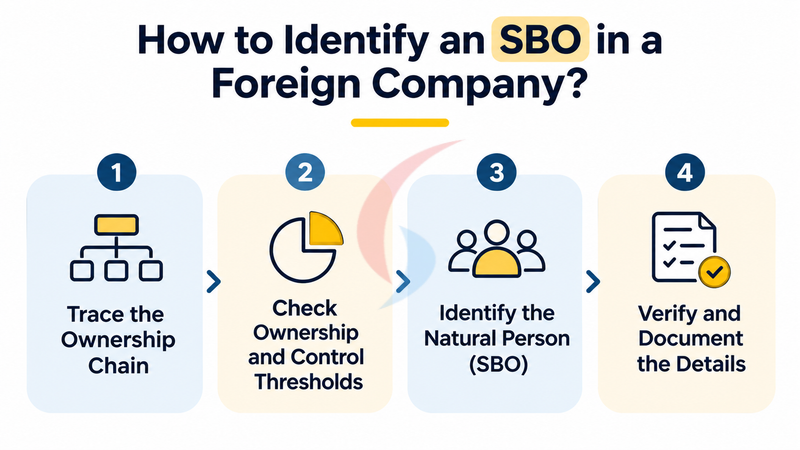
Under Explanation III of Rule 2(1)(h), an individual may hold an indirect interest if they possess a majority stake in the foreign corporate shareholder or its ultimate holding company.
A majority stake means holding more than 50% of equity share capital, voting rights or distributable dividend entitlements. The 50% majority stake test and the 10% SBO threshold serve different purposes and must be examined separately.
Understanding BEN-2 Through a Practical Example
Suppose GlobalTech India Private Limited receives foreign investment from GlobalTech Singapore Pte. Ltd., which acquires 80% of its shares. Mr. David holds 70% of the Singapore-based company.
|
Particulars |
Details |
|
Foreign company's holding in Indian company |
80% |
|
David's holding in foreign company |
70% |
|
Majority stake condition |
Satisfied |
|
SBO identification |
Applicable |
|
BEN-1 declaration |
Required |
|
BEN-2 filing |
Required |
Although David does not directly hold shares in the Indian company, he qualifies as an SBO through the prescribed indirect ownership test. The Indian company must obtain his BEN-1 declaration and file BEN-2 with the ROC.
BEN-2 Applicability in Different Foreign Investment Structures
|
Investment structure |
BEN-2 applicability |
|
Foreign individual holding shares directly |
Generally not applicable solely due to direct ownership |
|
Foreign wholly owned subsidiary |
Subject to SBO identification |
|
Foreign corporate shareholder |
Applicable if prescribed conditions are satisfied |
|
Foreign investment through trusts |
Subject to trust-related identification criteria |
|
Foreign investment funds |
Subject to pooled investment vehicle provisions |
|
Foreign investment below 10% |
May apply based on control, influence or combined entitlements |
|
Foreign company with dispersed ownership |
Requires detailed ownership assessment |
The nationality of an investor does not determine BEN-2 applicability. The actual ownership rights and control arrangements are more important.
BEN-2 Applicability in Foreign Wholly Owned Subsidiaries
An Indian wholly owned subsidiary (WOS) of a foreign company must examine the ownership of its overseas parent company to identify its Significant Beneficial Owners. Even though the foreign parent holds the entire share capital, the individuals behind that corporate entity may have reporting obligations.
The exemption under Rule 8(b) for a holding reporting company does not automatically apply to an overseas parent company. Where no individual satisfies the prescribed SBO conditions, the Indian subsidiary should maintain documentary evidence of its ownership assessment.
Businesses planning to establish a subsidiary can read our guide on Foreign Subsidiary Company and WOS Registration in India.
BEN-2 Applicability for Foreign Investment Funds and Trusts
Foreign investments are sometimes routed through private equity funds, venture capital funds and trusts. In such cases, the identification of an SBO depends on the legal structure of the investment vehicle.
For qualifying foreign pooled investment vehicles satisfying the prescribed FATF and IOSCO conditions, the relevant individual may be the general partner, investment manager or CEO of the corporate or partnership investment manager.
For trusts, the relevant individual may be the trustee of a discretionary or charitable trust, beneficiary of a specific trust or settlor of a revocable trust, depending on the nature of the arrangement.
Exemptions from BEN-2 Compliance
Rule 8 of the Companies (Significant Beneficial Owners) Rules, 2018 provides exemptions to the extent shares are held by specified entities.
|
Exempted entity |
Legal provision |
|
Investor Education and Protection Fund Authority |
Rule 8(a) |
|
Holding reporting company |
Rule 8(b) |
|
Central or State Government or local authority |
Rule 8(c) |
|
Specified government-controlled entities |
Rule 8(d) |
|
SEBI-registered AIFs, mutual funds, REITs and InvITs |
Rule 8(e) |
|
Investment vehicles regulated by RBI, IRDAI or PFRDA |
Rule 8(f) |
Under Rule 8(b), the details of the holding reporting company must still be disclosed through BEN-2. Foreign companies and overseas investment funds do not automatically qualify for these exemptions.
Documents Required for BEN-2 Filing
Indian companies receiving foreign investment should collect sufficient documents to verify their ultimate ownership structure and identify Significant Beneficial Owners (SBOs). These documents generally include duly signed Form BEN-1, the foreign company's incorporation certificate, shareholding pattern, ultimate holding company details, passport and identification documents of the SBO, and a corporate ownership structure chart.
Additional documents may include shareholder agreements, the register of members of the Indian company, details of voting rights and indirect ownership, and authorisation for filing BEN-2, wherever applicable. While BEN-1 serves as the principal supporting declaration for individual SBO reporting, other documentation requirements may vary depending on the ownership structure and applicable statutory provisions.
Procedure for Filing BEN-2 in Case of Foreign Investment
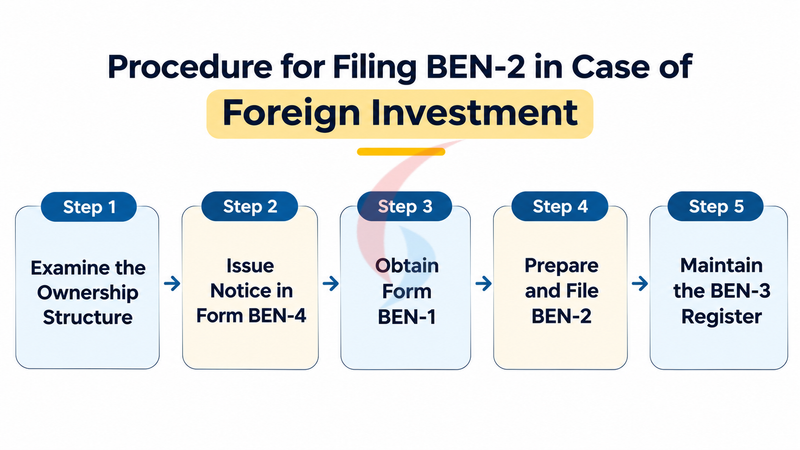
Step 1: Examine the Ownership Structure
The Indian company must review the shareholding pattern of its foreign shareholders and identify the individuals behind the corporate ownership structure. Voting rights, dividend entitlements and management control should also be examined.
Step 2: Issue Notice in Form BEN-4
Under Section 90(5) and Rule 2A, companies must issue BEN-4 notices wherever applicable, including to qualifying non-individual shareholders holding at least 10% of the prescribed rights. This helps obtain information regarding significant beneficial ownership.
Step 3: Obtain Form BEN-1
The identified SBO must submit a declaration in Form BEN-1 containing personal particulars, indirect ownership details and the nature of beneficial interest. The company should verify the declaration against supporting records.
Step 4: Prepare and File BEN-2
The company must complete the BEN-2 webform on the MCA V3 Portal, attach applicable documents and obtain the required digital signatures and professional certification. The prescribed filing fees must also be paid.
Step 5: Maintain the BEN-3 Register
Under Rule 5, the company must maintain a register of Significant Beneficial Owners in Form BEN-3. The register must be updated whenever there is a change in significant beneficial ownership.
For detailed filing requirements, refer to the official MCA BEN-2 Instruction Kit.
Due Date for BEN-2 Filing
BEN-2 is an event-based compliance rather than an annual filing. Companies must monitor changes in foreign ownership to ensure timely reporting.
|
Compliance |
Time limit |
|
Submission of BEN-1 |
Within 30 days of acquiring or changing SBO status |
|
Filing of BEN-2 |
Within 30 days of receiving BEN-1 |
|
Response to BEN-4 |
Within 30 days of notice |
|
Application to NCLT for non-disclosure |
Within 15 days after expiry of the notice period |
|
NCLT restriction order |
Within 60 days of receiving the application |
What Happens When Ownership Changes Outside India?
Imagine Nova Engineering Private Limited, an Indian subsidiary of a German company. The German parent company is controlled by Mr. Anderson. After a few years, another investor, Ms. Emma, acquires 75% of the German company.
Although the direct shareholding of the Indian subsidiary remains unchanged, its ultimate ownership has changed. The Indian company must reassess the SBO position, obtain applicable declarations and report the changes through BEN-2.
This example explains why Indian subsidiaries must remain informed about ownership changes taking place in their overseas parent companies.
Difference Between BEN-2, MGT-6 and FC-GPR
Indian companies receiving foreign investment may have multiple reporting obligations. Each form serves a different legal purpose.
|
Particulars |
BEN-2 |
MGT-6 |
FC-GPR |
|
Governing law |
Section 90 |
Section 89 |
FEMA |
|
Purpose |
SBO disclosure |
Beneficial interest disclosure |
Foreign investment reporting |
|
Authority |
ROC |
ROC |
RBI |
|
Supporting declaration |
BEN-1 |
MGT-4 and MGT-5, as applicable |
Investment documents |
|
Filing deadline |
30 days from declaration receipt |
30 days from declaration receipt |
30 days from issue of equity instruments |
Filing FC-GPR does not remove the requirement to comply with Section 89 or Section 90 of the Companies Act, 2013.
Also read: Wholly Owned Subsidiary Compliance: A Complete Roadmap for Businesses.
Latest Updates on BEN-2 Compliance in 2026
The Companies (Significant Beneficial Owners) Amendment Rules, 2024, notified on 15 July 2024 through G.S.R. 404(E), introduced a revised BEN-2 webform on the MCA V3 portal. The revised form provides separate reporting options for new declarations, changes in existing significant beneficial ownership and holding reporting company details.
The general 10% SBO threshold continues to apply under the provisions reviewed as of November 2026. Companies must also separately examine applicable foreign investment restrictions under FEMA and the FDI policy, as their beneficial ownership tests may differ from Section 90.
In 2026, ROC adjudication proceedings continued to address delayed BEN-2 filings, highlighting the importance of timely corporate ownership disclosures.
Why Choose Compliance Calendar LLP?
Compliance Calendar LLP assists Indian companies and multinational businesses with SBO identification, foreign shareholding analysis, BEN-1 declarations, BEN-4 notices, BEN-2 filing and statutory record maintenance.
Our professionals also provide Foreign Subsidiary Company Registration and FEMA Advisory Services, helping businesses fulfil their corporate and foreign investment reporting obligations.
For professional assistance, contact 9988424211 or email info@ccoffice.in
Frequently Asked Questions (FAQs)
Q1. Is BEN-2 mandatory for every foreign investment?
Ans. No. BEN-2 is applicable where the prescribed significant beneficial ownership or other reporting conditions are satisfied.
Q2. What is the minimum threshold for SBO identification?
Ans. The prescribed threshold is 10% of qualifying shares, voting rights or distribution entitlements. Significant influence and control are examined separately.
Q3. Can a foreign national be an SBO?
Ans. Yes. Foreign nationals satisfying the prescribed ownership or control conditions can qualify as Significant Beneficial Owners.
Q4. Is BEN-2 an annual compliance?
Ans. No. BEN-2 is an event-based compliance triggered by applicable ownership declarations and changes.
Q5. What is the due date for BEN-2 filing?
Ans. The reporting company must file BEN-2 within 30 days of receiving the BEN-1 declaration.
Q6. Is BEN-2 applicable to foreign wholly owned subsidiaries?
Ans. Foreign-owned Indian subsidiaries must assess their SBO position and file BEN-2 wherever the prescribed reporting conditions are satisfied.
Q7. Is BEN-2 required for direct foreign individual shareholding?
Ans. Direct shareholding alone does not ordinarily trigger SBO reporting. Qualifying indirect ownership or control arrangements must be examined.
Q8. Can BEN-2 be filed after the due date?
Ans. Yes, subject to applicable additional filing fees and potential statutory penalties for delayed compliance.
Q9. Does FC-GPR replace BEN-2 filing?
Ans. No. Both forms serve different legal purposes under FEMA and the Companies Act, 2013, respectively.
Q10. What happens if no SBO is identified?
Ans. The company should maintain evidence of its ownership assessment, issue applicable BEN-4 notices and examine other prescribed reporting obligations.
Article last updated on : 24 Nov 2026.



























































_learn_crop10_thumb.jpg)