


Indian companies often require additional funds to expand their business, purchase machinery, manage operational expenses or enter new markets. While domestic bank loans and equity funding are common financing options, companies having foreign directors may also consider borrowing directly from them. Such arrangements can offer flexibility in repayment, competitive borrowing costs and timely access to capital without immediate dilution of ownership.
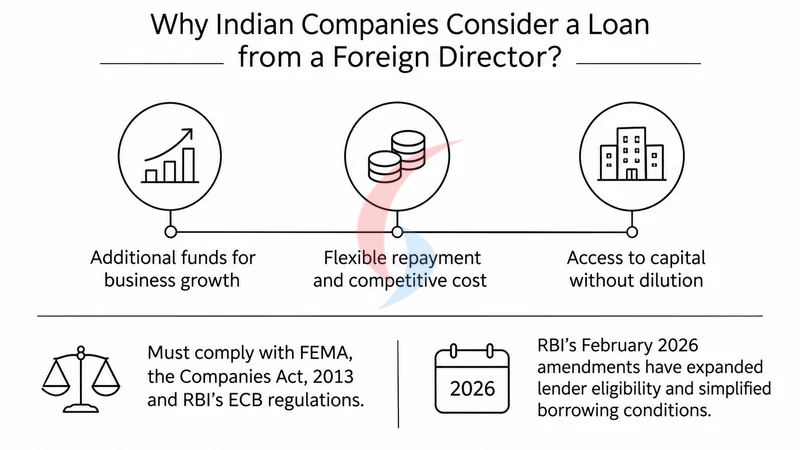
However, accepting a loan from a foreign director is not as simple as accepting an unsecured loan from a resident director. Cross-border borrowing attracts the provisions of the Foreign Exchange Management Act, 1999 (FEMA), the Companies Act, 2013, and the External Commercial Borrowing (ECB) regulations prescribed by the Reserve Bank of India (RBI).
The RBI introduced significant amendments to the ECB regulations in February 2026, expanding the eligibility of overseas lenders and simplifying various borrowing conditions. These changes have created additional financing opportunities for Indian businesses having non-resident directors.
What is a Loan from a Foreign Director?
A loan from a foreign director refers to financial assistance provided by a director residing outside India to an Indian company, generally under an agreement specifying the interest rate, repayment period, borrowing amount and other commercial conditions. Such loans may be denominated in Indian Rupees or foreign currency, subject to applicable FEMA regulations. Unlike equity investment, a conventional director's loan does not result in an immediate increase in share capital or dilution of existing shareholding.
It is important to distinguish between foreign nationality and residential status under FEMA. A foreign citizen residing in India may qualify as a resident under FEMA, whereas an Indian citizen residing abroad may qualify as a non-resident. Section 2(v) of FEMA determines residential status based on statutory conditions, including the purpose and circumstances of residence.
A loan received from a non-resident director cannot always be treated as an ordinary unsecured loan. Such transactions must be examined under FEMA and applicable overseas borrowing regulations. Understanding Why a Foreign Director’s Loan Becomes ECB helps companies avoid regulatory mistakes.
Can an Indian Company Borrow Money from a Foreign Director?
Yes, an eligible Indian company can borrow money from a non-resident director subject to compliance with the applicable ECB regulations. Under the Foreign Exchange Management (Borrowing and Lending) (First Amendment) Regulations, 2026, the RBI has expanded the recognised lender category to include persons resident outside India. Consequently, a non-resident director may qualify as a recognised lender even without holding shares in the borrowing company.
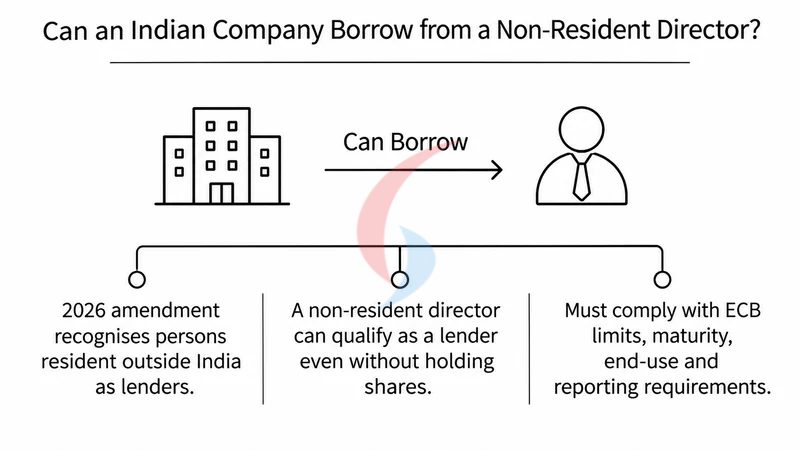
Under the earlier ECB provisions, individual overseas lenders were generally permitted where they qualified as foreign equity holders or subscribed to eligible bonds or debentures listed abroad. The revised regulations have substantially widened individual lender eligibility. However, this relaxation does not remove the requirement to comply with borrowing limits, maturity conditions, permitted end-use, banking procedures and statutory reporting.
Legal Provisions Governing Loans from Foreign Directors
Indian companies accepting loans from overseas directors must consider the following statutory provisions:
| Act or Regulation | Applicability |
| Foreign Exchange Management Act, 1999 | Regulates cross-border borrowing transactions. |
| FEMA (Borrowing and Lending) Regulations, 2018 | Governs borrowing between residents and non-residents, as amended. |
| FEMA Amendment Regulations, 2026 | Introduces revised ECB borrowing conditions. |
| Section 179, Companies Act, 2013 | Governs Board approval for borrowing. |
| Section 180, Companies Act, 2013 | Prescribes borrowing limits and shareholder approval, wherever applicable. |
| Section 184, Companies Act, 2013 | Governs disclosure of directors' interests, wherever applicable. |
| Companies (Acceptance of Deposits) Rules, 2014 | Determines whether the amount qualifies for exclusion from deposits. |
| RBI Master Direction on FEMA Reporting | Prescribes reporting forms and related obligations. |
Compliance with the Companies Act alone does not authorise an overseas borrowing transaction. The company must independently satisfy the applicable FEMA provisions before receiving funds.
FEMA compliance extends beyond foreign investment and also covers international borrowing and remittance transactions. Indian companies receiving financial assistance from overseas directors must understand their regulatory responsibilities. Read Who Needs FEMA Compliance in India to identify applicable obligations.
Latest RBI Rules for ECB
The RBI notified the revised ECB regulations on 9 February 2026, which were published in the Official Gazette on 16 February 2026. Subsequently, on 18 February 2026, the RBI issued revised ECB reporting instructions. The amendments have simplified overseas borrowing by expanding lender eligibility, revising borrowing limits and providing greater flexibility in the utilisation of funds.
| Particulars | Revised ECB provisions 2026 |
| Recognised lender | Includes persons resident outside India |
| Foreign shareholding | Not mandatory for individual lender eligibility |
| Borrowing currency | INR or foreign currency |
| Minimum average maturity | Generally three years |
| Borrowing limit | Higher of outstanding ECB up to USD 1 billion or total outstanding borrowing up to 300% of net worth, subject to applicable conditions |
| Interest rate | In accordance with prevailing market conditions, subject to applicable exceptions |
| Working capital | Permitted subject to applicable restrictions |
| Loan registration | LRN required before drawdown |
| Reporting | Form ECB 1, Revised Form ECB 1 and Form ECB 2 |
Eligible manufacturing companies may also access shorter maturity ECBs of one to three years, subject to the prescribed USD 50 million outstanding limit and other conditions.
The RBI periodically revises foreign exchange regulations to simplify cross-border financial transactions. Companies receiving overseas loans must remain updated with these regulatory changes. Read more about FEMA Compliance 2026: Latest Rules & Updates to understand the latest compliance requirements.
Storytelling: How a Foreign Director Helped an Indian Company Expand
Consider an illustrative example of NovaTech Solutions Private Limited, a growing technology company based in Gurugram. The company recently secured a major international contract but required Rs 2 crore to expand its operations, recruit employees and upgrade its technology infrastructure.
One of its directors, based in Singapore, offered to provide the required funds through his personal savings. The management initially believed that passing a Board resolution and executing an unsecured loan agreement would be sufficient to receive the money.
However, during a discussion with its FEMA compliance consultant, the management discovered that the proposed transaction was subject to ECB regulations. The company was advised to complete the regulatory documentation before accepting the overseas remittance.
The company subsequently verified the director's residential status, executed a four-year loan agreement on commercially appropriate terms, approached its designated AD Category I Bank and obtained a Loan Registration Number (LRN). After completing the necessary formalities, the company received the funds and maintained records of their utilisation.
What initially appeared to be an ordinary director's loan became a properly documented international borrowing transaction. The company secured its expansion capital while avoiding unnecessary regulatory complications. A foreign director's willingness to support a business financially should always be accompanied by proper documentation and FEMA compliance.
Conditions for Accepting Loans from Foreign Directors
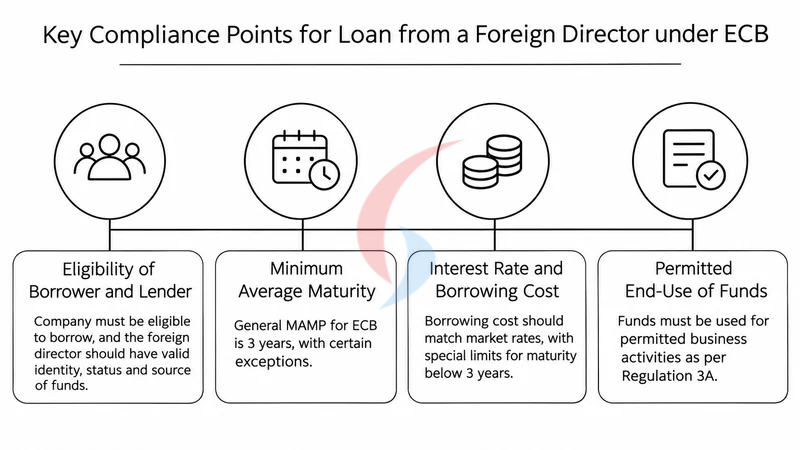
Indian companies accepting loans from foreign directors must comply with the applicable FEMA and RBI regulations. Companies must verify lender eligibility, borrowing limits, minimum maturity period, interest rates and permitted end-use of funds. Proper documentation, corporate approvals and timely ECB reporting are also essential to avoid regulatory non-compliance.
1. Eligibility of Borrower and Lender
The Indian borrowing entity must be legally permitted to borrow under its governing legislation. Under the revised ECB regulations, eligible entities may obtain commercial borrowing from persons resident outside India, including qualifying non-resident directors. The company should maintain sufficient evidence of the director's identity, residential status, source of funds and banking details.
2. Minimum Average Maturity Period
The general minimum average maturity period (MAMP) for ECB is three years. Companies cannot ordinarily structure repayment or exercise contractual repayment options in a manner that violates this requirement.Certain manufacturing sector borrowings and specified transactions qualify for exceptions under the revised regulations.
3. Interest Rate and Borrowing Cost
The 2026 amendments require borrowing costs to be consistent with prevailing market conditions. Special cost ceilings apply to eligible ECBs having an average maturity of less than three years. Companies should also consider related-party pricing requirements and maintain supporting documents demonstrating the commercial reasonableness of the interest rate.
4. Permitted End-Use of Funds
Companies must ensure that funds received from foreign directors are utilised for legally permissible business activities. Regulation 3A of the amended regulations specifies prohibited uses, along with applicable exceptions.
| Permitted activities, subject to conditions | Restricted activities, subject to exceptions |
| Business expansion | Chit fund business |
| Purchase of machinery | Nidhi company business |
| Working capital requirements | Prohibited real estate activities |
| Technology development | Trading in transferable development rights |
| Business operations | Restricted securities transactions |
| Eligible capital expenditure | Unauthorised on-lending |
Companies should maintain invoices, bank statements and expenditure records to demonstrate appropriate utilisation of borrowed funds.
Foreign borrowing involves several regulatory considerations, including maturity, borrowing costs and reporting obligations. Professional guidance can help companies structure their overseas borrowing appropriately. Explore FEMA Advisory 2026: Latest RBI Rules & Updates for further information.
Documents Required for Loan from Foreign Directors
Proper documentation enables the designated AD Bank to examine the transaction and process ECB registration. Although documentation requirements may vary depending on the nature of borrowing, companies generally require the following:
- Certificate of Incorporation, PAN, MOA and AOA.
- Board resolution approving overseas borrowing.
- Passport and residential status proof of the foreign director.
- Director's KYC and overseas banking details.
- Executed ECB loan agreement.
- Declaration regarding the source of funds.
- Latest audited financial statements.
- Proposed loan repayment and interest schedule.
- End-use declaration and supporting documents.
- Form ECB 1 and applicable professional certifications.
- Shareholding pattern and related-party details, wherever applicable.
Before accepting overseas funds, companies should verify lender eligibility, financial records and regulatory documentation. A proper compliance review can help identify potential FEMA violations. Businesses can refer to FEMA Due Diligence: Process, Checklist & Compliance for a detailed understanding.
Procedure to Obtain a Loan from a Foreign Director under ECB
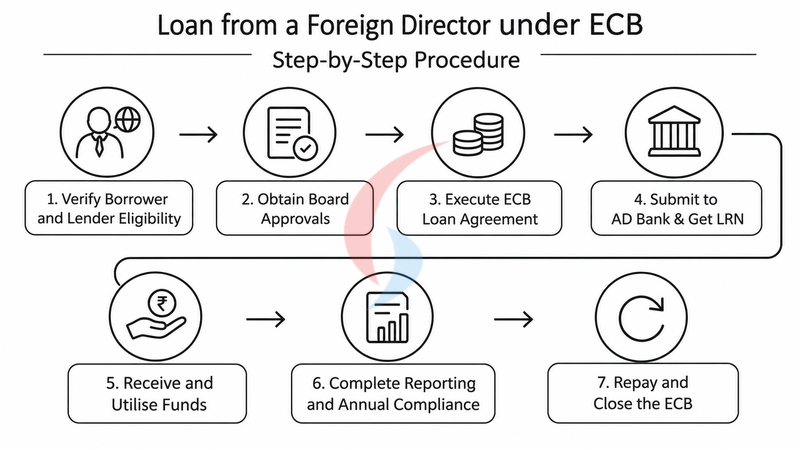
An Indian company planning to borrow funds from a non-resident director must follow the prescribed RBI regulations and complete the necessary corporate approvals before receiving the loan. The following step-by-step procedure helps companies ensure proper documentation, registration and reporting of overseas borrowing.
Step 1: Verify Borrower and Lender Eligibility
The company must first verify its eligibility to raise funds under the applicable ECB regulations. It must also examine the foreign director's residential status under FEMA, identity documents, source of funds and eligibility as a recognised lender.
Step 2: Obtain Necessary Corporate Approvals
The company must conduct a Board meeting and pass a resolution approving the proposed borrowing under Section 179(3)(d) of the Companies Act, 2013. Shareholder approval under Section 180 and disclosure of directors' interests must also be obtained wherever applicable.
Step 3: Prepare and Execute the ECB Loan Agreement
The Indian company and the foreign director must execute a formal loan agreement specifying the borrowing amount, currency, interest rate, maturity period and repayment obligations. The agreement should also include provisions relating to default, permitted utilisation and regulatory compliance.
Step 4: Submit Documents to the AD Category I Bank
The company must approach its designated Authorised Dealer (AD) Category I Bank with the executed loan agreement, Board resolution, lender's KYC documents and end-use declaration. The bank examines the proposed transaction to ensure compliance with FEMA and ECB regulations.
Step 5: Utilise Funds for Permitted Business Activities
The borrowed funds must be utilised in accordance with the declared purpose and applicable ECB end-use conditions. The company should maintain invoices, expenditure records and accounting documents to demonstrate proper utilisation of the loan.
Step 6: Complete ECB Reporting and Annual Compliance
Under the revised RBI regulations of 2026, Form ECB 2 must be submitted within seven calendar days following the month of loan receipt or debt servicing. Changes in borrowing terms must be reported through Revised Form ECB 1 within the applicable timeline. Form DPT-3 must also be filed wherever applicable.
Step 7: Repayment and Closure of ECB
The company must repay the principal amount and interest through its designated AD Bank according to the agreed repayment schedule and applicable maturity conditions. After full repayment, the company must complete final ECB reporting and coordinate with the bank for closure of the outstanding ECB records.
Managing overseas borrowing requires coordination with authorised dealer banks and timely regulatory reporting. Professional assistance can simplify documentation and reduce compliance-related complications. Learn how FEMA Advisory Consultants in India assist businesses with cross-border transactions.
RBI Reporting Requirements for Foreign Director Loans
ECB compliance does not end once the money reaches the company's bank account. Companies must continue reporting relevant transactions throughout the loan tenure. The RBI circular dated 18 February 2026 introduced revised reporting formats aligned with the amended ECB regulations.
| Form | Purpose | Timeline |
| Form ECB 1 | Registration and obtaining LRN | Before drawdown |
| Revised Form ECB 1 | Changes in reported ECB parameters | Within seven calendar days from the end of the relevant month |
| Form ECB 2 | Loan receipts, debt servicing and transactions affecting outstanding borrowing | Within seven calendar days from the end of the relevant month |
| Form DPT-3 | Reporting applicable outstanding amounts not considered deposits | Generally by 30 June annually |
An important change under the revised regulations is that Form ECB 2 reporting is linked to relevant borrowing and debt-servicing transactions, rather than the earlier routine monthly reporting requirement.
Companies receiving foreign investment and overseas loans must maintain separate records for their regulatory obligations. Timely reporting helps businesses avoid compliance complications during audits. Refer to the FEMA/RBI Compliance Checklist for Indian Companies with FDI for additional guidance.
Companies Act Compliance for Foreign Director Loans
Apart from FEMA compliance, Indian companies must comply with applicable corporate law requirements. Section 179(3)(d) of the Companies Act, 2013 empowers the Board to approve borrowing through a resolution passed at a Board meeting. Rule 2(1)(c)(ii) of the Companies (Acceptance of Deposits) Rules, 2014 excludes qualifying amounts received from overseas persons from the definition of deposits, subject to FEMA compliance.
Where the company relies on the director loan exclusion under Rule 2(1)(c)(viii), the director must provide a written declaration confirming that the money is not sourced from borrowing or deposits accepted from others. Relevant Board's Report disclosures must also be made.
Tax Implications of Loans from Foreign Directors
Interest payments to non-resident directors may attract withholding tax under applicable Indian income-tax legislation and relevant Double Taxation Avoidance Agreements (DTAA). Companies must examine the applicable withholding rate, obtain tax residency documents where treaty benefits are claimed and comply with Form 15CA and Form 15CB requirements, wherever applicable. International related-party borrowing may also attract transfer pricing provisions. Therefore, companies should maintain evidence demonstrating that the borrowing arrangement is commercially reasonable.
Companies may consider converting eligible overseas debt into equity subject to applicable FEMA and corporate law provisions. Such transactions require careful examination of investment eligibility and reporting requirements. Learn more about the Issue of Overseas Convertible Securities
What Happens If a Company Accepts a Foreign Director's Loan Without ECB Compliance?
Suppose an Indian company receives Rs 75 lakh from its overseas director without obtaining an LRN. The accountant records the amount as an unsecured director's loan without examining FEMA requirements. During statutory audit, the auditor identifies that the overseas borrowing was received without completing the prescribed registration. The company may then face difficulties in regulatory reporting, repayment of the loan and remittance of interest outside India.
Under Section 13 of FEMA, contraventions may attract penalties of up to three times the amount involved where quantifiable, or up to Rs 2 lakh where the amount cannot be quantified. Continuing contraventions may attract an additional penalty of up to Rs 5,000 per day after the first day. Reporting delays may be addressed through the applicable Late Submission Fee mechanism. However, substantive contraventions may require separate regulatory action or FEMA compounding, subject to eligibility.
Receiving overseas loans without completing the prescribed FEMA requirements may result in regulatory contraventions. Eligible violations can be regularised through the compounding process. Read FEMA Compounding Rules 2024: Key Amendments to understand the applicable provisions and procedures.
Why Choose Compliance Calendar LLP?
Accepting financial assistance from a foreign director requires coordination between company management, finance professionals, authorised dealer banks and regulatory authorities. Even a minor mistake in loan documentation or reporting can create difficulties during repayment or future fundraising.
Compliance Calendar LLP provides professional assistance with ECB Compliance, FEMA advisory, foreign borrowing documentation, Form ECB 1 filing, LRN registration, Form ECB 2 reporting and coordination with designated AD Banks.
Our professionals also assist businesses through FEMA Due Diligence Services, regulatory compliance reviews and identification of historical non-compliance. From planning an overseas borrowing transaction to its final repayment, Compliance Calendar LLP helps businesses manage their regulatory obligations while focusing on sustainable business growth.
For professional assistance, contact +91 9988424211 or email info@ccoffice.in
Frequently Asked Questions (FAQs)
Q1. Can an Indian private limited company accept a loan from a foreign director?
Ans. Yes, an eligible Indian private limited company can accept a loan from a non-resident director under applicable ECB regulations. The company must complete FEMA and corporate law compliance before receiving funds.
Q2. Is foreign shareholding mandatory for a director to provide an ECB loan?
Ans. No, the revised ECB regulations of 2026 have expanded recognised lender eligibility. A non-resident director may provide a loan without holding equity shares in the borrowing company.
Q3. Can a foreign director provide an interest-free loan?
Ans. The revised regulations recognise borrowing arrangements involving interest, if any, and repayment of principal. However, interest-free arrangements should be examined for market-based borrowing conditions and related-party tax implications.
Q4. Is RBI approval mandatory for every foreign director loan?
Ans. Separate prior RBI approval is not ordinarily required for a borrowing that satisfies applicable ECB regulations. However, obtaining an LRN and completing prescribed reporting through the designated AD Bank remain necessary.
Q5. What is the minimum maturity period for ECB?
Ans. The general minimum average maturity period is three years. Certain eligible manufacturing sector borrowings and specified transactions may qualify for exceptions.
Q6. Can ECB funds be used for working capital requirements?
Ans. Yes, working capital financing is generally permitted under the revised ECB regulations. Companies must ensure that utilisation complies with applicable borrowing conditions and prohibited end-use provisions.
Q7. Can a foreign director provide a loan in Indian Rupees?
Ans. Yes, ECB can be denominated in Indian Rupees or foreign currency. The transaction must comply with applicable FEMA regulations and authorised banking procedures.
Q8. Can a foreign director's loan be converted into equity?
Ans. Yes, eligible ECB may be converted into equity subject to applicable FDI regulations, pricing requirements and corporate approvals. Necessary ECB and foreign investment reporting must also be completed.
Q9. Is Form DPT-3 applicable to foreign director loans?
Ans. Companies may be required to report outstanding foreign director loans as amounts not considered deposits in Form DPT-3. Applicability depends on the relevant provisions and outstanding balances.
Q10. What happens if ECB reporting is delayed?
Ans. Eligible reporting delays may be regularised by completing the filing and paying the prescribed Late Submission Fee. Substantive FEMA violations may require compounding or other regulatory proceedings.
Article last updated on : 24 Nov 2026.








































































_learn_crop10_thumb.jpg)