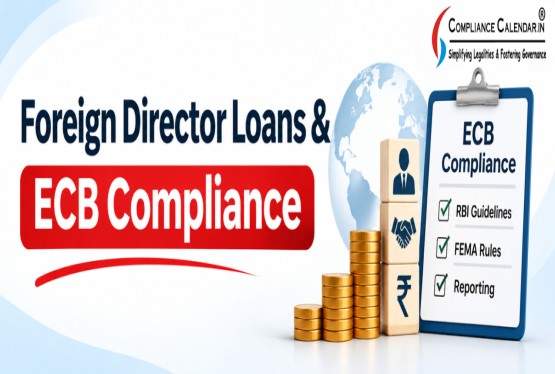



Indian companies often receive financial assistance from foreign directors to manage working capital, expand business operations or meet initial establishment costs. Such financial assistance may be received through External Commercial Borrowings (ECB), subject to the applicable regulations prescribed by the Reserve Bank of India (RBI).
However, as a business grows, the management may prefer to convert outstanding loans into equity rather than repay the borrowed amount. This arrangement allows the foreign director to become a shareholder or increase their existing shareholding while reducing the company's debt obligations and improving its financial position.
Loan to equity conversion for foreign directors involves compliance with the Companies Act, 2013, the Foreign Exchange Management Act, 1999 (FEMA), ECB regulations and Foreign Direct Investment (FDI) provisions. The revised ECB regulations introduced in February 2026 also permit the conversion of eligible overseas borrowings into non-debt instruments, subject to applicable conditions.
What is Loan to Equity Conversion for Foreign Directors?
Loan to equity conversion refers to an arrangement under which an Indian company issues shares to a foreign director against an outstanding loan instead of repaying the amount in cash. Following the conversion, the corresponding loan liability is extinguished, and the foreign director receives ownership rights in the company.
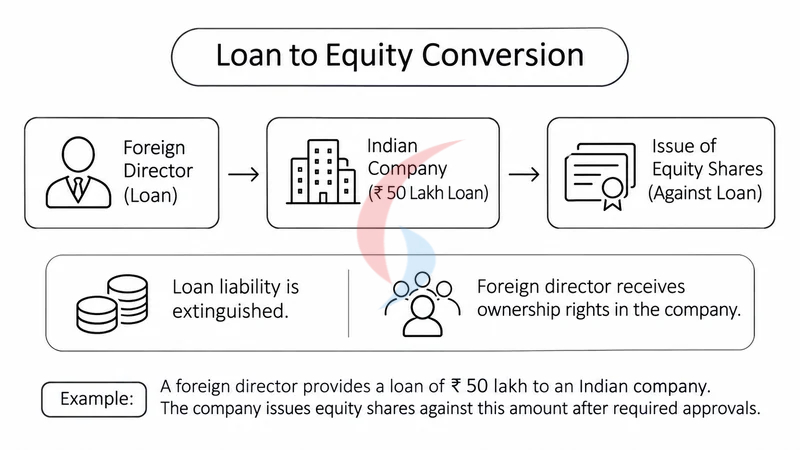
For example, if a foreign director has provided a loan of Rs 50 lakh to an Indian company, the company may issue equity shares against the outstanding amount after obtaining the necessary approvals and complying with applicable valuation requirements. The conversion may be complete or partial, depending on the agreement between the company and the foreign director.
Before converting an overseas director's loan into equity, companies must verify the compliance status of the original borrowing. Proper ECB registration and reporting are essential for completing the conversion. Read more about Loan from Foreign Directors and ECB Compliance
Can an Indian Company Convert a Foreign Director's Loan into Equity?
Yes, an Indian company can convert an eligible foreign director's loan into equity, provided the original borrowing complies with FEMA and the proposed conversion satisfies applicable foreign investment regulations. Under the revised FEMA (Borrowing and Lending) Regulations, 2018, as amended in February 2026, ECBs, including matured but unpaid borrowings, may be converted into non-debt instruments subject to the FEMA (Non-Debt Instruments) Rules, 2019.
However, merely passing a Board resolution or making an accounting adjustment does not complete the conversion. Companies must satisfy corporate approval, pricing, share allotment and regulatory reporting requirements.
Financial assistance received from non-resident directors may attract ECB regulations under FEMA. Companies must understand the regulatory nature of such borrowings before considering their conversion. Learn more about Why a Foreign Director’s Loan Becomes ECB?
Legal Provisions Governing Loan to Equity Conversion
The conversion of foreign directors' loans into equity is governed by several statutory provisions relating to corporate law, overseas borrowing and foreign investment.
| Legal provision | Applicability |
| Foreign Exchange Management Act, 1999 | Governs cross-border financial transactions. |
| FEMA (Borrowing and Lending) Regulations, 2018 | Regulates overseas borrowing and its conversion. |
| FEMA Amendment Regulations, 2026 | Prescribes revised ECB requirements. |
| FEMA (Non-Debt Instruments) Rules, 2019 | Governs foreign investment, pricing and sectoral restrictions. |
| Section 62(3), Companies Act, 2013 | Conversion based on previously approved loan terms. |
| Section 62(1)(c), Companies Act, 2013 | Preferential allotment of shares. |
| Section 42, Companies Act, 2013 | Private placement requirements, wherever applicable. |
| Section 247, Companies Act, 2013 | Valuation by registered valuers, wherever applicable. |
| Rule 13 of Companies (Share Capital and Debentures) Rules, 2014 | Governs preferential allotment. |
| FEMA Mode of Payment and Reporting Regulations, 2019 | Governs foreign investment reporting. |
Latest RBI Guidelines for Loan to Equity Conversion
The RBI introduced revised ECB regulations through a notification dated 9 February 2026, published in the Official Gazette on 16 February 2026. The amendments provide greater flexibility in overseas borrowing and its conversion into eligible non-debt instruments.
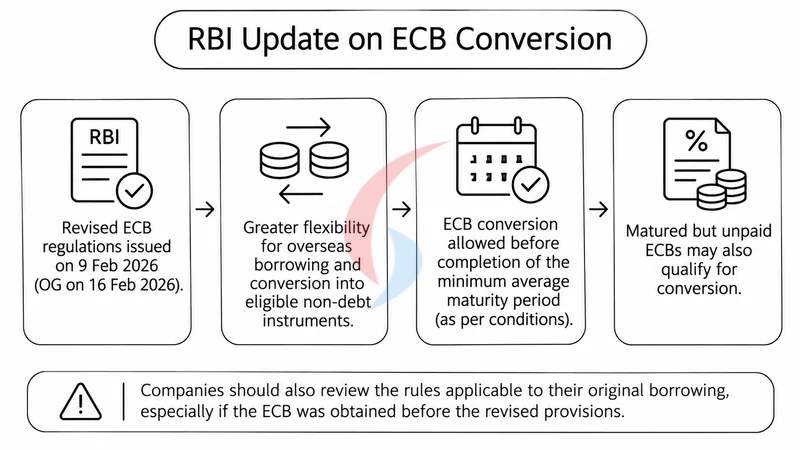
The regulations permit qualifying ECB conversion before completion of the minimum average maturity period, subject to applicable foreign investment requirements. Matured but unpaid ECBs may also qualify for conversion. Companies must also examine the regulations applicable to their original borrowing, particularly where the ECB was obtained before the introduction of the revised provisions.
Companies may raise overseas funds through different types of eligible convertible financial instruments. The regulatory treatment depends on the nature and conversion terms of the instrument. Read more about the Issue of Overseas Convertible Securities: Process, Procedure and Compliance
Conditions for Converting Foreign Directors' Loans into Equity
An Indian company must satisfy applicable ECB, FDI and corporate law requirements before converting a foreign director's loan into equity. The conversion must be supported by valid borrowing documents, lender consent, appropriate valuation and necessary corporate approvals.
| Condition | Compliance requirement |
| Lender consent | Written consent from the foreign director |
| Original borrowing | Compliance with applicable FEMA regulations |
| FDI sectoral cap | Foreign shareholding must remain within permitted limits |
| Entry route | Government approval wherever applicable |
| Pricing guidelines | Compliance with FEMA valuation requirements |
| Additional conversion cost | No additional conversion-related cost payable to the lender |
| Other lenders | Consent or exchange of information, as applicable |
| Regulatory reporting | ECB and FDI reporting requirements |
Where the company has obtained other credit facilities from RBI-regulated entities, applicable prudential and restructuring regulations must also be considered.
Conversion under Section 62 of the Companies Act, 2013
The procedure for converting a foreign director's loan into equity depends on whether the original loan agreement contained a conversion clause approved by the shareholders.
1. Conversion under Section 62(3)
Section 62(3) permits the conversion of loans into shares where the conversion option was included in the original borrowing terms and approved through a special resolution before raising the loan. The company cannot retrospectively rely on this exemption merely by adding a conversion clause after receiving the funds.
2. Conversion under Section 62(1)(c)
Where the original loan agreement does not contain a previously approved conversion option, the company may consider issuing shares through preferential allotment under Section 62(1)(c). The company must comply with applicable private placement provisions, obtain shareholder approval and arrange a valuation report from a registered valuer.
| Particulars | Section 62(3) | Section 62(1)(c) |
| Original conversion clause | Required | Not necessarily required |
| Special resolution | Before raising the loan | Before preferential allotment |
| Registered valuer report | Depends on applicable requirements | Required |
| Nature of allotment | Exercise of conversion option | Preferential allotment |
| FEMA compliance | Applicable | Applicable |
| FC-GPR reporting | Applicable for FDI | Applicable for FDI |
Companies may consider preferential allotment where the original loan agreement does not contain a previously approved conversion option. Such transactions require compliance with applicable corporate approvals, valuation and allotment provisions. Refer to Conversion of Loan into Equity under Section 62(1)(c) of the Companies Act, 2013
Storytelling: How a Foreign Director's Loan Helped a Startup Reduce Its Debt
Consider an illustrative example of Green Technologies Private Limited, a Bengaluru-based renewable energy startup. The company received an ECB loan of Rs 1 crore from one of its directors residing in Singapore to expand its manufacturing operations.
Although the business was growing, regular interest payments were affecting its cash flow. The management also planned to approach new investors, who were concerned about the company's outstanding liabilities.
The foreign director agreed to convert the entire outstanding principal into equity. After reviewing the original loan agreement, the company obtained the necessary corporate approvals, arranged a valuation report and coordinated with its designated AD Bank.
The agreed issue price was Rs 100 per share, including a face value of Rs 10 and securities premium of Rs 90. Accordingly, the company allotted 1 lakh equity shares to the foreign director.
| Particulars | Amount |
| Outstanding loan principal | Rs 1 crore |
| Issue price per share | Rs 100 |
| Equity shares allotted | 1,00,000 |
| Increase in share capital | Rs 10 lakh |
| Increase in securities premium | Rs 90 lakh |
| Remaining principal liability | Nil |
After completing the applicable ROC and RBI reporting, the company reduced its outstanding debt and strengthened its capital position. This example demonstrates how a properly structured loan conversion can help businesses manage financial obligations without requiring an immediate cash repayment.
Companies intending to convert directors' loans under Section 62(3) must obtain shareholder approval before raising the loan. Proper documentation of the conversion option is essential for complying with statutory requirements. Read more about Prior Approval of Members and MGT-14 Filing for Conversion of Directors' Loans
Documents Required for Loan to Equity Conversion
Companies should maintain proper corporate, financial and foreign investment records to support the proposed conversion. The documentation requirements may vary depending on the original borrowing terms and applicable conversion route.
- Certificate of Incorporation, MOA and AOA.
- Original loan agreement and conversion terms.
- Loan Registration Number (LRN).
- Previous ECB reporting records.
- Foreign director's passport and KYC documents.
- Original inward remittance records.
- Written consent from the foreign director.
- Latest audited financial statements.
- Share valuation report.
- Board and shareholder resolutions.
- Loan to equity conversion agreement.
- Pre-conversion and post-conversion shareholding patterns.
- Applicable government approvals.
- Form PAS-3 and FC-GPR supporting documents.
A comprehensive FEMA compliance review helps businesses identify historical borrowing and reporting discrepancies. Reviewing loan agreements, remittance records and regulatory filings is particularly important before converting overseas debt into equity. Read more about FEMA Due Diligence: Process, Checklist & Compliance
Procedure for Loan to Equity Conversion for Foreign Directors
The procedure for converting a foreign director's loan into equity involves reviewing the loan agreement, verifying FEMA compliance, obtaining necessary corporate approvals and determining the share valuation. The company must allot equity shares in accordance with the Companies Act, 2013 and applicable foreign investment regulations. It must also complete the applicable ROC and RBI reporting requirements, including PAS-3 and FC-GPR filings.
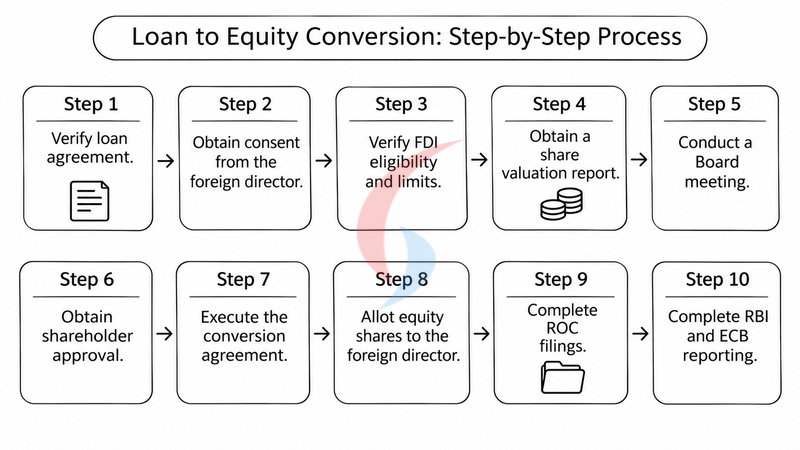
Step 1: Verify the Original Loan Agreement
Examine the original borrowing documents, outstanding loan balance and applicable ECB compliance records. Determine whether the agreement contains a conversion option previously approved under Section 62(3) of the Companies Act, 2013.
Step 2: Obtain Consent from the Foreign Director
Obtain written consent from the foreign director specifying the amount proposed for conversion and agreed commercial conditions. Coordinate with other existing lenders wherever their consent or intimation is required.
Step 3: Verify FDI Eligibility and Sectoral Limits
Examine whether the company's business activities permit foreign investment under the automatic or government approval route. Ensure that the proposed conversion does not breach applicable sectoral caps, beneficial ownership restrictions or investment conditions.
Step 4: Obtain a Share Valuation Report
Determine the fair value of the proposed equity shares in accordance with FEMA pricing guidelines and applicable Companies Act provisions. Obtain the necessary valuation reports from appropriately qualified professionals.
Step 5: Conduct a Board Meeting
Conduct a Board meeting to consider the proposed conversion, valuation report, number of shares and revised shareholding structure. Approve the conversion proposal and convene a general meeting wherever fresh shareholder approval is required.
Step 6: Obtain Shareholder Approval
Pass the necessary special resolution where the conversion is undertaken through preferential allotment under Section 62(1)(c). Complete Form MGT-14 filing and applicable private placement requirements within the prescribed timelines.
Step 7: Execute the Loan Conversion Agreement
Prepare an agreement specifying the outstanding loan amount, conversion price, number of equity shares and effective conversion date. Clearly document the settlement of the corresponding debt and treatment of any outstanding interest.
Step 8: Allot Equity Shares to the Foreign Director
Conduct a Board meeting to approve the allotment of equity shares against the eligible outstanding loan. Update statutory registers and issue share certificates or credit dematerialised shares, as applicable.
Step 9: Complete ROC Filing Requirements
File Form PAS-3 with the Registrar of Companies along with the applicable allotment documents. Where the existing authorised share capital is insufficient, complete the necessary capital increase and Form SH-7 filing before allotment.
Step 10: Complete RBI and ECB Reporting
Submit Form FC-GPR through the RBI FIRMS portal and report the loan conversion through Form ECB 2 via the designated AD Bank. Complete Revised Form ECB 1 reporting wherever applicable and reconcile the remaining outstanding loan balance.
Following loan conversion, companies must complete applicable post-allotment formalities and update statutory records. Share certificate issuance, dematerialisation and stamp duty requirements must also be examined. Refer to Share Certificates and Stamp Duty Payment in India
Valuation and Pricing Guidelines for Loan Conversion
Valuation is an important part of foreign director loan conversion because the transaction results in the issuance of shares to a non-resident investor. For an unlisted Indian company, the issue price must ordinarily not be lower than the fair value determined under an internationally accepted valuation methodology on an arm's length basis and certified by an eligible professional under FEMA.
Where preferential allotment provisions apply, a registered valuer's report is also required under the Companies Act. Companies should ensure that both statutory valuation requirements are satisfied rather than assuming that one valuation report automatically fulfils every requirement. Listed companies must comply with applicable SEBI pricing and issuance regulations.
Issuing equity shares to a foreign director requires compliance with applicable FEMA pricing guidelines. A proper valuation report helps establish the fair value of shares and supports foreign investment reporting. Learn more about the Need of Valuation Report under FEMA Law.
Exchange Rate Applicable to ECB Conversion
Under the revised ECB regulations of 2026, the foreign currency loan liability may be converted using the exchange rate prevailing on the date of the conversion agreement. An alternative exchange rate may be used provided it does not produce a higher liability than the amount determined using the prevailing rate. Companies should preserve the exchange rate calculation and conversion agreement as supporting documents for valuation, accounting and regulatory reporting.
ROC and RBI Filing Requirements
The conversion of overseas debt into equity creates reporting obligations under both corporate law and FEMA.
| Form | Purpose | Due date |
| MGT-14 | Filing applicable special resolutions | Within 30 days of resolution |
| SH-7 | Increase in authorised share capital, if required | Within 30 days of alteration |
| PAS-3 | Return of allotment | Within 15 days for private placement; generally 30 days for other allotments |
| FC-GPR | Reporting issuance of equity instruments under FDI | Within 30 days of issue |
| Revised Form ECB 1 | Reporting changes in ECB parameters, wherever applicable | Within seven calendar days from the end of the relevant month |
| ECB 2 | Reporting full or partial loan conversion under revised ECB provisions | Within seven calendar days from the end of the relevant month |
| FLA Return | Annual foreign investment reporting, wherever applicable | Generally by 15 July annually |
| CHG-4 | Satisfaction of registered charge, wherever applicable | Ordinarily within 30 days of satisfaction |
Companies can complete their corporate filings through the MCA Portal and foreign investment reporting through the RBI FIRMS Portal.
Conversion of financial instruments into equity may create additional foreign investment reporting obligations. Companies must identify the applicable reporting treatment based on the nature of the original instrument. Explore FC-GPR Filing After CCPS Conversion into Equity to understand reporting considerations for a related but distinct type of conversion.
Accounting Treatment of Loan to Equity Conversion
The company must remove the converted loan liability from its books and recognise the corresponding equity share capital and securities premium. Using the earlier example, a simplified journal entry, assuming the applicable accounting requirements support recognition at these amounts, would be:
| Particulars | Debit (Rs) | Credit (Rs) |
| Foreign Director's Loan A/c | 1,00,00,000 | — |
| Equity Share Capital A/c | — | 10,00,000 |
| Securities Premium A/c | — | 90,00,000 |
| Total | 1,00,00,000 | 1,00,00,000 |
Companies following Ind AS must separately examine applicable financial liability derecognition and equity measurement requirements. Any difference arising from the conversion must be accounted for according to the applicable accounting standards.
Tax Implications of Loan to Equity Conversion
Companies must examine the tax implications of converting both principal and accrued interest into equity. Where outstanding interest is converted into shares, applicable withholding tax obligations may arise even without an actual cash payment.
Related-party borrowing and conversion arrangements may also attract transfer pricing requirements. The company should maintain supporting documents demonstrating the commercial reasonableness of the transaction and obtain professional tax advice wherever necessary.
Can a Non-Compliant Foreign Director's Loan Be Converted into Equity?
An Indian company cannot automatically regularise an unauthorised overseas loan by converting it into equity. If the original borrowing was received without complying with applicable FEMA regulations, the company must examine and address the underlying contravention. Eligible reporting delays may be resolved through the applicable Late Submission Fee mechanism, while substantive violations may require FEMA compounding or other regulatory action.
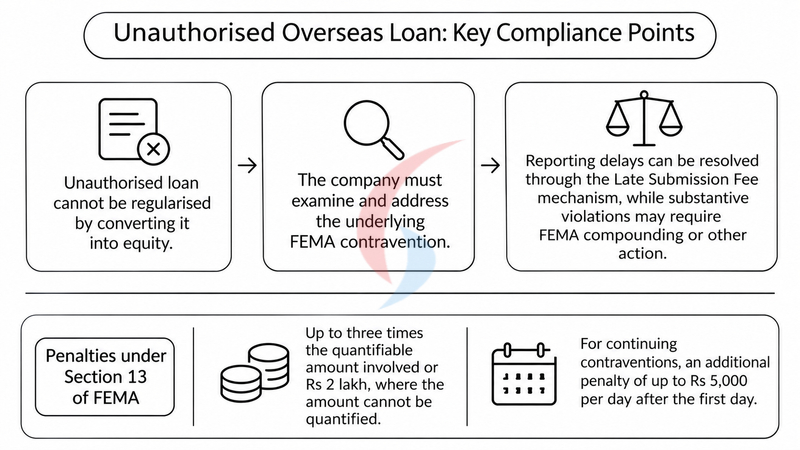
Under Section 13 of FEMA, contraventions may attract penalties of up to three times the quantifiable amount involved or Rs 2 lakh where the amount cannot be quantified. Continuing contraventions may attract additional penalties of up to Rs 5,000 per day after the first day.
Historical FEMA violations should be examined before undertaking any overseas debt conversion. Professional advisory services can help businesses identify appropriate regulatory corrective measures. Learn more about FEMA Advisory Consultants in India
Why Choose Compliance Calendar LLP?
Compliance Calendar LLP provides professional assistance to Indian companies with foreign director loan conversion, ECB compliance, FEMA advisory, share valuation coordination and corporate approvals. Our professionals review existing loan agreements, foreign investment eligibility and statutory requirements to help businesses identify the appropriate conversion procedure.
From preparing Board and shareholder resolutions to completing PAS-3, FC-GPR and ECB reporting, Compliance Calendar LLP provides comprehensive regulatory support. Our team also assists with FEMA due diligence, historical compliance reviews and coordination with authorised dealer banks.
For professional assistance, contact +91 9988424211 or email info@ccoffice.in
Frequently Asked Questions (FAQs)
Q1. Can a foreign director's loan be converted into equity in India?
Ans. Yes, eligible loans from non-resident directors can be converted into equity shares. The company must comply with applicable FEMA, ECB, FDI and Companies Act provisions.
Q2. Is a conversion clause mandatory in the original loan agreement?
Ans. A previously approved conversion clause is necessary to rely on Section 62(3). Otherwise, the company may consider preferential allotment under Section 62(1)(c), subject to applicable conditions.
Q3. Is a valuation report mandatory for loan to equity conversion?
Ans. Companies must comply with applicable FEMA pricing guidelines. A registered valuer's report is additionally required where the conversion is undertaken through preferential allotment.
Q4. Can an ECB loan be converted before completing its minimum maturity period?
Ans. Yes, the revised ECB regulations of 2026 provide an exception to the minimum average maturity requirement for eligible conversions. Applicable foreign investment conditions must still be satisfied.
Q5. Is Form FC-GPR mandatory for loan to equity conversion?
Ans. Yes, where the issuance of shares qualifies as FDI, Form FC-GPR must be filed. The prescribed timeline is 30 days from the date of issuance of equity instruments.
Q6. Can outstanding interest also be converted into equity?
Ans. Eligible outstanding interest may be considered for conversion, subject to FEMA provisions and applicable tax requirements. Companies must examine withholding tax obligations before completing the transaction.
Q7. Can a foreign director partially convert a loan into equity?
Ans. Yes, partial conversion is permitted subject to applicable regulations. The remaining outstanding loan must continue to comply with relevant ECB conditions and reporting requirements.
Q8. Is Form PAS-3 required for converting a loan into equity?
Ans. Yes, companies must file Form PAS-3 to report the allotment of shares. The applicable filing deadline depends on the statutory allotment route followed.
Q9. Is a fresh foreign inward remittance required for conversion?
Ans. Generally, no fresh remittance is required because shares are issued against an eligible existing loan liability. The original borrowing and conversion must be properly documented and reported.
Q10. Can loan conversion regularise previous FEMA violations?
Ans. No, converting a loan into equity does not automatically resolve previous FEMA violations. Companies must separately address historical reporting defaults and substantive contraventions wherever applicable.
Article last updated on : 25 Nov 2026.

















































_learn_crop10_thumb.jpg)