



Foreign companies establishing subsidiaries in India often appoint their overseas executives as directors to supervise business operations, implement management strategies and maintain coordination between the Indian subsidiary and its foreign holding company. Appointing a foreign director also helps businesses benefit from international experience, technical knowledge and global business practices.
The Companies Act, 2013 permits foreign nationals to become directors of Indian companies, subject to prescribed eligibility conditions and statutory requirements. However, their appointment involves certain additional formalities, including obtaining a Director Identification Number (DIN), Digital Signature Certificate (DSC), authentication of overseas documents and security clearance, wherever applicable.
Indian subsidiaries must also comply with resident director requirements, corporate approvals and Registrar of Companies (ROC) filings. Understanding these requirements before initiating the appointment process helps companies avoid regulatory delays and maintain proper corporate governance.
Foreign companies establishing subsidiaries in India must comply with incorporation, management and foreign investment requirements. Appointment of eligible directors is an important part of establishing a legally compliant Indian subsidiary. Read more about Foreign Subsidiary Company/WOS Registration in India.
Can a Foreign National Become a Director of an Indian Subsidiary?
Yes, a foreign national can become a director of an Indian subsidiary under the Companies Act, 2013. There is no general restriction based on nationality for holding directorship in an Indian company.
The proposed director must possess a valid DIN, satisfy the eligibility requirements under Section 164 and provide consent to act as a director. Additional security clearance requirements apply to nationals of countries sharing a land border with India. A foreign director is not necessarily required to hold shares in the Indian subsidiary. However, the company's Articles of Association (AOA) and applicable sector-specific regulations must also be examined before appointment.
Legal Provisions Governing the Appointment of Foreign Directors
The appointment of foreign directors in Indian subsidiaries is primarily governed by the Companies Act, 2013 and the Companies (Appointment and Qualification of Directors) Rules, 2014.
| Legal provision | Applicability |
| Section 149 | Board composition and resident director requirements |
| Section 152 | Appointment of directors |
| Sections 153 and 154 | Application and allotment of DIN |
| Section 155 | Prohibition on holding multiple DINs |
| Section 160 | Right of eligible persons to stand for directorship |
| Section 161 | Appointment of additional, alternate and nominee directors |
| Section 164 | Disqualifications for appointment |
| Section 165 | Maximum number of directorships |
| Section 166 | Duties of directors |
| Section 170 | Maintenance of statutory registers |
| Section 184 | Disclosure of directors' interests |
| Companies (Appointment and Qualification of Directors) Rules, 2014 | Appointment, DIN and reporting requirements |
| Amendment Rules, 2022 | Security clearance for specified foreign nationals |
Eligibility Criteria for Appointment of a Foreign Director
The proposed foreign director must satisfy the applicable statutory conditions before being appointed to the Board of an Indian subsidiary. The company should verify the individual's eligibility, identification documents and existing directorships. The following requirements must be considered:
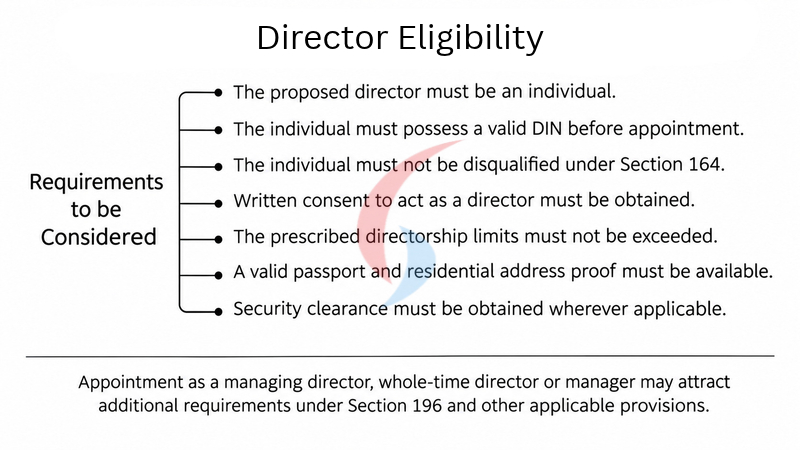
Resident Director Requirement under Section 149(3)
Every Indian company must have at least one director who stays in India for a total period of not less than 182 days during the financial year. For newly incorporated companies, this requirement applies proportionately during the financial year of incorporation.
The resident director requirement is based on physical stay in India rather than citizenship. Therefore, a foreign national may also satisfy this requirement if the prescribed period of stay is fulfilled.
| Particulars | Statutory requirement |
| Private limited company | Minimum two directors |
| Public limited company | Minimum three directors |
| Resident director | At least one director satisfying Section 149(3) |
| Minimum period of stay | 182 days during the financial year |
| Maximum directors | 15, unless increased through a special resolution |
| Foreign nationality | Generally permitted |
A foreign holding company can appoint multiple foreign directors to its Indian subsidiary, provided the subsidiary continues to comply with applicable Board composition and residency requirements.
Every Indian subsidiary must maintain the prescribed Board composition and comply with resident director requirements. Foreign ownership does not exempt companies from these statutory obligations. Learn more about Resident Director Appointment under Companies Act, 2013
Types of Foreign Director Appointments in Indian Subsidiaries
Foreign executives may be appointed in different capacities depending on the company's operational requirements and corporate structure.
| Type of director | Applicable provision | Purpose |
| Regular director | Section 152 | Management and corporate governance |
| Additional director | Section 161(1) | Appointment by the Board, subject to AOA |
| Alternate director | Section 161(2) | Acts during the original director's qualifying absence from India |
| Nominee director | Section 161(3) | Represents nomination rights under applicable arrangements |
| Managing director | Section 196 | Exercises substantial management powers |
| Independent director | Section 149 | Provides independent oversight, subject to eligibility |
The foreign holding company's nomination rights should be examined alongside the subsidiary's Articles of Association and applicable statutory provisions.
Changes in company management must be supported by appropriate corporate approvals and statutory filings. Indian subsidiaries should maintain updated records whenever directors are appointed, replaced or removed. Refer to Change of Management in Companies – Appointment and Resignation of Directors
Security Clearance for Foreign Directors from Land-Border Countries
The Ministry of Corporate Affairs (MCA), through the Companies (Appointment and Qualification of Directors) Amendment Rules, 2022, introduced additional security clearance requirements for nationals of countries sharing a land border with India.
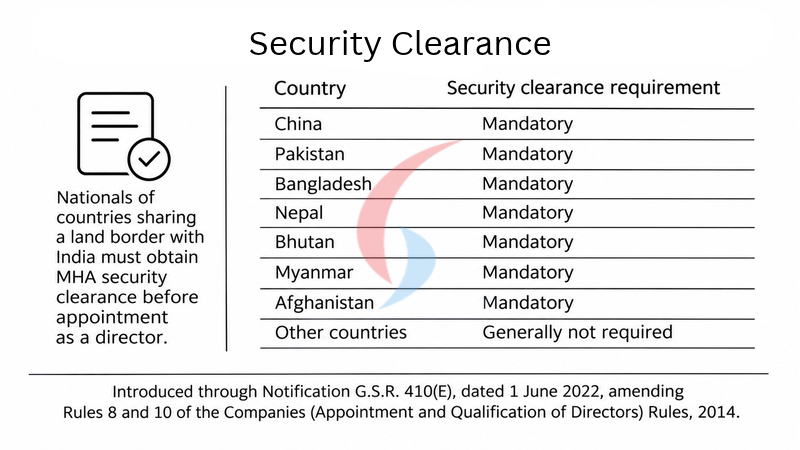
Such individuals must obtain security clearance from the Ministry of Home Affairs (MHA) before appointment as directors. The prescribed clearance must also accompany their DIN application and consent to act as a director, wherever applicable.
Foreign nationals from countries sharing a land border with India must obtain the prescribed security clearance before their appointment. Companies should verify these requirements before initiating DIN applications. Refer to DIN Security Clearance Mandate for Foreign Directors from MCA
Storytelling: How a Singapore-Based Company Appointed a Foreign Director in India
Consider an illustrative example of GlobalNova Technologies India Private Limited, a wholly owned subsidiary of a Singapore-based technology company. As its Indian operations expanded, the foreign holding company decided to appoint its regional business head to the subsidiary's Board.
Initially, the management believed that issuing an appointment letter from its Singapore office would be sufficient. However, the proposed director did not possess a DIN or an Indian Digital Signature Certificate.
The management approached corporate compliance professionals, who reviewed the subsidiary's Articles of Association, arranged authentication of overseas documents and assisted with obtaining the DSC and DIN. The company also verified that its existing resident director fulfilled the requirements under Section 149(3).
After obtaining the necessary approvals, the company appointed the foreign director and filed Form DIR-12 with the Registrar of Companies.
This example demonstrates that appointing an overseas executive involves more than an internal management decision. Proper statutory approvals and documentation are essential to establish a legally compliant directorship.
Documents Required for Appointment of a Foreign Director
Foreign directors must provide appropriate identification and residential documents for completing their DIN application and appointment formalities. Documents executed outside India must be authenticated according to applicable requirements.
| Document | Purpose |
| Valid passport | Identity and nationality verification |
| Overseas address proof | Residential address verification |
| Recent passport-size photograph | DIN and DSC application |
| Email ID and mobile number | MCA registration and verification |
| Digital Signature Certificate | Electronic authentication |
| Director Identification Number | Statutory director identification |
| Form DIR-2 | Consent to act as director |
| Form DIR-8 | Disclosure of disqualifications |
| Form MBP-1 | Disclosure of interests |
| Board or shareholder resolution | Approval of appointment |
| Security clearance | Applicable to specified foreign nationals |
| Nomination letter | Where nominated by the holding company |
Individuals proposing to become directors of existing Indian companies must obtain a DIN if they do not already possess one. Proper documentation and professional verification support the application process. Refer to MCA Form DIR-3: Application for Allotment of DIN
Apostille and Notarisation Requirements for Foreign Directors
Documents issued or executed outside India may require notarisation, apostille or consular authentication, depending on the country concerned and applicable MCA requirements.
| Country category | Authentication requirement |
| Commonwealth countries | Notarisation, as applicable |
| Hague Apostille Convention countries | Apostille and applicable notarisation |
| Other countries | Notarisation and diplomatic or consular authentication, as applicable |
| Documents in foreign languages | Authenticated English translation, wherever required |
Companies should verify the specific authentication requirements applicable to DIN applications, incorporation documents and supporting records before submitting them to MCA.
Appointment of a director requires compliance with statutory eligibility, corporate approvals and ROC filing requirements. Companies must follow the appropriate appointment procedure according to their Articles of Association. Read more about How to Appoint a Director in a Company
Procedure for Appointment of a Foreign Director in Indian Subsidiary
The appointment of a foreign director in an Indian subsidiary involves obtaining a DIN, submitting the required documents and securing necessary corporate approvals. The company must also file Form DIR-12 with the ROC and comply with applicable statutory requirements.
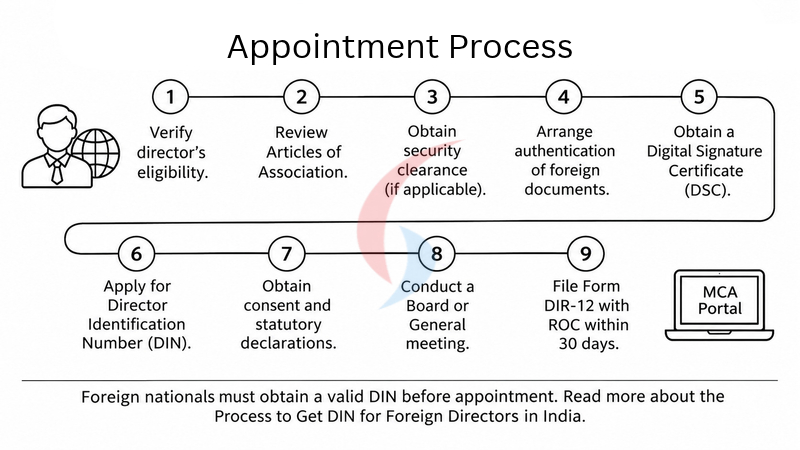
Step 1: Verify the Director's Eligibility
Examine the proposed director's nationality, residential status, existing directorships and eligibility under Section 164 of the Companies Act, 2013. Verify whether security clearance or any sector-specific regulatory approval is required.
Step 2: Review the Articles of Association
Examine the subsidiary's Articles of Association to identify appointment powers, nomination rights and applicable restrictions. Determine whether the appointment requires Board approval or approval from the shareholders.
Step 3: Obtain Security Clearance, Wherever Applicable
Where the proposed director is a national of a country sharing a land border with India, obtains the necessary clearance from the Ministry of Home Affairs. The clearance must be available before completing the applicable DIN and appointment formalities.
Step 4: Arrange Authentication of Foreign Documents
Collect the proposed director's passport, residential address proof and other supporting documents. Complete notarisation, apostille or consular authentication according to the applicable requirements of the country where the documents are executed.
Step 5: Obtain a Digital Signature Certificate (DSC)
Apply for a DSC through an authorised certifying authority using the foreign director's identification and residential documents. Complete the prescribed verification procedure and associate the DSC with the MCA account wherever required.
Foreign nationals must obtain a valid Director Identification Number before being appointed as directors of Indian companies. The application involves identity verification, authentication of foreign documents and statutory declarations. Read more about the Process to Get DIN for Foreign Directors in India
Step 6: Apply for Director Identification Number (DIN)
If the proposed director does not already possess a DIN, submit Form DIR-3 through the MCA Portal. The application must include the prescribed supporting documents and corporate authorisation for the proposed appointment in an existing company.
Step 7: Obtain Consent and Statutory Declarations
Obtain Form DIR-2 from the proposed foreign director confirming consent to act as a director. Collect Form DIR-8 and other applicable declarations relating to disqualification, existing directorships and statutory eligibility.
Step 8: Conduct a Board or General Meeting
Conduct the appropriate meeting to approve the appointment under Section 152 or Section 161 of the Companies Act, 2013. Pass the necessary resolution and record the appointment date, designation and applicable terms in the meeting minutes.
Step 9: File Form DIR-12 with ROC
Submit Form DIR-12 through the MCA portal within 30 days of appointment, along with the prescribed documents and declarations. Ensure that the consent and declaration requirements of the MCA V3 webform are properly completed.
Companies must report the appointment and changes in their directors through the prescribed MCA webform. Timely filing ensures that the company's statutory records reflect its updated Board composition. Read more about MCA Form DIR-12: Appointment of Directors and KMP
Step 10: Update Statutory Registers and Compliance Records
Update the register of directors and key managerial personnel maintained under Section 170. Obtain applicable interest disclosures, update internal records and inform banks or regulatory authorities wherever necessary.
Appointment of Foreign Directors During Company Incorporation
Where a foreign director is appointed at the time of incorporation of an Indian subsidiary, the appointment details are submitted through the SPICe+ incorporation process. Eligible proposed first directors who do not possess a DIN may apply for DIN allotment through SPICe+, subject to applicable limits. The prescribed foreign document authentication and security clearance requirements must also be fulfilled. Foreign holding companies should finalise their Board composition before incorporation to ensure compliance with the minimum number of directors and resident director requirements.
Foreign holding companies should determine the initial Board composition before incorporating their Indian subsidiaries. The proposed first directors must fulfil applicable eligibility and documentation requirements. Learn more about Appointment of First Directors under Companies Act, 2013
ROC Forms and Compliance Requirements
| Form | Purpose | Timeline |
| DIR-3 | Application for DIN | Before appointment |
| DIR-2 | Consent to act as director | On or before appointment |
| DIR-8 | Disclosure of disqualification | As prescribed |
| DIR-12 | Reporting appointment | Within 30 days |
| MBP-1 | Disclosure of interests | At the applicable Board meeting under Section 184 |
| DIR-3 KYC Web | Periodic director KYC | As per the revised three-year cycle |
| MGT-14 | Filing applicable resolutions | Within 30 days, wherever applicable |
| MR-1 | Return of appointment of managerial personnel | Within 60 days, wherever applicable |
Latest MCA Update on Director KYC Compliance
The MCA notified the Companies (Appointment and Qualification of Directors) Amendment Rules, 2025 on 31 December 2025, effective from 31 March 2026. Under the amended Rule 12A, the earlier annual DIR-3 KYC requirement has been replaced with a three-year KYC compliance cycle. Directors must submit their KYC intimation through Form DIR-3 KYC Web by 30 June following the applicable third consecutive financial year.
For existing directors who had duly completed their KYC under the earlier requirements, the next applicable filing deadline is generally 30 June 2028. Changes in prescribed personal details must be reported separately within the applicable timeline. Foreign directors must also comply with these revised requirements to maintain their DIN status.
Companies can refer to the official PIB announcement on Director KYC amendments.
FEMA Compliance for Appointment of Foreign Directors
The appointment of a foreign national as a director does not independently constitute foreign direct investment. Therefore, Form FC-GPR is not required merely because a foreign director has been appointed.
However, if the company issues equity shares to the foreign director, applicable FEMA pricing guidelines, sectoral restrictions and foreign investment reporting requirements must be examined. Remuneration paid outside India may also involve applicable foreign exchange and taxation requirements.
Duties and Responsibilities of Foreign Directors
Foreign directors have substantially the same statutory duties as other directors of Indian companies. Section 166 of the Companies Act, 2013 requires directors to act in good faith, exercise reasonable care and avoid conflicts of interest.
A foreign director nominated by an overseas holding company must consider the interests of the Indian subsidiary while performing statutory duties. The nomination does not remove personal responsibilities under Indian corporate law.
Foreign-owned subsidiaries must comply with ongoing corporate, financial and foreign investment reporting obligations. Directors play an important role in ensuring that these statutory requirements are fulfilled. Learn more about Wholly Owned Subsidiary Compliance: A Complete Roadmap for Businesses
Penalty for Non-Compliance in Foreign Director Appointment
Failure to comply with statutory appointment requirements may expose the company and responsible officers to penalties.
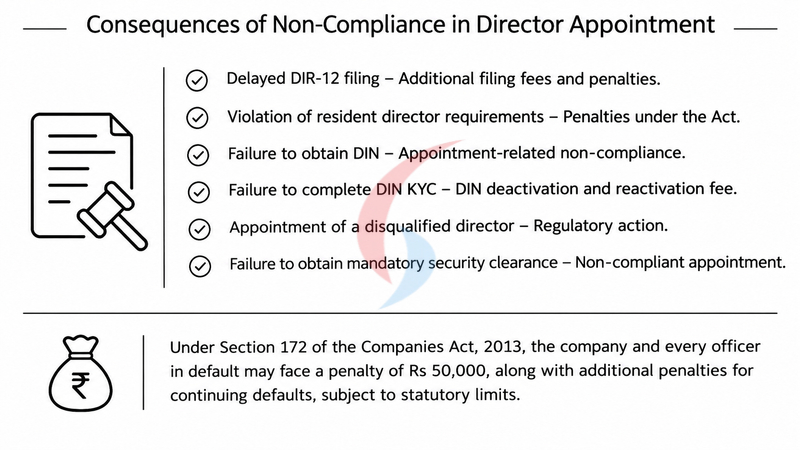
| Non-compliance | Regulatory consequence |
| Delayed DIR-12 filing | Additional filing fees and applicable penalties |
| Violation of resident director requirements | Penalties under applicable Companies Act provisions |
| Failure to obtain DIN | Appointment-related non-compliance |
| Failure to complete prescribed DIN KYC | DIN deactivation and applicable reactivation fee |
| Appointment of a disqualified director | Regulatory action under applicable provisions |
| Failure to obtain mandatory security clearance | Non-compliant appointment |
Under Section 172 of the Companies Act, 2013, where no separate penalty is prescribed for a contravention under the relevant chapter, the company and every officer in default may face a penalty of Rs 50,000, along with additional penalties for continuing defaults, subject to statutory limits.
Why Choose Compliance Calendar LLP?
Compliance Calendar LLP provides professional assistance to foreign holding companies and their Indian subsidiaries with foreign director appointments, DIN applications, DSC registration, overseas document authentication and corporate approvals. Our professionals assist businesses in understanding resident director requirements, statutory declarations and applicable security clearance obligations.
Compliance Calendar LLP provides professional assistance with DIN Security Clearance and Class 3 Digital Signature Certificates. Our professionals also assist foreign subsidiaries with Company Law Advisory, WOS compliance, FEMA advisor, statutory documentation, ROC filings and applicable corporate governance requirements.
For professional assistance, contact +91 9988424211 or email info@ccoffice.in
Frequently Asked Questions (FAQs)
Q1. Can a foreign national become a director of an Indian subsidiary?
Ans. Yes, foreign nationals can become directors of Indian subsidiaries under the Companies Act, 2013. They must satisfy applicable eligibility, DIN and statutory appointment requirements.
Q2. Is an Indian PAN mandatory for foreign directors?
Ans. An Indian PAN is not ordinarily mandatory solely for obtaining a DIN as a foreign national. However, separate taxation requirements may make obtaining a PAN necessary.
Q3. Is a DIN mandatory for a foreign director?
Ans. Yes, every foreign national appointed as a director of an Indian company must possess a DIN. An individual who already holds a DIN cannot apply for another one.
Q4. Can all directors of an Indian subsidiary be foreign nationals?
Ans. Yes, provided at least one director satisfies the resident director requirement under Section 149(3). Indian citizenship is not mandatory for fulfilling this requirement.
Q5. Is security clearance mandatory for every foreign director?
Ans. No, the specific MCA security clearance requirement applies to nationals of countries sharing a land border with India. Additional sector-specific restrictions may also apply.
Q6. What is the due date for filing Form DIR-12?
Ans. Form DIR-12 must ordinarily be filed within 30 days of the director's appointment. Delayed filing may attract additional fees and applicable penalties.
Q7. Can a foreign director attend Board meetings remotely?
Ans. Yes, foreign directors can participate in Board meetings through permitted video conferencing facilities. Companies must comply with applicable meeting, quorum and documentation requirements.
Q8. Is foreign shareholding mandatory for appointment as a director?
Ans. No, foreign nationals are not generally required to hold shares to become directors. However, the company's Articles of Association should be examined for specific conditions.
Q9. Is the annual DIR-3 KYC mandatory for foreign directors in 2026?
The MCA replaced annual director KYC with a three-year compliance cycle effective from 31 March 2026. Foreign directors must follow the revised KYC requirements and applicable deadlines.
Q10. Can a foreign director receive remuneration from an Indian subsidiary?
Ans. Yes, foreign directors may receive remuneration subject to applicable corporate law, taxation and FEMA provisions. The company must obtain necessary approvals and comply with applicable withholding tax obligations.
Article last updated on : 25 Nov 2026.












































































_learn_crop10_thumb.jpg)