


A company may stop selling products, suspend its operations or postpone its business plans for an entire financial year. There may be no customers, no invoices, no employees and no significant transactions in its bank account. Yet, when the financial year ends, the company may still have to submit an annual return to the Reserve Bank of India (RBI).
This situation often surprises Indian companies that have received foreign investment or invested in overseas businesses. Their directors may assume that because the company did not conduct any business, no foreign exchange reporting is required. However, FLA Return filing depends primarily on qualifying outstanding foreign investment, not on business turnover or operational activity.
Under the Foreign Exchange Management Act, 1999 (FEMA) and RBI reporting instructions, an Indian company may be required to file the Annual Return on Foreign Liabilities and Assets (FLA Return) even when it has zero revenue, no fresh foreign investment and no commercial activity during the financial year.
What Is an FLA Return Under RBI?
The Annual Return on Foreign Liabilities and Assets, commonly called the FLA Return, is an annual reporting requirement administered by the Reserve Bank of India.
Its purpose is to collect information about foreign investment received by Indian entities and qualifying investments held by Indian entities outside India. The information supports RBI's assessment of India's international investment position, balance of payments and foreign investment statistics.
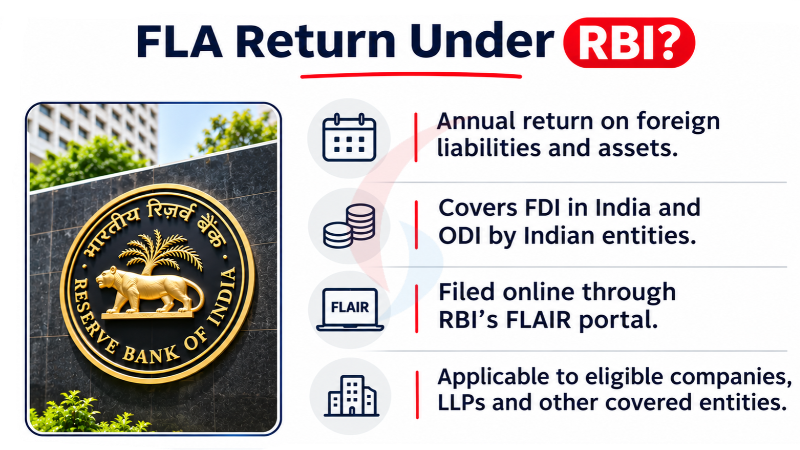
An FLA Return generally records relevant foreign assets and liabilities for two reporting dates: 31 March of the latest financial year and 31 March of the preceding financial year.
The return is submitted through RBI's online Foreign Liabilities and Assets Information Reporting (FLAIR) portal. RBI's FAQ, updated on 1 July 2026, confirms that eligible Indian companies, LLPs and other covered entities with outstanding qualifying FDI or ODI must submit the return annually.
Is FLA Return Filing Mandatory for Companies with No Business Activity?
Yes, an FLA Return may be mandatory even when the company has not conducted any business during the year. The key question is whether the company has qualifying outstanding Foreign Direct Investment (FDI) or Overseas Direct Investment (ODI) at the relevant year-end reporting dates.
A company may have no sales, no employees, no purchases and no new investment transactions. However, if a foreign shareholder continues to own shares issued under the applicable FDI provisions, the outstanding investment may still need to be reported.
Similarly, an Indian company may have suspended its operations while continuing to hold shares in an overseas subsidiary. The absence of business transactions does not automatically remove its reporting obligation.
RBI also clarifies that the FLA Return captures information for both the current and previous financial years. Consequently, a company may need to file even if its qualifying foreign investment became nil during the latest year but was outstanding at the preceding 31 March.
The distinction can be understood through the following examples.
|
Company's Situation |
Is FLA Return Required? |
|
No business activity, but outstanding qualifying FDI |
Yes |
|
Zero turnover with an existing overseas subsidiary |
Yes, generally |
|
No new foreign investment, but existing FDI continues |
Yes |
|
Foreign investor exited during the year, but investment existed at the previous 31 March |
Yes, generally |
|
No qualifying FDI or ODI at either relevant year-end |
Generally, no |
|
Only share application money, without qualifying outstanding FDI or ODI |
Generally, no |
|
Only domestic shareholders and domestic investments |
Generally, no |
The final applicability decision should be based on the company's investment records and RBI's reporting instructions rather than its turnover alone.
A Practical Story: A Company That Stopped Business but Still Had to File FLA
Consider the fictional example of ABC Private Limited, a Bengaluru-based company incorporated in 2023 to develop software for international customers. During its first year, ABC received Rs 45 lakh from a Singapore-based investor in exchange for 40% equity ownership. The investment was reported through the applicable foreign investment reporting procedures.
However, business did not develop as expected. The company struggled to acquire customers and decided to suspend its commercial operations in January 2025. By FY 2025–26, it had no revenue, no active employees and no new foreign investment.
The directors assumed that because the company was inactive, it did not need to file any RBI annual return. While preparing the company's annual records, its accountant discovered that the Singapore investor still held 40% of the company's equity shares as of 31 March 2026.
Although ABC had no business activity, the outstanding foreign investment remained part of its financial position. Therefore, the company was generally required to submit its FLA Return for FY 2025–26 by 15 July 2026. The example highlights an important compliance principle: business inactivity does not cancel an existing foreign investment reporting obligation.
Even when an Indian company is waiting for new funding, temporarily suspended or undergoing restructuring, its directors should review outstanding FDI and ODI before deciding whether FLA filing is necessary.
Legal Provisions Governing FLA Return Filing in India
FLA Return filing operates under FEMA and RBI's prescribed foreign exchange reporting requirements. The reporting obligation has developed through RBI circulars, regulations and directions.
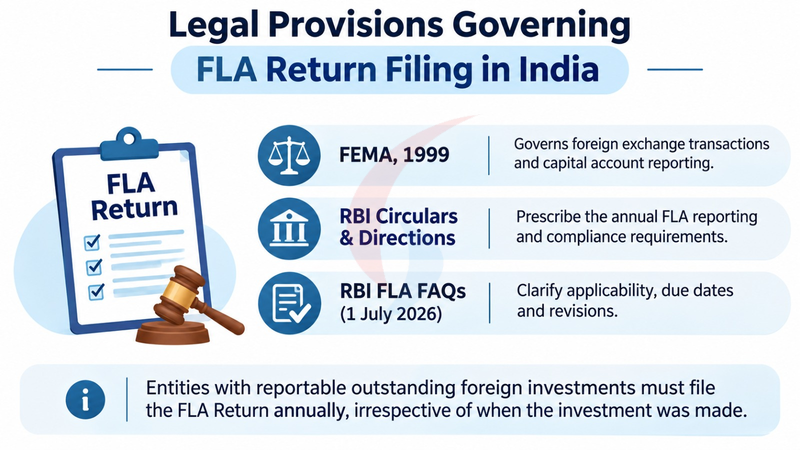
|
Act / Regulation |
Relevant Provision or Requirement |
|
Governs foreign exchange transactions and regulatory compliance |
|
|
Deals with capital account transactions |
|
|
Provides for penalties for contraventions |
|
|
Provides for compounding of eligible contraventions |
|
|
Forms part of the foundation of annual FLA reporting |
|
|
Contains reporting provisions for non-debt instruments |
|
|
RBI A.P. (DIR Series) Circular No. 16, dated 30 September 2022 |
Addresses the Late Submission Fee mechanism for applicable reporting delays |
|
Clarify applicability, due dates, previous-year reporting and revisions |
Under the applicable RBI instructions, entities having reportable outstanding foreign investments must provide the prescribed information irrespective of whether the investment arose during the latest year or in an earlier year.
RBI's Master Direction on Reporting under FEMA consolidates various foreign exchange reporting requirements. The annual FLA Return is a separate compliance obligation and is not automatically fulfilled merely because a company has already submitted Form FC-GPR or FC-TRS.
Which Inactive Companies Must File an FLA Return?
Several types of companies may have an FLA reporting obligation even when their commercial activities have stopped.
1. Foreign-Owned Indian Subsidiaries
An Indian subsidiary whose shares are held by a foreign parent company generally has reportable foreign investment. If the subsidiary has no sales or operations during the year, its foreign shareholding does not disappear. For example, a Japanese parent company may establish an Indian subsidiary for future manufacturing operations. The subsidiary may not commence production during the first financial year. Nevertheless, its qualifying outstanding foreign equity can require annual FLA reporting.
2. Startups with Foreign Investment
Startups sometimes receive funding before launching products or generating revenue. A startup may spend an entire year developing technology or conducting research without recording any sales. If qualifying foreign investment remains outstanding, the startup should examine its FLA filing obligation regardless of its commercial performance.
For related compliance requirements, read FEMA Compliance for Startup Investment in Tranches
3. Companies Holding Overseas Investments
An Indian company that previously invested in a foreign subsidiary may need to report that investment even when the subsidiary or Indian parent is inactive. For example, an Indian trading company may own a wholly owned subsidiary in Dubai that has stopped operations. If the relevant overseas investment remains outstanding, the company generally needs to consider FLA reporting.
4. Companies Undergoing Restructuring
A company may temporarily suspend operations during a merger, acquisition, business transfer or restructuring. Such commercial changes do not necessarily eliminate its outstanding foreign investment position. Until the relevant investment has been legally transferred, extinguished or otherwise dealt with under applicable law, the company should assess its FLA reporting responsibilities.
Is FLA Return Required When Turnover Is Zero?
Yes, zero turnover does not automatically provide an exemption from FLA Return filing. Turnover represents the revenue earned from business activities. The FLA Return, however, is concerned with foreign financial liabilities and assets.
A company may report Rs 0 in sales while continuing to have foreign share capital, reserves, overseas equity investments or other reportable financial positions. For example, an Indian company could have no revenue in FY 2025–26 but still have Rs 25 lakh of qualifying foreign investment outstanding at the year-end.
The company should not treat its nil sales position as a reason to avoid FLA filing. The financial and investment details must be reported according to the relevant RBI instructions. This position is equally important for companies with accumulated losses or negative net worth.
Read FLA Return for Companies with Negative Net Worth to understand how financially distressed companies should examine their reporting obligations.
FLA Return Due Date for FY 2025–26
The prescribed annual due date for an FLA Return is generally 15 July of the reporting year. For FY 2025–26, the regular filing deadline was 15 July 2026. As of November 2026, this date has already passed, so companies with pending mandatory returns should review the applicable delayed filing procedure.
|
Particulars |
Details |
|
Reporting Financial Year |
FY 2025–26 |
|
Current Reporting Date |
31 March 2026 |
|
Previous Reporting Date |
31 March 2025 |
|
Regular Filing Due Date |
15 July 2026 |
|
Filing Authority |
Reserve Bank of India |
|
Filing Portal |
RBI FLAIR |
|
Next Regular Due Date |
15 July 2027, for FY 2026–27 |
RBI's July 2026 FAQ confirms the annual 15 July deadline and permits filing based on audited or unaudited financial statements.
For additional information, read FLA Return Filing and Due Dates with the Checklist
Documents Required for FLA Return Filing by an Inactive Company
Companies with no business activity may have fewer transactions to report, but they still need reliable financial information and foreign investment records. The following documents and details should be available during the applicability review and return preparation.
|
Documents / Records |
Purpose |
|
Certificate of Incorporation |
Identifies the reporting entity |
|
PAN and CIN / LLPIN |
Supports entity identification |
|
Balance Sheet |
Provides financial position information |
|
Profit and Loss Account |
Supports financial reporting |
|
Foreign Shareholding Pattern |
Establishes foreign ownership |
|
Previous FC-GPR Records |
Supports foreign equity investment details |
|
FC-TRS Records, if applicable |
Supports foreign share transfers |
|
Overseas Investment Records |
Identifies qualifying foreign assets |
|
Previous FLA Return |
Supports comparative reporting |
|
Authority and Verification Letters |
Required for applicable FLAIR registration procedures |
The company should maintain supporting documents even where the accounts contain no business revenue or major operating expenses.
RBI clarifies that the complete balance sheet and profit and loss account are not ordinarily required to be uploaded as attachments with the annual FLA Return. However, the underlying financial information is necessary for accurate reporting.
How to File an FLA Return for a Company with No Business Activity
An inactive company must follow the prescribed RBI FLAIR filing process if it has qualifying outstanding foreign investment. Even when business activity and revenue are nil, the company must accurately report its foreign liabilities and assets.
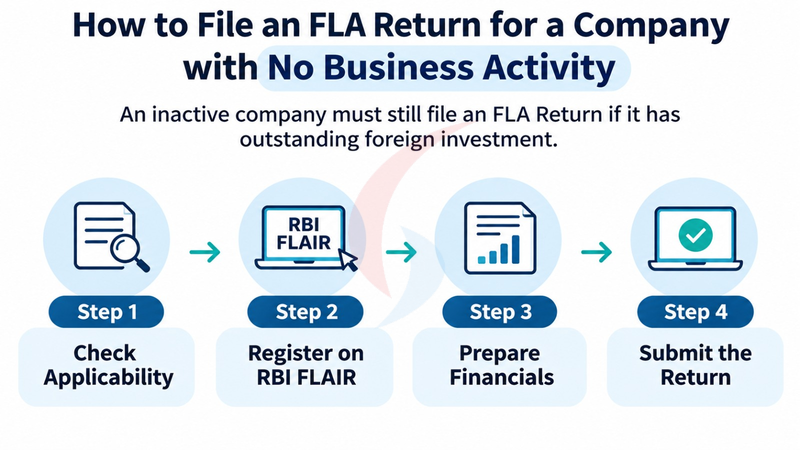
|
Step |
Filing Process |
Details |
|---|---|---|
|
Step 1 |
Verify FLA Applicability |
Review the company's foreign shareholding and overseas investments at both relevant March-end dates. Check whether qualifying FDI or ODI remains outstanding. |
|
Step 2 |
Register on RBI FLAIR Portal |
Visit the RBI FLAIR Portal. First-time users must complete entity registration and submit the required verification and authority letters. Existing users can log in directly. |
|
Step 3 |
Prepare Financial Information |
Collect financial statements, foreign investor details, overseas investment records and previous-year figures. Report the actual financial position even when business activity is nil. |
|
Step 4 |
Complete and Submit the Return |
Select the relevant financial year, enter the required details and verify the information. Submit the return electronically and retain the acknowledgement for future reference. |
RBI's FLAIR instructions provide guidance on entity registration, authorised-user verification, return submission and revision of previously filed information. Companies can refer to the RBI FLA Return FAQs for official guidance.
For a detailed explanation, read How to File Foreign Liabilities and Assets on the FLAIR Portal of RBI.
Penalty for Non-Filing or Delayed FLA Return
Failure to submit a mandatory FLA Return within the prescribed deadline can result in a contravention under FEMA. Section 13 of FEMA, 1999 provides for penalties in cases of contravention. Where the amount involved is quantifiable, the penalty may extend to three times that amount. Where it is not quantifiable, the statutory penalty may extend to Rs 2 lakh, with an additional penalty of up to Rs 5,000 per day for a continuing contravention after the first day.
However, these are statutory maximum provisions and should not be interpreted as automatic penalties imposed for every delayed FLA Return.
RBI also provides a Late Submission Fee (LSF) mechanism for specified reporting delays. The applicable LSF for the relevant periodic reporting category is generally Rs 7,500 per delayed FLA Return, subject to the prescribed conditions and RBI's acceptance of the regularisation process.
Companies that have missed previous filing deadlines should determine which financial years require reporting and follow the prescribed procedure rather than submitting inaccurate or duplicate returns.
For related compliance issues, read FC-GPR and FLA Return: Filing Rules and Penalties.
Latest RBI Updates for FLA Return Filing in 2026
The RBI published updated guidance during 2026, providing useful clarification on annual FLA reporting and the FLAIR filing system.
|
RBI Update |
Date |
Importance |
|
FLAIR Online Reporting FAQs |
25 March 2026 |
Clarifies registration, authorised-user information and online submission |
|
Annual FLA Return FAQs |
1 July 2026 |
Clarifies filing applicability, due dates and revisions |
|
FLA Return Deadline for FY 2025–26 |
15 July 2026 |
Regular annual filing deadline |
An important clarification in the July 2026 FAQ concerns the reporting of previous-year investment positions. If qualifying FDI or ODI was outstanding at the previous March-end but no longer exists at the latest March-end, the company may still need to submit the return for that reporting year.
The guidance also confirms that companies may file using provisional figures when audited accounts are unavailable, followed by an approved revision. For entities that have missed earlier years, the FLAIR system provides a mechanism for requesting permission to file or revise the relevant returns.
Difference Between FLA Return and Other FEMA Reporting
A company with foreign investment may need to comply with several RBI reporting requirements. The FLA Return is not a substitute for transaction-based filings.
|
Reporting Form |
Purpose |
Filing Requirement |
|
FLA Return |
Reports annual foreign liabilities and assets |
Annually, where applicable |
|
FC-GPR |
Reports the issue of qualifying equity instruments to non-residents |
Transaction-based |
|
FC-TRS |
Reports specified transfers of equity instruments |
Transaction-based |
|
ODI Reporting |
Reports prescribed overseas investment transactions |
As applicable |
|
Annual Performance Report (APR) |
Reports information about overseas investments |
Annually, where applicable |
For example, a company that received FDI in 2024 may have completed FC-GPR filing at that time. If the foreign investment remains outstanding in 2026, an annual FLA Return may still be required.
Businesses can explore FEMA/RBI Compliance Checklist for Indian Companies with FDI for a broader understanding of foreign investment reporting.
Why Choose Compliance Calendar LLP ?
Compliance Calendar LLP provides professional assistance to Indian companies, startups, LLPs and foreign-owned subsidiaries with annual FLA Return filing and related FEMA compliance requirements.
Our team helps companies determine whether FLA filing is mandatory, even when business operations are suspended or turnover is nil. We assist with foreign investment record reviews, FLAIR portal registration, financial information preparation and applicable filing procedures.
Businesses with pending annual returns can also obtain assistance in reviewing earlier reporting periods, preparing correction requests and understanding applicable RBI regularisation procedures.
For professional support, visit our FLA Return Filing Service Contact Compliance Calendar LLP: 9988424211 or info@ccoffice.in
Frequently Asked Questions (FAQs)
Q1. Is FLA Return mandatory for a company with no business activity?
Ans: Yes, if the company has qualifying FDI or ODI outstanding at either relevant March-end reporting date. Nil turnover or temporarily suspended business operations do not automatically remove its annual reporting obligation.
Q2. Is FLA Return required when company turnover is zero?
Ans: Yes, where qualifying foreign investment remains outstanding. Turnover measures business revenue, while the FLA Return reports foreign financial assets and liabilities under the applicable RBI instructions.
Q3. Is FLA Return required if no new foreign investment was received?
Ans: Yes, if qualifying foreign investment received in earlier years remains outstanding. The FLA Return is an annual position-based report and is not limited to new investment transactions.
Q4. What if a company has no foreign investment at all?
Ans: If the company has no qualifying outstanding FDI or ODI at either relevant reporting date, an ordinary FLA Return is generally not required solely because the company exists.
Q5. What is the FLA Return due date for FY 2025–26?
Ans: The regular filing deadline was 15 July 2026. Eligible companies were required to file through RBI's FLAIR portal using audited or provisional financial information.
Q6. Can an inactive company file FLA Return without audited accounts?
Ans: Yes. RBI permits filing with provisional or unaudited figures when audited accounts are unavailable. After completing the audit, the company should follow the approved revision procedure.
Q7. Is FLA Return mandatory for a dormant company?
Ans: Dormant status under the Companies Act does not automatically exempt a company from FEMA reporting. A dormant company should examine its qualifying foreign investment positions before determining applicability.
Q8. Is FLA Return required if the foreign shareholder exits during the year?
Ans: It may still be required if qualifying foreign investment was outstanding at the preceding 31 March. RBI's annual reporting captures both the current and previous financial year-end positions.
Q9. What is the penalty for late FLA Return filing?
Ans: Delayed filing may attract applicable Late Submission Fees or other FEMA consequences. The relevant periodic reporting LSF is generally Rs 7,500 per return, subject to RBI requirements.
Q10. Can Compliance Calendar LLP assist inactive companies with FLA Return filing?
Ans: Yes. Compliance Calendar LLP assists with FLA applicability checks, foreign investment reviews, FLAIR registration, annual return preparation, revisions and pending FEMA reporting compliance.
Article last updated on : 25 Nov 2026.










































































_learn_crop10_thumb.jpg)