


Foreign companies often establish subsidiaries in India to expand their business operations, access new markets and take advantage of local business opportunities. Although these subsidiaries operate under the ownership or control of a foreign holding company, they are required to comply with Indian corporate laws independently.
One of the most important annual compliance requirements for an Indian subsidiary of a foreign company is the preparation and approval of its balance sheet, financial statements and Directors' Report. These documents provide shareholders, management and regulatory authorities with information regarding the company's financial performance, business activities and statutory compliance.
The Companies Act, 2013 prescribes specific requirements relating to the preparation, approval, signing, adoption and filing of financial statements. Foreign ownership does not exempt an Indian subsidiary from these obligations. Companies must complete the necessary Board approvals, statutory audits, shareholder meetings and Registrar of Companies (ROC) filings within the applicable timelines.
Foreign companies establishing subsidiaries in India must comply with applicable incorporation and post-registration requirements. Proper corporate structuring helps businesses manage their statutory obligations efficiently. Learn more about the Incorporation of a Foreign Subsidiary Company in India
What is a Foreign Subsidiary Company?
A subsidiary company is an entity whose Board composition or more than half of its total voting power is controlled by another company, known as the holding company, in accordance with Section 2(87) of the Companies Act, 2013. In the context of foreign investment in India, a foreign-owned subsidiary is a company incorporated in India and controlled by an overseas holding company. Although its shareholders may be located outside India, the subsidiary has a separate legal identity and must comply with applicable Indian laws.
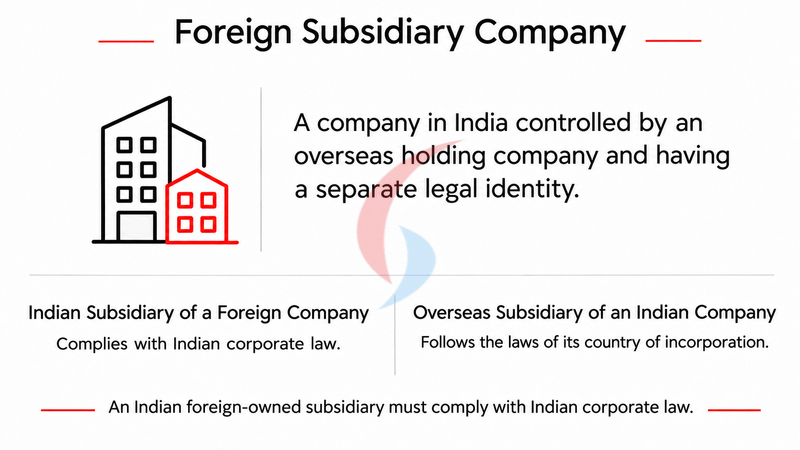
It is important to distinguish between an Indian subsidiary of a foreign company and an overseas subsidiary of an Indian company. While the former must comply with Indian corporate law, the latter follows the laws of its country of incorporation, along with applicable consolidation and overseas investment reporting obligations of its Indian parent.
Foreign-owned subsidiaries must comply with applicable Indian corporate laws, taxation and FEMA reporting requirements. These obligations continue throughout the company's business operations. Read more about Wholly Owned Subsidiary Compliance: A Complete Roadmap for Businesses
Legal Provisions Governing Balance Sheet and Directors' Report Approval
The preparation and approval of financial statements in an Indian subsidiary of a foreign company are primarily governed by the Companies Act, 2013 and the Companies (Accounts) Rules, 2014.
| Legal provision | Applicability |
|---|---|
| Section 2(40) | Defines financial statements. |
| Section 128 | Maintenance of books of account. |
| Section 129 | Preparation and presentation of financial statements. |
| Section 133 | Compliance with applicable accounting standards. |
| Section 134 | Approval and signing of financial statements and Directors' Report. |
| Section 136 | Circulation of financial statements to members. |
| Section 137 | Filing of financial statements with ROC. |
| Section 173 | Conducting Board meetings. |
| Section 179(3)(g) | Board approval of financial statements and Board's Report. |
| Companies (Accounts) Rules, 2014 | Prescribes financial reporting and disclosure requirements. |
| Schedule III | Prescribes the applicable financial statement presentation format. |
| Secretarial Standard SS-1 | Governs Board meetings. |
| Secretarial Standard SS-2 | Governs general meetings. |
Companies can refer to the Companies Act, 2013 for detailed statutory requirements.
Foreign subsidiaries frequently enter into commercial transactions with their holding companies and other group entities. Such transactions must comply with applicable approval, accounting and disclosure requirements. Read more about Related Party Transactions under the Companies Act, 2013
What are the Financial Statements of a Foreign Subsidiary?
Financial statements provide a detailed overview of a company's financial position and performance during a particular financial year. Under Section 129 of the Companies Act, 2013, financial statements must fairly represent the company's financial affairs and comply with applicable accounting standards.
The financial statements of an Indian subsidiary generally include:
-
Balance sheet.
-
Statement of profit and loss.
-
Cash flow statement, wherever applicable.
-
Statement of changes in equity, wherever applicable.
-
Explanatory notes forming part of the financial statements.
-
Consolidated financial statements, wherever applicable.
The company must prepare its financial statements under applicable Accounting Standards (AS) or Indian Accounting Standards (Ind AS). Financial reports prepared exclusively for the foreign holding company's internal purposes cannot replace the subsidiary's statutory financial statements in India.
Importance of Balance Sheet and Directors' Report Approval
The approval of financial statements and the Directors' Report is more than an annual ROC filing requirement. It ensures that the management reviews the company's financial performance, verifies statutory disclosures and acknowledges its responsibilities towards shareholders.
For foreign-owned subsidiaries, proper approval also helps maintain consistency between Indian statutory accounts and international group reporting. It supports financial transparency, investor confidence, statutory audits and compliance with applicable tax and foreign exchange regulations.
Who Approves the Balance Sheet of a Foreign Subsidiary?
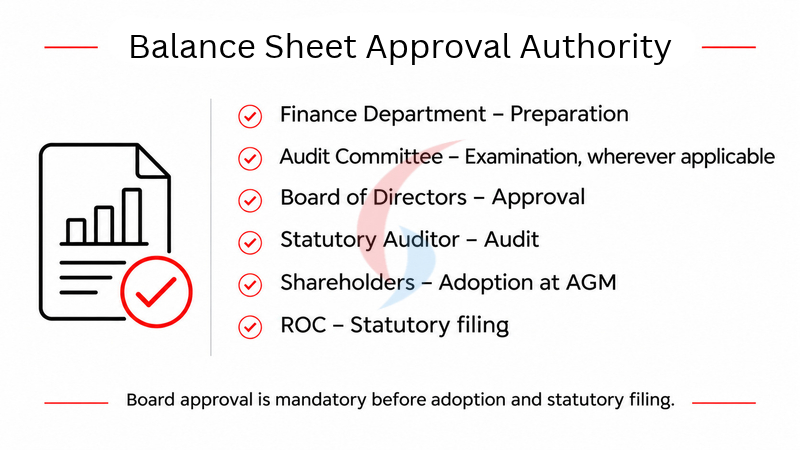
Under Section 134(1) of the Companies Act, 2013, the Board of Directors must approve the financial statements before they are signed and submitted to the statutory auditor for their report. The foreign holding company cannot replace the statutory approval required from the Indian subsidiary's Board. Although the parent company may review financial information for internal reporting purposes, the subsidiary must independently complete the necessary corporate approvals.
| Authority | Responsibility |
|---|---|
| Finance Department | Preparation of financial statements |
| Audit Committee, wherever applicable | Examination of financial statements |
| Board of Directors | Approval of financial statements and Directors' Report |
| Statutory Auditor | Independent examination and audit reporting |
| Shareholders | Adoption of financial statements at the AGM |
| Registrar of Companies | Receiving statutory financial filings |
What is the Directors' Report in a Foreign Subsidiary?
The Directors' Report, also known as the Board's Report, is an annual statutory document that provides information about the company's business performance, financial position, management decisions and regulatory compliance. Section 134(3) of the Companies Act, 2013, read with the Companies (Accounts) Rules, 2014, prescribes the applicable disclosures. The report must be prepared for the Indian subsidiary independently, even if the foreign holding company prepares a separate annual report for the entire group.
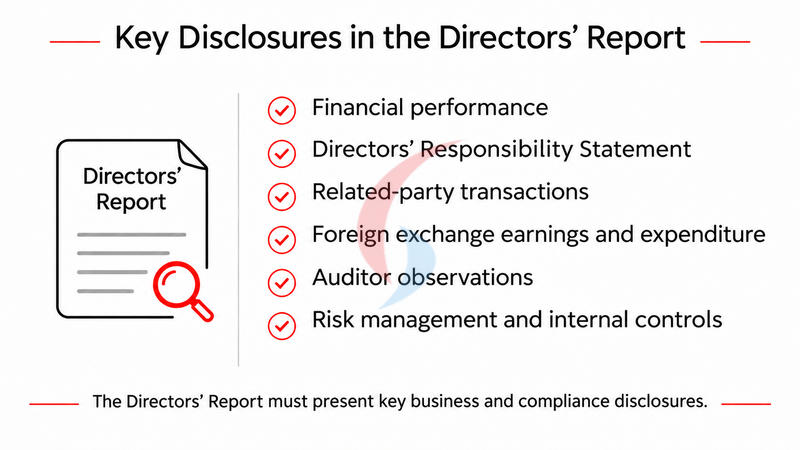
The Directors' Report generally includes the following information, wherever applicable:
-
Financial performance and state of the company's affairs.
-
Number of Board meetings conducted.
-
Directors' Responsibility Statement.
-
Details of related-party transactions.
-
Loans, guarantees and investments.
-
Explanations regarding adverse auditor observations.
-
Material changes affecting the company's financial position.
-
Foreign exchange earnings and expenditure.
-
Risk management and internal financial controls.
-
Corporate Social Responsibility disclosures.
-
Changes in directors and key managerial personnel.
-
Other prescribed statutory disclosures.
A subsidiary company is excluded from the definition of a small company under Section 2(85). Therefore, it cannot claim small-company reporting exemptions merely because its turnover or paid-up capital is low.
The Directors' Report must contain accurate information regarding financial performance and statutory compliance. Incorrect or misleading disclosures may expose companies and responsible officers to regulatory consequences. Read more about What if There is False Disclosure in Board's Report?
Storytelling: How a Foreign Subsidiary Managed Its First Annual Financial Approval
Consider an illustrative example of GlobalNova Technologies India Private Limited, a wholly owned subsidiary of a Singapore-based technology company. The Indian subsidiary completed its financial year on 31 March 2026 and started preparing its annual financial statements.
The foreign management believed that approval from the Singapore holding company would be sufficient because it controlled the entire Indian business. However, during discussions with the company's compliance professionals, the management discovered that separate approval from the Indian subsidiary's Board was mandatory.
Another challenge was that two directors were residing outside India. The company arranged a Board meeting through video conferencing, circulated the necessary documents and obtained approval for its financial statements and Directors' Report.
After completing the signing and statutory audit requirements, the company conducted its Annual General Meeting and submitted the applicable ROC forms within the prescribed timelines.
This example highlights that foreign ownership does not remove the statutory responsibilities of an Indian subsidiary. Proper coordination between overseas management and Indian compliance professionals is essential for completing annual compliance.
Documents Required for Balance Sheet and Directors' Report Approval
Before conducting the Board meeting, the company should collect all relevant financial and corporate records to ensure accurate reporting and statutory disclosures.
| Document | Purpose |
|---|---|
| Trial balance and financial ledgers | Preparation of annual accounts |
| Balance sheet | Disclosure of financial position |
| Profit and loss statement | Disclosure of financial performance |
| Draft Directors' Report | Annual statutory disclosures |
| Related-party transaction records | Verification of group transactions |
| Foreign investment records | FEMA and shareholding reconciliation |
| Board meeting notice and agenda | Conducting the approval meeting |
| Draft Board resolutions | Recording statutory approvals |
| Directors' declarations | Verification of statutory disclosures |
| Draft audit observations | Addressing financial discrepancies |
| Previous year's annual filings | Ensuring reporting consistency |
Board meetings and Annual General Meetings play an important role in approving and adopting annual financial statements. Companies must comply with notice, quorum, resolution and documentation requirements. Refer to Board Meeting and AGM Compliances in India for detailed guidance.
Procedure for Approval of Balance Sheet and Directors' Report
The approval process requires coordination between the finance department, directors, statutory auditors and shareholders. Companies should follow the prescribed procedure to ensure proper approval, signing and filing of financial statements.
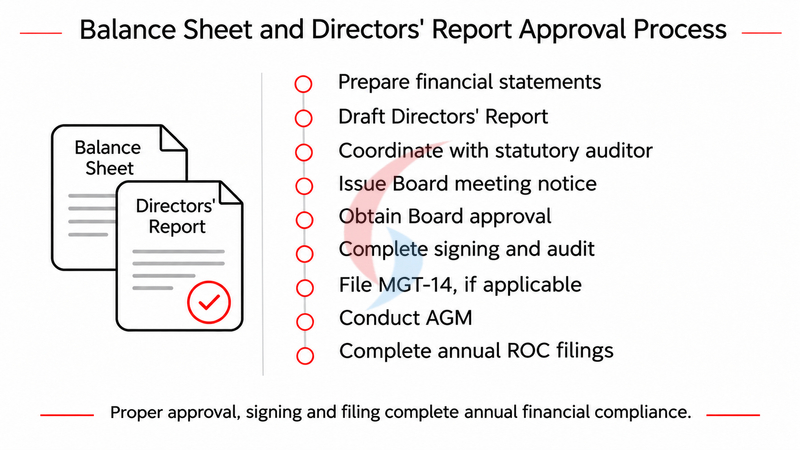
Step 1: Prepare the Financial Statements
The finance department must prepare the annual financial statements in accordance with applicable accounting standards and Schedule III of the Companies Act, 2013. All financial transactions, foreign investments and related-party balances should be properly reconciled.
Step 2: Prepare the Draft Directors' Report
The company must prepare its Directors' Report containing applicable disclosures under Section 134 and the Companies (Accounts) Rules, 2014. The report should accurately reflect business activities, financial performance and statutory compliance during the financial year.
Step 3: Coordinate with the Statutory Auditor
The company must provide financial records and supporting documents to its statutory auditor for examination. Preliminary audit observations and financial discrepancies should be addressed before finalising the accounts for Board approval.
Step 4: Issue Notice of the Board Meeting
The company must issue a Board meeting notice along with the agenda and relevant financial documents to all directors. Generally, at least seven days' notice must be provided under Section 173(3), unless the applicable shorter-notice conditions are satisfied.
Step 5: Conduct the Board Meeting and Obtain Approval
The Board must meet to review and approve the financial statements and Directors' Report under Sections 134 and 179(3)(g). Directors residing outside India may participate through video conferencing, subject to applicable meeting and quorum requirements.
Step 6: Sign the Financial Statements and Directors' Report
After Board approval, the financial statements and Directors' Report must be signed by the prescribed persons under Section 134. The approved and signed financial statements must be submitted to the statutory auditor for issuance of the audit report.
Step 7: Complete Applicable MGT-14 Filing
Companies required to report Board resolutions under Section 117 must file Form MGT-14 within 30 days of passing the resolution. Eligible private limited companies may claim the applicable exemption, subject to prescribed conditions.
Step 8: Conduct the Annual General Meeting
The company must circulate the financial statements, Directors' Report, Auditor's Report and other applicable documents to its members. The financial statements must then be presented before the shareholders for adoption at the Annual General Meeting.
Step 9: File Annual Returns and Financial Statements
After the AGM, the company must file Form AOC-4 or its applicable variant and Form MGT-7 within the prescribed timelines. All supporting documents, resolutions and meeting minutes should be preserved for future regulatory verification.
Companies must submit their approved financial statements and supporting documents to the Registrar of Companies. Accurate financial disclosures are essential for completing statutory annual filings. Learn more about Form AOC-4 and Financial Disclosures
Signing Requirements for Financial Statements and Directors' Report
Section 134 prescribes different signing requirements for financial statements and the Directors' Report. Companies must ensure that the documents are signed by the appropriate persons before completing annual compliance.
| Document | Signing authority |
|---|---|
| Balance sheet and financial statements | Board-authorised chairperson or two directors, including the managing director, if appointed, along with applicable appointed KMP |
| Directors' Report | Board-authorised chairperson or at least two directors, including the managing director, where appointed |
| Auditor's Report | Statutory auditor |
| Board meeting minutes | Chairperson as prescribed under SS-1 |
| ROC forms | Authorised signatory and professional certification, wherever applicable |
Foreign directors may sign financial statements if they are legally eligible and satisfy the applicable statutory signing requirements. Indian nationality is not a mandatory condition for signing these documents.
Can Foreign Directors Approve Financial Statements Through Video Conferencing?
Yes, foreign directors can participate in Board meetings through video conferencing or other permitted audio-visual means under Section 173(2) of the Companies Act, 2013. The MCA amendment dated 15 June 2021 removed the earlier restrictions on approving financial statements and the Directors' Report through video conferencing. Companies must nevertheless comply with applicable notice, quorum, recording and meeting minute requirements. This provision is particularly beneficial for Indian subsidiaries whose directors reside in different countries
ROC Filing Requirements and Due Dates
An Indian subsidiary of a foreign company must complete its annual ROC filings after obtaining the necessary approvals. The following are the ordinary statutory timelines, subject to applicable exemptions or extensions.
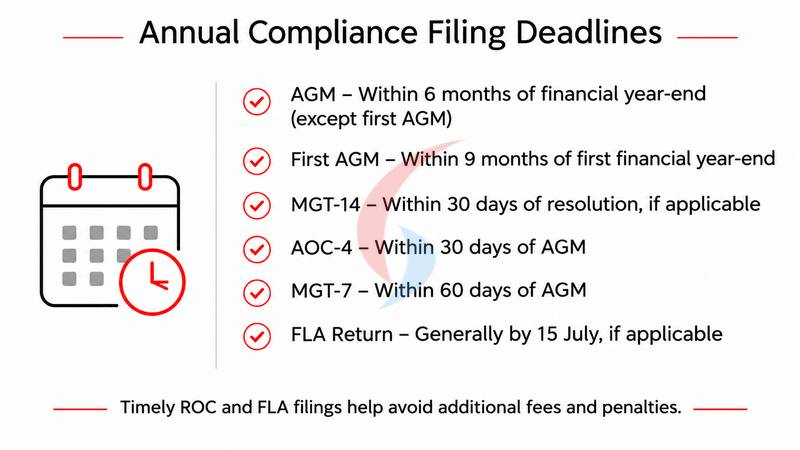
| Compliance | Due date |
|---|---|
| Annual General Meeting | Within six months from the financial year-end, except the first AGM |
| First Annual General Meeting | Within nine months from the first financial year-end |
| Form MGT-14 | Within 30 days of resolution, wherever applicable |
| Form AOC-4 | Within 30 days of AGM |
| Form AOC-4 CFS | Within 30 days of AGM, wherever applicable |
| Form MGT-7 | Within 60 days of AGM |
| FLA Return | Generally by 15 July, wherever applicable |
Companies can complete their statutory ROC filings through the MCA V3 Portal.
Certain companies must submit their financial statements in the prescribed XBRL format. Foreign subsidiaries should examine their applicability before completing annual financial filings. Learn more about MCA Form AOC-4 XBRL Filing of Financial Statements
Approval Requirements for an Overseas Subsidiary of an Indian Company
Where an Indian company establishes a subsidiary outside India, the overseas subsidiary must prepare and approve its financial statements according to the laws of its country of incorporation. However, the Indian holding company must examine its consolidation obligations under Section 129, subsidiary disclosures in Form AOC-1 and attachment requirements under Section 137 of the Companies Act, 2013. The Indian holding company must also comply with applicable Overseas Direct Investment (ODI) reporting requirements, including Annual Performance Report (APR) and FLA Return filing, wherever applicable.
Penalty for Non-Compliance with Financial Statement Approval
Failure to obtain proper Board approval, prepare statutory disclosures or complete annual ROC filings may result in penalties under the Companies Act, 2013.
| Non-compliance | Applicable penalty |
|---|---|
| Violation of Section 134 | Rs 3 lakh for the company |
| Officer in default under Section 134 | Rs 50,000 |
| Failure to file financial statements under Section 137 | Rs 10,000 and Rs 100 per day for continuing default, subject to a maximum of Rs 2 lakh for the company |
| Responsible officer under Section 137 | Rs 10,000 and Rs 100 per day for continuing default, subject to a maximum of Rs 50,000 |
| Delayed AOC-4 filing | Additional filing fee generally of Rs 100 per day |
Apart from monetary penalties, non-compliance may create difficulties during statutory audits, foreign investment transactions, due diligence and business restructuring.
Failure to submit annual financial statements and annual returns may result in statutory penalties and additional filing fees. Companies should complete their ROC filings within the prescribed timelines. Refer to Consequences of Not Doing Mandatory Filing: AOC-4 and MGT-7
Why Choose Compliance Calendar LLP?
Compliance Calendar LLP provides professional assistance to foreign subsidiaries with annual corporate compliance, financial statement approval, Directors' Report preparation, Board meeting documentation and ROC filings. Our professionals assist companies in understanding applicable statutory requirements and completing necessary approvals in accordance with the Companies Act, 2013.
From preparing Board resolutions and coordinating with foreign directors to filing AOC-4 and MGT-7, Compliance Calendar LLP provides comprehensive compliance support. Our team also assists with FEMA compliance, FLA Return filing and foreign investment reporting, helping businesses manage their Indian regulatory obligations.
For professional assistance, contact +91 9988424211 or email info@ccoffice.in
Frequently Asked Questions (FAQs)
Q1. Who approves the balance sheet of a foreign subsidiary in India?
Ans. The Board of Directors of the Indian subsidiary must approve its financial statements under Section 134. Approval from the foreign holding company alone cannot replace this statutory requirement.
Q2. Is the Directors' Report mandatory for a foreign subsidiary?
Ans. Yes, an Indian subsidiary must prepare its Directors' Report under the Companies Act, 2013. The report must contain all applicable statutory disclosures and receive Board approval.
Q3. Can foreign directors sign the balance sheet?
Ans. Yes, foreign directors can sign financial statements if they satisfy the requirements under Section 134. Their nationality or overseas residence does not independently restrict their signing authority.
Q4. Can financial statements be approved through video conferencing?
Ans. Yes, directors can approve financial statements through a properly conducted Board meeting using video conferencing. The company must comply with applicable meeting, quorum and documentation requirements.
Q5. Is Form MGT-14 mandatory for financial statement approval?
Ans. Form MGT-14 is applicable to companies required to report such Board resolutions under Section 117. Eligible private limited companies may avail themselves of the prescribed exemption.
Q6. Is a statutory audit mandatory for an Indian foreign-owned subsidiary?
Ans. Yes, companies incorporated in India must undergo statutory audits irrespective of their foreign ownership. The audited financial statements form part of their annual compliance requirements.
Q7. What is the due date for filing Form AOC-4?
Ans. Form AOC-4 must ordinarily be filed within 30 days of the Annual General Meeting. Delayed filing may attract additional fees and statutory penalties.
Q8. Can a foreign-owned subsidiary qualify as a small company?
Ans. No, subsidiary companies are excluded from the small-company definition under Section 2(85). They cannot claim small-company exemptions solely based on their capital or turnover.
Q9. Is FLA Return filing mandatory for foreign subsidiaries?
Ans. An Indian subsidiary having reportable outstanding foreign investment must generally submit its annual FLA Return. The ordinary filing deadline is 15 July every year.
Q10. Can financial statements be approved through a circular resolution?
Ans. No, Section 179(3)(g) requires approval of financial statements and the Board's Report at a Board meeting. A properly conducted video conferencing meeting is permissible, but a circular resolution cannot replace it.
Article last updated on : 24 Nov 2026.


































































_learn_crop10_thumb.jpg)