


Finding an old share certificate can be exciting, especially when the investment was made many years ago. A small investment in a listed company may have increased in value because of bonus shares, stock splits or long-term growth. However, recovering those shares can become difficult when the shareholder's name does not match their present identity documents.
For example, an old certificate may show the name R. K. Sharma, while the shareholder's PAN card shows Rajesh Kumar Sharma. In another case, a woman may have purchased shares before marriage, but her current documents carry her married surname.
Such differences may appear minor, but the company's Registrar and Transfer Agent (RTA) must establish that the claimant is legally entitled to the shares before updating records or processing a recovery request.
Share Recovery When Shareholder Names Do Not Match involves verifying the investor's identity, correcting discrepancies in shareholding records and completing the applicable procedures for physical shares, dematerialisation or recovery from the Investor Education and Protection Fund (IEPF).
Under the Companies Act, 2013, IEPF Rules and SEBI regulations, shareholders can resolve legitimate name discrepancies by producing appropriate documentary evidence. A mismatch does not automatically result in loss of ownership.
What Is a Shareholder Name Mismatch?
A shareholder name mismatch occurs when the name appearing in a company's register of members, physical share certificate or depository records differs from the name shown in the investor's current identification documents. The difference may involve initials, spelling, surname changes, missing middle names or an incorrect entry made when the shares were originally purchased.
For example, a shareholder who purchased shares in 1998 may have used an abbreviated name because PAN-based verification was less common at the time. Years later, the shareholder may need to establish that the person named on the certificate and the person identified by the current PAN are the same individual.
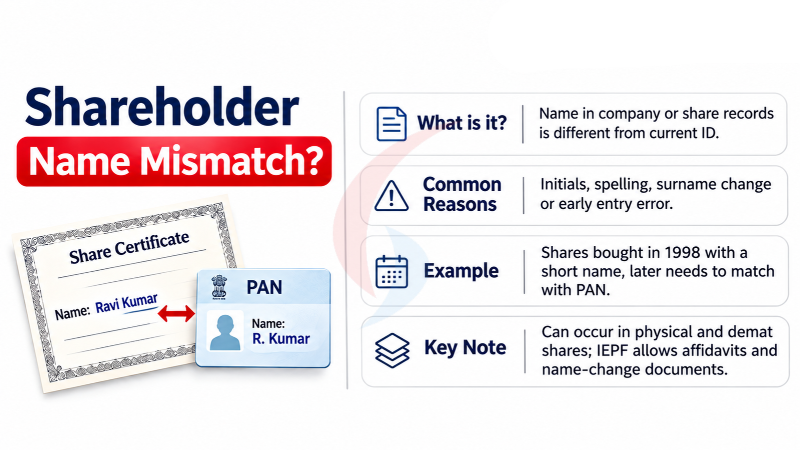
A mismatch can arise in both physical and dematerialised shareholding records. However, the correction procedure differs depending on where the shares are held and whether they have already been transferred to IEPF. The IEPF Authority's official FAQs specifically recognise name mismatches and identify affidavits and supporting name-change documents as possible evidence.
For more information, read Name Mismatch and Name Change in Share Certificates.
A Realistic Example: An Old Share Certificate with a Different Name
For Example, a fictional example involving Meera Verma, a resident of Delhi. In 2001, Meera purchased 200 shares of a listed company under her maiden name, Meera Gupta. The shares were held in physical form, and she received the original certificates.
After her marriage, she changed her surname to Verma and updated her PAN, bank account and other identification records. Over the years, she also moved to another address and stopped receiving dividend communications. In 2026, Meera discovered the certificates while checking old family documents. She contacted the company's RTA, which confirmed that the shares had been transferred to IEPF after the applicable period of unclaimed dividends.
Meera wanted to recover the shares, but the name on the certificate was different from her current PAN and demat account. Instead of filing an incorrect claim under her old name, she collected her marriage certificate, PAN, old investment documents and an affidavit establishing that Meera Gupta and Meera Verma were the same person.
After the RTA examined the evidence, she proceeded with the applicable name verification and IEPF claim requirements. Her case illustrates an important point: share recovery is possible despite a name difference, provided the claimant can establish identity and legal entitlement.
Why Do Shareholder Names Not Match?
Name discrepancies often develop over time rather than because of fraudulent or incorrect ownership.
|
Reason for Mismatch |
Example |
|---|---|
|
Initials instead of full name |
R. K. Sharma / Rajesh Kumar Sharma |
|
Marriage-related surname change |
Meera Gupta / Meera Verma |
|
Spelling mistake |
Mohan Kumar / Mohan Kumer |
|
Missing middle name |
Amit Singh / Amit Raj Singh |
|
Legal name change |
Old name replaced through a valid legal procedure |
|
Different name order |
Kumar Ravi / Ravi Kumar |
|
Old company records |
Name entered differently during physical share allotment |
|
Inheritance-related confusion |
Claimant's name differs from deceased shareholder's name |
Not all these situations can be handled through the same procedure. A spelling correction may require simpler documentary evidence, while a major name change may need additional verification. Where the registered shareholder has died, the problem is not merely a name mismatch. The claimant must also establish a valid right to receive the securities through the applicable transmission procedure.
Read How to Identify Share Certificates in India before starting the recovery process.
Legal Provisions for Share Recovery with Name Mismatch
Share recovery is governed by the Companies Act, 2013, applicable IEPF Rules and SEBI regulations concerning listed companies and their RTAs.
|
Law / Provision |
Key Requirement |
|---|---|
|
Governs transfer and transmission of securities |
|
|
Addresses refusal of registration and related remedies |
|
|
Provides for rectification of the register of members |
|
|
Governs unpaid dividends and transfer of qualifying shares to IEPF |
|
|
Establishes IEPF and provides for recovery of eligible amounts |
|
|
Governs transfer of qualifying shares to IEPF |
|
|
Governs refund and recovery claims |
|
|
Prescribe investor service, KYC, name-change and transmission procedures |
Section 124(6) is particularly important where shares have been transferred to IEPF because dividends remained unpaid or unclaimed for seven consecutive years, subject to statutory conditions. Section 125 and Rule 7 provide the basis for eligible shareholders and other legally entitled claimants to seek recovery from the Fund. For name corrections in listed securities, the applicable SEBI directions and RTA procedures must also be followed.
Documents Required for Share Recovery When Names Do Not Match
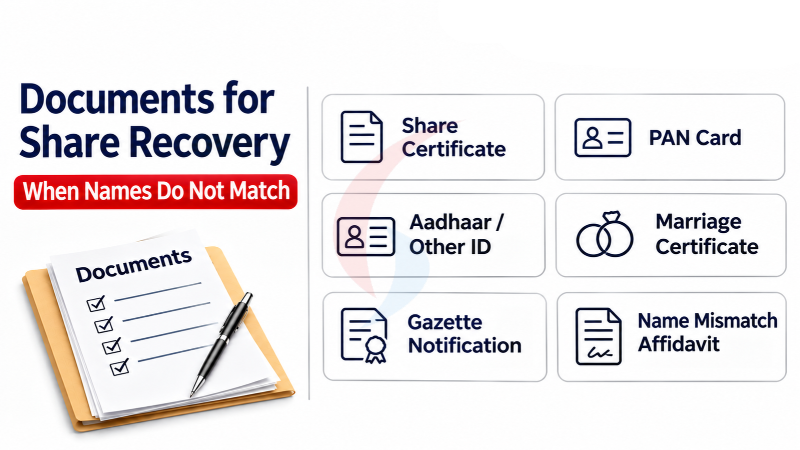
The exact documents depend on the nature of the mismatch and whether the shares remain with the company, are held in demat form or have been transferred to IEPF.
|
Document |
Purpose |
|---|---|
|
Original Share Certificate or Available Copy |
Identifies the original investment |
|
PAN Card |
Establishes current identification |
|
Aadhaar / Passport / Other Permitted ID |
Supports identity verification |
|
Marriage Certificate |
Explains a marriage-related name change |
|
Gazette Notification |
Supports a formal legal name change |
|
Name Mismatch Affidavit |
Explains the difference between two names |
|
Bank Records |
Provides additional identity and payment evidence |
|
Folio Number and Shareholding Details |
Helps the RTA locate the investment |
|
Demat Client Master List |
Identifies the account for receiving securities |
|
Applicable SEBI Service Request Forms |
Supports KYC or investor service processing |
|
IEPF-5 Acknowledgement |
Supports an IEPF recovery claim |
|
Death Certificate / Succession Documents |
Required where applicable to deceased shareholders |
The IEPF Authority's official guidance states that where a shareholder's name differs from the PAN or old certificate, an affidavit explaining the difference may be needed, together with evidence such as a marriage certificate or Gazette notification. Updating shareholder KYC records is an important part of verifying identity and resolving documentation issues.
Read KYC Updation for Recovery of Unclaimed Shares from IEPF for additional guidance.
How to Recover Shares When Shareholder Names Do Not Match
The correct procedure depends on whether the shares remain with the company, are already dematerialised or have been transferred to IEPF. For listed companies, the RTA generally handles physical shareholder records and related service requests.
|
Step |
Recovery Procedure |
What the Shareholder Should Do |
|---|---|---|
|
Step 1 |
Identify the Shares |
Find the company name, folio number and share certificate details. |
|
Step 2 |
Contact the Company or RTA |
Request confirmation of the registered name, shareholding and current status. |
|
Step 3 |
Identify the Mismatch |
Check whether it involves initials, spelling, marriage or a legal name change. |
|
Step 4 |
Prepare Supporting Documents |
Collect identity proof, name-change records and affidavits where applicable. |
|
Step 5 |
Submit the Correction Request |
Follow the applicable RTA or depository procedure. |
|
Step 6 |
Complete Demat or IEPF Formalities |
Use the relevant procedure based on where the shares are held. |
|
Step 7 |
Verify Recovery |
Confirm the updated records and credit of shares to the correct demat account. |
A shareholder should not submit a fresh IEPF claim merely because the name differs. The company or RTA should first confirm whether the shares have actually been transferred to IEPF.
What If the Shares Have Already Been Transferred to IEPF?
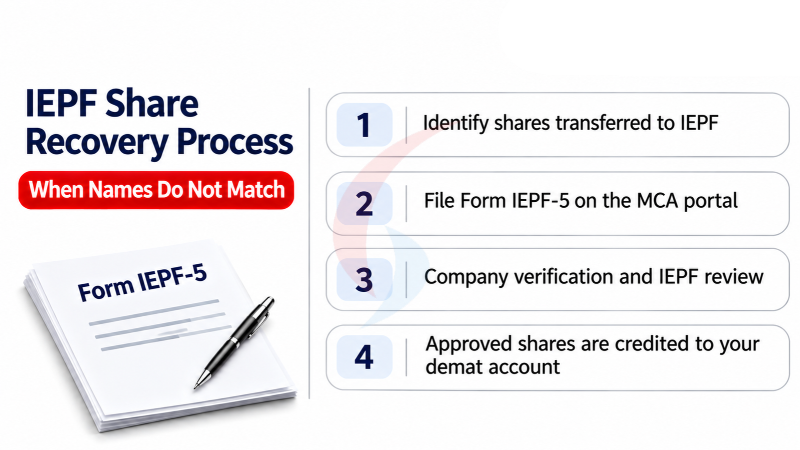
When dividends remain unpaid or unclaimed for seven consecutive years, the related shares may become liable for transfer to IEPF under Section 124(6) of the Companies Act, 2013, subject to prescribed conditions. Shareholders whose eligible shares have been transferred can apply for recovery through Form IEPF-5. However, name discrepancies must be properly explained so that the company and IEPF Authority can verify the claim.
For example, Meera Verma would need to establish that she is the same person recorded as Meera Gupta in the original shareholding records. The company must review the evidence and submit its prescribed verification report before the IEPF Authority determines the claim.
The general IEPF recovery procedure involves the following stages:
|
Stage |
Required Action |
|---|---|
|
Identify IEPF Shares |
Confirm the shares and dividends transferred to IEPF. |
|
Resolve Name Discrepancy |
Prepare identity and name-change evidence. |
|
File Form IEPF-5 |
Submit the claim through the prescribed MCA filing facility. |
|
Company Verification |
Submit supporting documents to the concerned company or Nodal Officer. |
|
IEPF Authority Review |
The Authority examines the claim and verification report. |
|
Recovery |
Approved shares are credited to the eligible claimant's demat account, and refundable amounts are processed under the rules. |
Rule 7 of the IEPF Authority (Accounting, Audit, Transfer and Refund) Rules, 2016 governs this process. A claim may require further information or correction before approval.
For additional information, read Recovery of Shares in India: IEPF Claim Process
What If the Original Shareholder Has Died?
A name mismatch involving a deceased shareholder requires a different approach. For example, an old share certificate may be registered in the name of Suresh Chandra Gupta, while his daughter, Ananya Gupta, wishes to recover the shares after his death.
Ananya cannot treat the different names as a simple spelling correction. She must establish her legal entitlement through the applicable share transmission or succession procedure. Depending on the facts, supporting documents may include a death certificate, nomination records, succession certificate, probate, letters of administration, legal-heir records or prescribed indemnity documents.
The exact requirements depend on the holding, claim value, existence of a nominee, applicable succession law and current SEBI transmission rules. Share transmission must be distinguished from an ordinary transfer of shares. Transmission occurs by operation of law, such as after a shareholder's death, while a transfer ordinarily arises from a voluntary transaction.
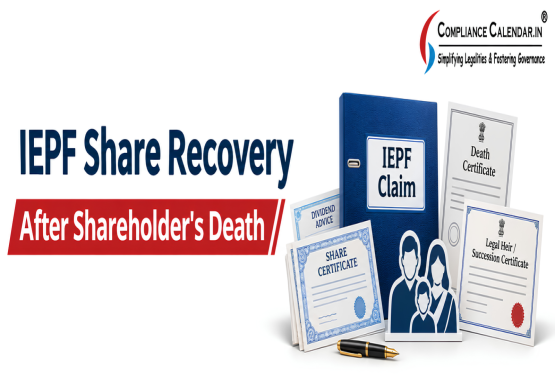
For more details, read IEPF Share Recovery After Shareholder's Death
Latest SEBI and IEPF Updates Affecting Share Recovery in 2026
The following developments are particularly relevant to investors recovering old physical shares or correcting identity records.
|
Regulatory Update |
Date |
Importance for Shareholders |
|---|---|---|
|
IEPF Amendment Rules, 2025 |
Effective 6 October 2025 |
Revised Form IEPF-5 and associated claim information requirements. |
|
SEBI's Updated Investor Service FAQs |
January 2026 |
Explains minor and major name mismatches and related documentation. |
|
SEBI Special Window for Physical Share Transfers |
5 February 2026 – 4 February 2027 |
Allows certain eligible pre-April 2019 physical share transfers to be completed and dematerialised. |
|
SEBI RTA Master Circular |
6 February 2026 |
Consolidates requirements governing RTA services, including investor requests. |
|
SEBI Simplified Transmission Rules |
23 July 2026 |
Introduces a standardised, risk-based approach to transmission of securities. |
The October 2025 IEPF amendment is particularly relevant because claimants filing in 2026 should use the prescribed current Form IEPF-5 rather than outdated versions.
SEBI's physical share transfer special window is also important, but it has a limited scope. It is intended for eligible transfers involving transfer deeds executed before 1 April 2019, including certain previously rejected or returned requests. It is not a general amnesty for every name mismatch or IEPF claim.
Why Choose Compliance Calendar LLP ?
Compliance Calendar LLP assists shareholders, nominees and legal heirs with the recovery of unclaimed shares, correction of shareholder records and IEPF claim documentation. Our team helps identify shares, review name discrepancies, prepare supporting documents, coordinate with companies and RTAs, and complete the applicable IEPF claim procedure.
We also assist with share transmission, demat-related documentation and recovery of eligible unclaimed dividends. For professional assistance, visit our Recovery of Shares from IEPF Service.
Contact Compliance Calendar LLP: 9988424211 or info@ccoffice.in
Frequently Asked Questions (FAQs)
Q1. Can I recover shares if my name does not match the share certificate?
Ans: Yes. Shares may be recovered if you provide sufficient evidence establishing that the registered shareholder and the claimant are the same person. The required documents depend on the nature of the mismatch.
Q2. Is an affidavit mandatory for every shareholder name mismatch?
Ans: Not necessarily. Minor differences may be addressed under applicable SEBI procedures, while other cases may require an affidavit or additional identity documents. Follow the current RTA requirements.
Q3. Can shares be recovered after a surname change due to marriage?
Ans: Yes. A shareholder may establish the connection between the old and new names through a marriage certificate, identity documents and other prescribed evidence.
Q4. What if my name on the PAN card differs from the share certificate?
Ans: Contact the company's RTA and identify the type of discrepancy. Submit the prescribed documents linking the name on the share certificate with your current identification.
Q5. Can I recover shares transferred to IEPF with a different name?
Ans: Yes, subject to establishing identity and entitlement. The claimant must complete the applicable verification procedure and submit Form IEPF-5 with the required supporting documents.
Q6. Is a Gazette notification compulsory for share recovery?
Ans: Not in every case. It may be relevant for a formal legal name change, while minor spelling differences or marriage-related changes may be supported by other permitted evidence.
Q7. Can legal heirs recover shares when the original shareholder has died?
Ans: Yes. Eligible nominees, legal heirs or successors may pursue recovery after satisfying applicable transmission and entitlement requirements, including submission of the necessary supporting records.
Q8. Can I recover shares without the original share certificate?
Ans: It may be possible through the applicable lost-security, duplicate-security or IEPF procedure. The shareholder should first obtain holding details and the prescribed requirements from the RTA.
Q9. What are the latest share recovery updates in 2026?
Ans: Important changes include SEBI's January 2026 investor service measures, its physical share transfer special window and the July 2026 simplified transmission circular.
Q10. Can Compliance Calendar LLP assist with shareholder name mismatch cases?
Ans: Yes. Compliance Calendar LLP assists with shareholding verification, name discrepancy documentation, RTA coordination, applicable transmission procedures and IEPF recovery claims.
Article last updated on : 26 Nov 2026.













































_learn_crop10_thumb.jpg)