



A foreign investor may be ready to invest in an Indian company, but the company's bank account may not be ready to receive the money. This situation is common when a foreign parent company establishes an Indian subsidiary, invests in a newly incorporated startup or plans to fund its Indian operations immediately.
The investor may have already signed the incorporation documents, appointed directors and arranged the investment amount. However, the Indian bank may still be completing Know Your Customer (KYC) checks or verifying the foreign shareholder's documents.
The question then arises: Can an Indian company receive foreign investment before opening its bank account?
The answer depends on whether the Indian company has already been incorporated, how the money is proposed to be received and whether a permitted alternative arrangement is available under the Foreign Exchange Management Act, 1999 (FEMA).
In an ordinary Foreign Direct Investment (FDI) transaction, investment money should follow a permitted banking route. A newly incorporated company generally opens its bank account before receiving funds for a fresh equity subscription. However, RBI regulations also recognise specific arrangements for permitted accounts, escrow transactions and certain pre-incorporation expenses.
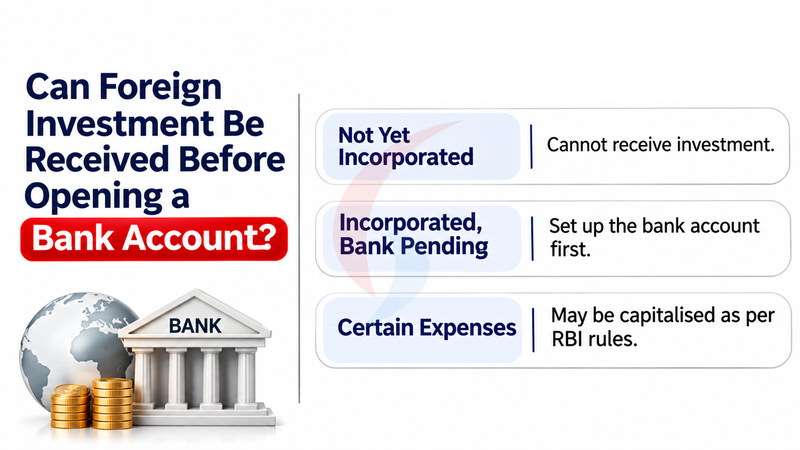
Can Foreign Investment Be Received Before Opening a Bank Account?
A company cannot simply avoid FEMA banking requirements because its corporate bank account has not yet been opened.
Foreign investment must be received or settled through a mode permitted under the applicable FEMA rules. The ordinary route for a fresh equity subscription is an inward remittance through banking channels into the company's authorised banking arrangement. The relevant distinction is between a company that has not yet been incorporated and a company that has been incorporated but is waiting for its bank account to become operational.
|
Situation |
General Legal Position |
|
Indian company not yet incorporated |
It cannot ordinarily receive a fresh equity subscription into a corporate account that does not exist. |
|
Company incorporated but bank account pending |
The company should ordinarily complete banking arrangements before receiving fresh subscription money. |
|
Foreign investor pays incorporation expenses |
Certain expenses may qualify for subsequent capitalisation under RBI conditions. |
|
Investor proposes to use a personal account |
Personal-account receipt should not be treated as an automatic substitute for permitted FDI payment arrangements. |
|
Investor uses an eligible escrow arrangement |
May be possible for specified transactions, subject to RBI conditions. |
|
Foreign shareholder subscribes to the MOA |
The company must coordinate subscriber payment, corporate requirements and applicable FEMA reporting. |
RBI's Master Direction on Foreign Investment in India explains the permitted payment methods and the treatment of specified pre-incorporation expenses.
For related guidance, read How to Efficiently Incorporate a Company and Receive Foreign Investment
A Practical Story: When a Foreign Investor Sends Money Too Early
For Example, a fictional company, ABC Technologies Private Limited, incorporated in Bengaluru in April 2026.
Its Singapore-based parent company planned to invest Rs 40 lakh to support software development and initial operations. The directors completed incorporation and immediately started the process of opening a current account with an Indian bank.
The foreign investor wanted to transfer funds without waiting for the bank account to become operational. One director suggested receiving the money temporarily into his personal account and transferring it to the company later.
Before proceeding, the company consulted its compliance adviser. The adviser explained that money intended as foreign equity investment must follow the prescribed FEMA payment route. Merely transferring funds through a director's personal account could create difficulties in establishing the correct remitter, investment purpose and receipt of share consideration.
ABC decided to complete the bank's KYC verification first. After opening its corporate current account, it received the foreign investment through the authorised banking channel and completed the applicable share and RBI reporting formalities.
Legal Provisions Applicable to Foreign Investment Before Bank Account Opening
Foreign investment in India is governed by FEMA, the Non-Debt Instruments Rules, RBI payment and reporting regulations, and relevant company-law provisions.
|
Act / Regulation |
Key Legal Requirement |
|
Regulates applicable capital account transactions. |
|
|
Governs authorised persons dealing in foreign exchange. |
|
|
Prescribe FDI eligibility, investment conditions, pricing and transfers. |
|
|
Govern permitted payment modes, issue of equity instruments, refunds and reporting. |
|
|
Explains operational requirements, including pre-incorporation expenditure. |
|
|
Govern permitted accounts maintained by persons resident outside India. |
|
|
Requires applicable companies to complete commencement-of-business declarations. |
|
|
Govern relevant private placement and further issue of share capital procedures. |
The correct provision depends on whether the transaction involves subscription to incorporation shares, fresh allotment, transfer of existing shares or capitalisation of permitted expenses. For example, a foreign shareholder subscribing to the Memorandum of Association (MOA) at incorporation is not in exactly the same position as a foreign investor subscribing to a subsequent funding round. Businesses should therefore identify the legal nature of the investment before deciding how the funds can be received.
Foreign Investment at the Time of Company Incorporation
Foreign investors often establish a wholly owned subsidiary (WOS) in India by subscribing to its MOA. At incorporation, the foreign parent company may become a shareholder by agreeing to subscribe to the stated number of shares. However, the actual payment of subscription money and the company's subsequent regulatory reporting must still be completed according to the applicable legal requirements.
Once the Indian company receives its Certificate of Incorporation and PAN, its directors can approach an authorised dealer bank to open the company's current account. The bank generally verifies the incorporation documents, beneficial ownership information, authorised signatories and the foreign investor's identity before permitting the account to operate.
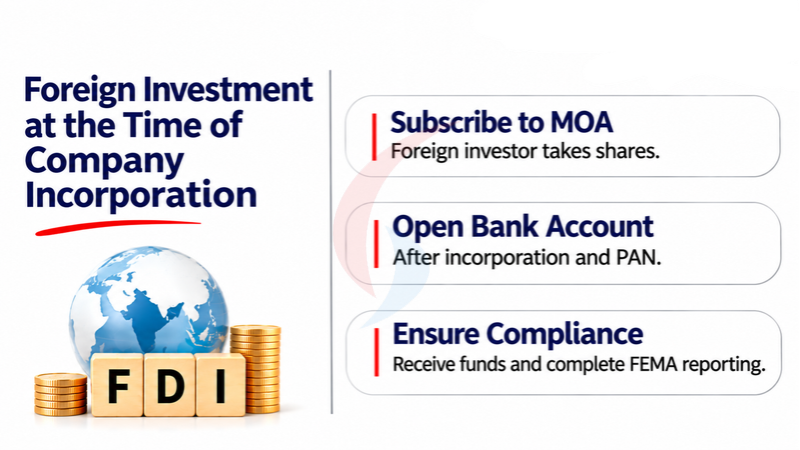
Where the foreign shareholder subscribed to the MOA, particular attention is required for the subscription money, incorporation-date securities records, commencement-of-business declaration and FEMA reporting. The company should not assume that the ordinary 60-day allotment rule is applied in precisely the same way to shares that were subscribed for at incorporation.
For additional guidance, read Documents for FDI Reporting in Case of Subscription to MOA
Can a Foreign Investor Pay Pre-Incorporation Expenses?
Yes. RBI recognises certain circumstances where a foreign parent company incurs expenses before its Indian subsidiary is incorporated or begins operations. For example, the overseas parent may pay professional fees, incorporation expenses, office rent or other necessary setup costs.
Under the RBI Master Direction, a wholly owned Indian subsidiary operating in a sector permitting 100% FDI under the automatic route, without FDI-linked performance conditions, may issue equity instruments against eligible pre-incorporation or pre-operative expenses.
The amount covered by this specific provision is limited to 5% of the subsidiary's authorised capital or USD 500,000, whichever is lower, subject to the prescribed conditions.
|
Requirement |
RBI Condition |
|
Eligible Indian Company |
Wholly owned subsidiary of a non-resident entity |
|
FDI Sector |
100% automatic route without FDI-linked performance conditions |
|
Maximum Eligible Amount |
5% of authorised capital or USD 500,000, whichever is lower |
|
Supporting Documents |
Evidence of eligible expenses and statutory auditor's certificate |
|
FC-GPR Reporting |
Within 30 days of issue, and not later than one year from incorporation under the specified provision |
|
Permitted Expenses |
Qualifying incorporation and pre-operative expenditure |
RBI recognises qualifying payments made to consultants, attorneys, service providers and other permitted recipients for establishing or commencing the Indian business. It cannot automatically convert every payment made by its foreign parent into share capital. Other routes for capitalising eligible pre-incorporation expenses may have additional approval and documentation requirements
Documents Required to Receive Foreign Investment
Banks normally request information about the Indian company, foreign investor and proposed transaction before accepting and classifying the remittance.
|
Documents |
Purpose |
|
Establishes the company's legal existence |
|
|
PAN of Indian Company |
Supports bank and regulatory verification |
|
Confirm the business objects and share capital |
|
|
Board Resolution |
Authorises banking arrangements and signatories |
|
Foreign Investor's Incorporation Documents |
Establish the overseas investor's identity |
|
Shareholding and Beneficial Ownership Details |
Support KYC and FDI eligibility checks |
|
Passport / Identification of Relevant Persons |
Required for applicable identity verification |
|
Investment or Subscription Agreement |
Explains the transaction, where applicable |
|
Remittance Advice and Bank Records |
Establish the source and receipt of funds |
|
Valuation Report, Where Required |
Supports applicable FEMA pricing compliance |
|
Government Approval, Where Applicable |
Establishes eligibility under the approval route |
The final documentation depends on the investor, bank, investment structure and sector. Banks may request additional information to satisfy customer due diligence and anti-money-laundering requirements.
For related guidance, read Choosing the Right Banker for FDI Transactions
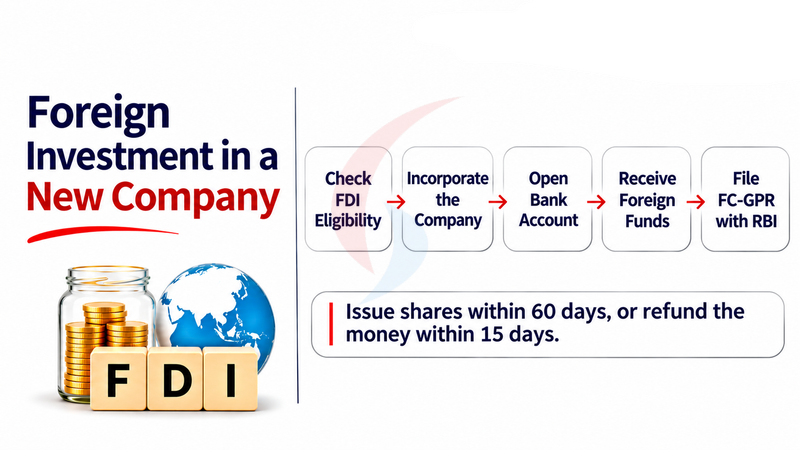
Process for Receiving Foreign Investment in a Newly Incorporated Company
The safest approach is to coordinate incorporation, banking and FEMA reporting before the foreign investor transfers money.
|
Step |
Process |
Important Action |
|
Step 1 |
Check FDI Eligibility |
Verify sectoral caps, investment route and beneficial ownership. |
|
Step 2 |
Complete Incorporation |
Obtain the Certificate of Incorporation, CIN and PAN. |
|
Step 3 |
Open Corporate Bank Account |
Complete the authorised dealer bank's KYC requirements. |
|
Step 4 |
Prepare Investment Documents |
Confirm subscription terms, valuation and applicable approvals. |
|
Step 5 |
Receive Foreign Remittance |
Use the permitted banking route and retain supporting records. |
|
Step 6 |
Complete Share Formalities |
Follow the applicable allotment or incorporation subscription requirements. |
|
Step 7 |
Complete RBI Reporting |
File FC-GPR and other applicable forms within prescribed deadlines. |
|
Step 8 |
Maintain Annual Compliance |
Complete applicable FLA Return and company-law reporting. |
For a subsequent issue of equity instruments against foreign subscription money, the company must generally issue the instruments within 60 days of receiving the consideration. If the instruments are not issued, the money must be refunded within 15 days after those 60 days expire.
Important FEMA and Companies Act Filing Deadlines
|
Filing / Compliance |
General Deadline |
|
Issue of Equity Instruments Against Fresh Foreign Consideration |
Within 60 days of receipt |
|
Refund if Instruments Are Not Issued |
Within 15 days after expiry of the 60-day period |
|
Within 30 days of issue, subject to applicable special rules |
|
|
Generally 15 July every year, where applicable |
|
|
INC-20A Declaration |
Within 180 days of incorporation for applicable companies |
|
PAS-3 Return of Allotment |
As prescribed for the relevant allotment |
|
Generally within 60 days of the prescribed trigger for reportable transfers |
Under Section 10A of the Companies Act, 2013, applicable companies having share capital must file their declaration of commencement of business within 180 days of incorporation, confirming that the subscribers have paid the value of shares agreed to be taken by them.
For reporting guidance, explore Difference Between FC-GPR Filing and FC-TRS Filing
What if Foreign Investment Was Already Sent to the Wrong Account?
Sometimes a foreign investor transfers money before consulting the company's authorised dealer bank. For example, GreenNova's foreign parent might transfer Rs 10 lakh to a director's personal account, assuming the director can later deposit the money into the company's current account. The company should not automatically record that personal-account receipt as valid foreign equity consideration.
Instead, it must identify the original remitter, recipient, transaction purpose, banking records and applicable FEMA requirements. The authorised dealer bank should examine whether the transaction can be regularised and what corrections or refunds are required.
If the money was received through a non-permitted route, simply transferring it later to the company's account may not resolve the original compliance issue. Depending on the facts, the company may need to return the money, arrange a fresh permitted remittance or examine the applicable FEMA regularisation process.
For related guidance, read Change of Purpose Code with AD Bank for FDI Reporting
Latest FEMA and FDI Updates in 2026
The following developments are relevant to foreign investors establishing or funding Indian companies in 2026
|
Regulatory Update |
Date |
Key Requirement |
|
January 2025 |
Updated permitted payment arrangements, including eligible repatriable accounts. |
|
|
15 March 2026 |
Revised beneficial ownership criteria for investments connected with land-border countries. |
|
|
May 2026 |
Gave effect to revised land-border investment requirements. |
|
|
13 June 2026 |
Updated prescribed arrangements for specified investment transactions. |
|
|
Updated through 15 June 2026 |
Consolidates applicable foreign investment, payment and other requirements. |
|
|
Updated 23 October 2026 |
Clarifies the application of revised beneficial ownership and approval requirements. |
The May 2026 amendment is particularly important where a foreign investor is incorporated outside a country sharing a land border with India but has investors or beneficial owners connected with such a country. The revised conditions must be assessed before accepting foreign investment. An ordinary bank-account opening process does not replace any required government approval or foreign investment disclosure.
Why Choose Compliance Calendar LLP ?
Compliance Calendar LLP assists foreign companies, Indian startups and newly incorporated subsidiaries with FDI documentation, FEMA compliance, corporate registration and RBI reporting. Our professionals help businesses examine investment eligibility, coordinate required documents, understand banking and remittance procedures, and prepare applicable filings such as FC-GPR and FLA Returns. For further information, explore our Foreign Subsidiary Company Registration Service and FEMA Compliance 2026: Latest Rules and Updates.
For professional assistance, contact 9988424211 or info@ccoffice.in
Frequently Asked Questions (FAQs)
Q1. Can a foreign investor invest before an Indian company opens its bank account?
Ans: Certain permitted arrangements may be available, but a fresh equity subscription ordinarily requires an appropriate banking route. Companies should coordinate with an authorised dealer bank before receiving funds.
Q2. Can foreign investment be received in a director's personal account?
Ans: A director's personal account should not be treated as an automatic substitute for the company's permitted FDI banking arrangement. Such receipts can create FEMA compliance and documentation issues.
Q3. Can a foreign parent pay expenses before its Indian subsidiary is incorporated?
Ans: Yes, certain pre-incorporation and pre-operative expenses may qualify for capitalisation under RBI conditions. Eligibility depends on the investment route, business sector, expenditure and prescribed documentation.
Q4. Is a corporate bank account necessary for FC-GPR filing?
Ans: The company must have appropriate evidence supporting the foreign investment transaction. A corporate bank account is ordinarily used for inward equity remittances, although specific permitted arrangements may apply.
Q5. What is the deadline for issuing shares against foreign investment?
Ans: For ordinary fresh equity subscription consideration, instruments must generally be issued within 60 days of receipt. If not issued, the amount must normally be refunded within the prescribed additional 15 days.
Q6. Can foreign investors use an escrow account?
Ans: Yes, eligible foreign investment transactions may use prescribed escrow arrangements. However, an escrow account is not an unrestricted alternative for receiving every type of fresh foreign equity investment.
Q7. Is RBI approval required before receiving FDI?
Ans: Not always. Investments satisfying automatic-route conditions generally do not require prior government approval. Government-route investments and regulated sectors may involve additional approval requirements.
Q8. What happens if foreign investment is received through the wrong account?
Ans: The company should review the payment with its authorised dealer bank and determine whether correction, refund or regularisation is required. A later transfer does not automatically cure the original issue.
Q9. What are the important FDI changes in 2026?
Ans: Important developments include amendments affecting beneficial ownership, investments connected with land-border countries, and specified foreign investment payment and reporting requirements.
Q10. Can Compliance Calendar LLP assist with foreign investment before bank account opening?
Ans: Yes. Compliance Calendar LLP assists businesses with FDI eligibility reviews, incorporation documentation, banking-related compliance, FEMA reporting and applicable RBI filing procedures.
Article last updated on : 26 Nov 2026.









































































_learn_crop10_thumb.jpg)